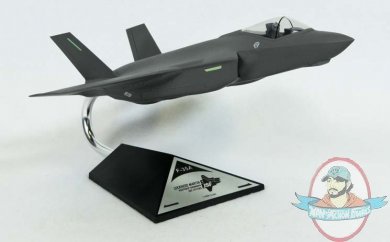
"The Joint Strike Fighter (JSF) is a joint, multinational acquisition program for the United States Air Force (USAF), Navy, Marine Corps and eight cooperative international partners. It was created to replace various aircraft while keeping development, production and operating costs down. The objective is to develop a technically superior and affordable fleet of aircraft that would be capable of a wide range of missions in a variety of theaters. The F-35 Lightning II, which is descended from the X-35, has become synonymous with the JSF program. I The JSF program's hallmark of affordability is achieved through a high degree of commonality among its three variants: conventional takeoff and landing (CTOL), short takeoff and vertical landing (STOVL), and carrier-based. The CTOL variant is designated F-35A, and the first aircraft rolled off the assembly line on February 19, 2006. After undergoing extensive ground testing, it completed its maiden flight on December 15, 2006. The F-35A is the smallest, lightest version and is the only one equipped with an internal gun. It is intended to replace the F-16 Fighting Falcons and A-10 Thunderbolts of the Air Force beginning in 2011. The F-35A matches or exceeds F-16 performance levels and goes beyond with increased range on internal fuel and advanced avionics. As a result, operational effectiveness, supportability, and survivability are greatly enhanced. Unlike the F-16, the aircraft is stealthy, enabling first-look, first-shot capability. It is equipped with internal laser designators and infrared sensors as well. As of 2004, requirements called for 1,763 F-35As, making it the most-produced variant. The Air Force is tentatively scheduled to receive its first aircraft in 2008, but initial operational capability for the service is set for 2011. The Lightning II is expected to be the world's premier strike aircraft through 2040. It will provide air-to-air capability second only to the F-22 Raptor. "
Scale: 1/48 scale model
Wing Span: 8.5
Length: 12.75
CF035AAFCCT
|
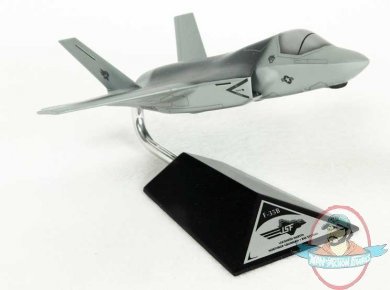
"The F-35B, a variant of the F-35 Lightning II, is the Short Takeoff and Vertical Landing (STOVL) aircraft. This takeoff and landing operation succeeds through a very innovative technology known as the shaft-driven lift fan propulsion system. Besides the propulsion system, the STOVL variant differs only slightly from the US Air Force variant. The short takeoff/vertical landing (STOVL) F-35B will replace the aging AV-8B Harrier STOVL attack jets (which have also proven increasingly difficult to support) of the US Marine Corps, as well as its F/A-18s. The F-35B will have a stealthy, belly-mounted 25 mm missionized gun pod and a combat radius of more than 450 NM- nearly two times that of legacy STOVL strike fighters. A shaft-driven lift fan, in combination with a vectoring rear exhaust nozzle, gives this fighter the ability to take off in short distances, accelerate to supersonic speeds in level flight, and land vertically. Thanks to the lift-fan system, the F-35B's total vertical lifting thrust is about 39,700 pounds (the aircraft weighs about 30,000 pounds)- more than 14,000 pounds greater than the engine alone would produce without the lift fan. The F-35B will be the world's first operational supersonic STOVL aircraft. The F-35B is similar in size to the Air Force F-35A, trading fuel volume for vertical flight systems. Like the AV-8 Harrier II, guns will be carried in a ventral pod. Vertical flight is by far the riskiest, and in the end, a decisive factor in design. "
Scale: 1/48 scale model
Wing Span: 8.5
Length: 12.75
CF035B1TR
|
"The F-35B JSF STOVL is a single-seat, single-engine, stealth-capable military strike fighter, a short takeoff and vertical landing (STOVL) variant aircraft that can perform close air support, tactical bombing, and air-to-air combat. The F-35B was developed by an aerospace industry team led by Lockheed Martin, with Northrop Grumman and BAE Systems as major partners. It took its first flight on December 15, 2006. The F-35B was the result of the Joint Strike Fighter (JSF) program created by the U.S. Defense Department, out of a requirement for a multi-role fighter aircraft capable of both air-to-ground and air-to-air missions. The F-35B replaced the AV-8B Harrier STOVL and F/A-18 fighter planes of the US Marine Corps. The F-35B's advantage over other legacy STOVL strike fighters is its concealed belly-mounted 25 mm gun pod and combat radius of more than 450 NM, which is two times greater than the latter. The U.S. Air Force (USAF) requested to acquire hundreds of F-35B STOVL for the battlefield close support role in 2004. JSF program officials insisted that they do not want to build a fourth JSF variant despite the USAF's interest in acquiring a new STOVL model. However, Lockheed Martin still developed the fourth version of the Joint Strike Fighter to satisfy the needs of the Navy, Marine Corps and Air Force of the United States, and the Royal Air Force and Navy of the United Kingdom. "
Scale: 1/72 scale model
Wing Span: 5.75
Length: 8.5
CF035B2TR
|
"Known as the Joint Strike Fighter (previously the Joint Advanced Strike Technology) program, the F-35 Lightning II is a family of multi-role aircraft developed under a multinational acquisition program. In cooperation with BAE Systems and Northrop Grumman, the F-35 is currently under development and production by Lockheed Martin. Lockheed Martin was selected by the Department of Defense (DOD) on October 26, 2001 after beating out competition from McDonnell Douglas and then Boeing in the design and demonstration phases of the program (1994-2001). The aircraft will be powered by the Pratt & Whitney F135 engine. The distinguishing feature of the United States Marine Corps (USMC) version of the JSF is its short takeoff/vertical landing capability (STOVL). There will not be an internally mounted machine gun, but an external gun can be fitted. This version requires controllability on all axes while hovering. Another critical design feature is its impact on the ground surface beneath it during hover. The USMC expects their version of the JSF will replace the F/A-18 Hornet and the AV-8 Harrier. The Marine Corps expects to purchase 480 STOVL versions of the F-35. "
Scale: 1/40 scale model
Wing Span: 10.75
Length: 15
CF035B3TR
|
Scale: 1/40 scale model
Wing Span: 10.75
Length: 15
CF035A2TR
|
Model Description
The F-35 is descended from the X-35, the product of the Joint Strike Fighter (JSF) program. JSF development is being principally funded by the United States, with the United Kingdom and other partner governments providing additional funding. The partner nations are either NATO members or close U.S. allies. It is being designed and built by an aerospace industry team led by Lockheed Martin. The F-35 took its first flight on 15 December 2006. This specific F-35A is painted in the Thunderbird paint scheme. The Thunderbirds are the air demonstration squadron of the U.S. Air Force (USAF), based at Nellis AFB in Las Vegas, Nevada. The squadron tours the United States and much of the world, performing aerobatic formation and solo flying in specially-marked USAF jet aircraft. The name is taken from the legendary creature that appears in the mythology of several indigenous North American cultures.
Scale: 1/40 scale model
Wing Span: 10.75
Length: 15
CF035TBR
|
An STOVL is an acronym for Short Take Off and Vertical Landing. It is an ability of some aircraft like the F35B to take off from a short runway or take off verticalyy if it doesn't have a very heavy payload and land vertically. This is often accomplished on aircraft carriers through the use of "ski-jump" runways, instead of the conventional catapult system. STOVL use tends to allow aircraft to carry a larger payload as compared to during the VTOL use, while still only requiring a short runway.
Scale: 1/48
Wing Span: 8.50
Length: 12.75
CF035BMCCTP
|
"The Boeing F/A-18F Super Hornet is a carrier-based multi-mission strike fighter that entered service with the United States Navy (USN) in 1999. It is a larger and more advanced version of the night strike F/A-18C/D Hornet. The Super Hornet prodvides the battle group commander with a platform that has range, endurance, and ordnance carriage capabilities comparable to those of the retired A-6 Intruder. Ordered from McDonnell Douglas by the USN in 1992, the Super Hornet first flew in November 1995. It is informally referred to as the Rhino, to distinguish it from earlier model legacy Hornets. Initial production began in 1995. Flight testing started in 1996 and ended in 1999. Testing involved 3,100 test flights covering 4,600 flight hours. The aircraft passed the Navy's operational tests and evaluations in February 2000, and has replaced the A-6 Intruder, S-3 Viking and KA-6D. The Super Hornet is capable of performing a broad spectrum of roles, including day/night strikes with precision-guided weapons, anti-air warfare, fighter escort, reconnaissance, forward air control, close air support, suppression of enemy air defense (SEAD), maritime strike and air-to-air refueling. During Operation Iraqi Freedom, the Super Hornet flew close air support, strike, escort SEAD and aerial refueling roles. Two F/A-18Fs were forward deployed to USS Abraham Lincoln (CVN-72). On September 8, 2006, an F/A-18F from the Navy's Strike Fighter Squadron 211 expended GBU-12 and GBU-38 bombs against Taliban fighters and Taliban fortifications west and northwest of Kandahar. This was the first time the unit was in combat with the aircraft. By the end of 2010, five F/A-18F squadrons (along with five F/A-18E squadrons) will operate on aircraft carriers in the Atlantic Fleet area of responsibility. "
Scale: 1/48 scale model
Wing Span: 10.25
Length: 14
CF018FTR
|
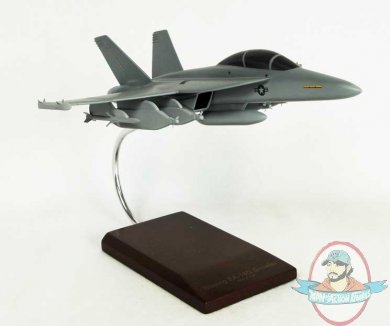
"The Boeing EA-18G Growler is a carrier-based electronic warfare aircraft based on the two-seat F/A-18F Super Hornet. It began production in 2007 and is scheduled for fleet deployment in 2009. The EA-18G will serve as the United States Navy's replacement for the EA-6B Prowler, providing a capability to detect, identify, locate, and suppress hostile emitters. The Growler will perform full-spectrum electronic surveillance and electronic attack of enemy threat radars and communications nets. It is a highly flexible design that enables the warfighter to perform a broad range of tactical missions, operating from either the deck of an aircraft carrier or land-based fields. Since the EA-18G is a derivative of the F/A-18F, it is expected to significantly reduce support and training costs for the Navy. "
Scale: 1/48 scale model
Wing Span: 14
Length: 10.25
CF018GR
|
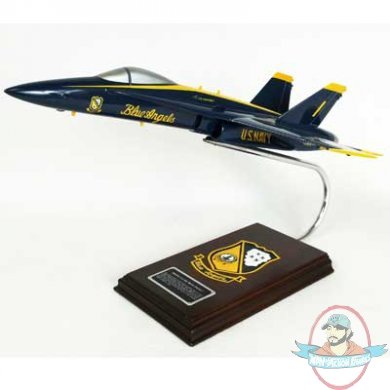
"The F/A-18 Hornet is a modern supersonic, carrier-capable fighter and attack aircraft, designed for both air and ground attacks. It was developed in 1970 based upon the experimental YF-17 designed by the McDonnell Douglas Company for the U.S. Navy and U.S. Marine Corps. The F/A-18 has been the aerial show aircraft for the Blue Angels since 1986. Its main missions include fighter escort, fleet air defense, suppression of enemy air defenses, interdiction, close air support and reconnaissance. Its versatility and dependability have proven it to be a useful carrier specialist but has been remarked for its low range and lack of payload compared to other strike fighter aircrafts. The Hornet first flew on November 18 1978, and was introduced to several other nations on January 7, 1983. A total of 1,458 F/A-18A built. In 1970, the F/A-18 Hornet served for the U.S. Navy and U.S. Marine Corps. The Hornet is also used by the air forces of several other nations. The F/A-18A Hornet is a single-seat fighter/attack “Hornet” variant by the U.S. Marine Corps. The U.S Marine Corps is a part of American military which is responsible for providing power projection from the sea, utilizing the mobility of the U.S. Navy to rapidly deliver combined-arms task forces. The F/A-18A was a previously designated F-18A and A-18A. The Hornet has a dual fighter/attack mission capability. The F/A-18A was also used by the U.S. Naval Flight Demonstration Team, the Blue Angels, in their air shows and other special events across the US and worldwide. On November 8 1986, during the 40th anniversary of the Blue Angels, the team unveiled the F/A-18A as their newest aircraft. "
Scale: 1/48 scale model
Wing Span: 14
Length: 10.25
CF018MTP
|
"The F/A-18 Hornet is a single seat or a tandem seat aircraft designed for the US Navy and US Marine Corps. The F/A-18 Hornet can operate from either aircraft carriers or land bases. The F/A-18 Hornet aircraft had diverse roles, such as a fighter escort, suppressing enemy air defenses, reconnaissance, forward air control, close and deep air support and day and night strike missions. Since 1986, the F/A-18 Hornet was used for the aerial demonstration for the Blue Eagles. The versatility of the aircraft proved that the F/A-18 Hornet is a valuable asset. The F/A-18 Hornet aircraft has many features -- a digital control by wire flight control system and a solid thrust to weight ratio and superior turn characteristics with energy sustainability. Moreover, the F/A-18 Hornet was also considered as the Navy’s first tactical jet aircraft to integrate a digital MUX bus architecture for the entire system’s avionics suite. The F/A-18 Hornet is said to be the first tactical aircraft designed to carry out both air to air and air to ground missions. It was used by the US Navy, US Marine Corps, and the Air Forces of Canada, Australia, Spain, Kuwait, Finland, Switzerland and Malaysia. "
Scale: 1/48 scale model
Wing Span: 14
Length: 10.25
CF018TP
|
"The McDonnell Douglas F/A-18 Hornet was a result of the United States Navy's (USN) Naval Fighter Attack Experimental program to procure a multirole aircraft to replace the F-4 Phantom II, A-4 Skyhawk and A-7 Corsair II, and to complement the F-14 Tomcat. Secretary of the Navy W. Graham Claytor, Jr. gave the name “Hornet” on March 1, 1977. The F/A-18 is a twin-engine, multi-mission fighter/attack aircraft that can operate from either aircraft carriers or land bases. It was designed to attack both ground and aerial targets. Developed in the 1970s for service with the Navy and the US Marine Corps, it is also used by the air forces of several other nations. The Hornet fills a vast spectrum of roles, including fleet air defense, interdiction, air superiority, suppression of enemy air defenses, close and deep air support, reconnaissance, forward air control, fighter escort, and day and night strike missions. In addition, it is the aerial demonstration aircraft of the USN's Navy Flight Demonstration Squadron, the Blue Angels. Formed in 1946, the Blue Angels are the world's first officially sanctioned military aerial demonstration team. The group has been using the Hornet since they completed their 40th anniversary year and unveiled the sleek aircraft on November 8, 1986. The power and aerodynamics of the Hornet allows them to perform a slow high angle of attack “tail sitting” maneuver, and to fly a loop with landing gear down in formation, neither of which has been duplicated by the Thunderbirds of the Air Force. The Blue Angels perform more than 70 shows at 34 locations throughout the United States each year, where they still employ many of the same practices and techniques in their aerial displays as in 1946. Since their inception, they have flown for more than 427 million spectators worldwide. "
Scale: 1/38 scale model
Wing Span: 14
Length: 20
CF018BATS
Pre-Order! Available: September
|
"The McDonnell Douglas F/A-18 Hornet is a twin engine, multi-mission fighter/attack aircraft that can operate from either aircraft carriers or land bases. It was designed to attack both ground and aerial targets. Developed in the 1970s for service with the United States Navy (USN) and the US Marine Corps (USMC), it is also used by the air forces of several other nations. The Hornet fills a vast spectrum of roles, including fleet air defense, interdiction, air superiority, suppression of enemy air defenses (SEAD), close and deep air support, reconnaissance, forward air control, fighter escort, and day and night strike missions. In addition, it has been the aerial demonstration aircraft of the USN's Navy Flight Demonstration Squadron, the Blue Angels, since 1986. The F/A-18 was a result of the USN's Naval Fighter Attack Experimental (VFAX) program to procure a multirole aircraft to replace the F-4 Phantom II, A-4 Skyhawk and A-7 Corsair II, and to complement the F-14 Tomcat. Secretary of the Navy W. Graham Claytor, Jr. gave the name “Hornet” on March 1, 1977. The F/A-18 was among the first planes to heavily utilize multi-function displays, which at the switch of a button allow the pilot to perform either fighter or attack roles, or even both. The Hornet is also notable for having been designed with maintenance in mind, hence requiring far less downtime than its counterparts. "
Scale: 1/38 scale model
Wing Span: 11.75
Length: 17.5
CF018CTS
|
"The Boeing F/A-18E Super Hornet is a carrier-based multi-mission strike fighter that entered service with the United States Navy (USN) in 1999. It is a larger and more advanced version of the night strike F/A-18C/D Hornet. The Super Hornet provides the battle group commander with a platform that has range, endurance, and ordnance carriage capabilities comparable to those of the retired A-6 Intruder. Ordered from McDonnell Douglas by the USN in 1992, the Super Hornet first flew in November 1995. It is informally referred to as the Rhino, to distinguish it from earlier model legacy Hornets. Initial production began in 1995. Flight testing started in 1996 and ended in 1999. Testing involved 3,100 test flights covering 4,600 flight hours. The aircraft passed the Navy's operational tests and evaluations in February 2000, and has replaced the A-6 Intruder, S-3 Viking and KA-6D. The Super Hornet is capable of performing a broad spectrum of roles, including day/night strikes with precision-guided weapons, anti-air warfare, fighter escort, reconnaissance, forward air control, close air support, suppression of enemy air defense (SEAD), maritime strike and air-to-air refueling. The Navy's Strike Fighter Squadron 115 was the first unit to bring their Super Hornets to combat. On November 6, 2002, in support of Operation Southern Watch, two F/A-18Es conducted a “Response Option” strike on two surface-to-air missile launchers at Al Kut and an air defense command and control bunker at Tallil Air Base. It was the first time 2,000-pound JDAM bombs were dropped from the F/A-18E in wartime. During Operation Iraqi Freedom, the Super Hornet flew close air support, strike, escort SEAD and aerial refueling roles."
Scale: 1/48 scale model
Wing Span: 11.5
Length: 15
CF018ETR
|
Block 60 - In May 1998 the UAE announced selection of the Block 60 F-16 to be delivered between 2002-2004. The upgrade package consists of a range of modern systems including conformal fuel tanks for greater range, new cockpit displays, an internal sensor suite, a new mission computer and other advanced features including a new agile beam radar.
Wing Span: 6 Inches
Length: 8.5 Inches
|
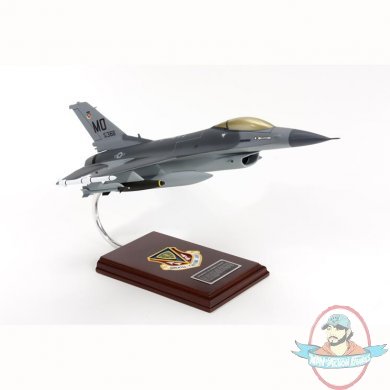
"The F-16 Fighting Falcon is a compact, single-engined jet fighter aircraft manufactured for the United States Air Force (USAF). Though designed as a lightweight fighter, it has evolved into a successful multirole aircraft. It is highly maneuverable and has proven its worth in air-to-air combat and air-to-surface attack. The Falcon is the largest Western fighter program with over 4,000 aircraft built since its production in 1976. Though no longer produced for the Air Force, it is still being made for export. Its relatively low cost and high performance has made it popular worldwide, serving a total of 24 countries. From the very beginning, the Falcon was intended to be a cost-effective workhorse that could perform various missions. Advanced aerospace science and proven reliable systems from other planes were integrated into the F16. These simplified the aircraft and reduced its size, weight, purchase price and maintenance costs. The F-16 has excellent acceleration, being one of the few jets with a thrust-to-weight ratio greater than one. It can also be armed with a wide variety of air-to-air and air-to-ground missiles, rockets or bombs. An all-weather capability allows it to accurately deliver ordnance during non-visual bombing conditions. The F-16C is the upgraded version of the F-16A, with the latest cockpit control and display technology. The Falcon has participated in numerous conflicts, mostly in the Middle East. Since the end of Operation Desert Storm, it patrolled the Iraqi no-fly zones. Two air-to-air victories were scored in Operation Southern Watch, the first one by an F-16D and the second by an F16C. On January 17, 1993, an F-16C destroyed an Iraqi MiG-23 with an AIM-120 Advanced Medium-Range Air-to-Air Missile (AMRAAM). The F-16 was also employed by NATO during Operation Allied Force over Yugoslavia, conducting air-to-ground sorties and achieving one or two aerial victories, one by a Royal Netherlands Air Force F-16A and another possibly by a USAF F-16C. A Yugoslavian MiG-29 may have been shot down by an F-16C with two AMRAAMs, but the Serbs subsequently found fragments of a Strela-2M MANPAD in the wreckage of the MiG-29. "
Scale: 1/32 scale model
Wing Span: 12.63
Length: 18.5
CF016CTS
|
"The F-16 Fighting Falcon is a compact, single-engined jet fighter aircraft manufactured for the United States Air Force (USAF). Though designed as a lightweight fighter, it has evolved into a successful multirole aircraft. It is highly maneuverable and has proven its worth in air-to-air combat and air-to-surface attack. The Falcon is the largest Western fighter program with over 4,000 aircraft built since its production in 1976. Though no longer produced for the Air Force, it is still being made for export. Its relatively low cost and high performance has made it popular worldwide, serving a total of 24 countries. The F-16C is the upgraded version of the F-16A, with the latest cockpit control and display technology. The Falcon has participated in numerous conflicts, mostly in the Middle East. Since the end of Operation Desert Storm, it patrolled the Iraqi no-fly zones. Two air-to-air victories were scored in Operation Southern Watch, the first one by an F-16D and the second by an F-16C. On January 17, 1993, an F-16C destroyed an Iraqi MiG-23 with an AIM-120 Advanced Medium-Range Air-to-Air Missile (AMRAAM). The F-16 was also employed by NATO during Operation Allied Force over Yugoslavia, conducting air-to-ground sorties and achieving one or two aerial victories, one by a Royal Netherlands Air Force F-16A and another possibly by a USAF F-16C. A Yugoslavian MiG-29 may have been shot down by an F16C with two AMRAAMs, but the Serbs subsequently found fragments of a Strela-2M MANPAD in the wreckage of the MiG-29. The USAF plans to retain the Falcon until 2025. It can be seen in movies such as Blue Thunder, Jewel of the Nile, the Iron Eagle series, X2 and The Sum of All Fears. The aircraft is also a popular model for computer flight simulators, appearing in over twenty games, including F-16 Fighting Falcon, Strike Commander and iF-16. "
Scale: 1/32 scale model
Wing Span: 12.63
Length: 18.5
CF016CT
|
"The F-16 Fighting Falcon is a compact, single-engined jet fighter aircraft manufactured by General Dynamics and later Lockheed Martin for the United States Air Force (USAF). Though designed as a lightweight fighter, it has evolved into a successful multirole aircraft. It is highly maneuverable and has proven its worth in air-to-air combat and air-to-surface attack. The Falcon is the largest Western fighter program with over 4,000 aircraft built since its production in 1976. Though no longer produced for the Air Force, it is still being made for export. Its relatively low cost and high performance has made it popular in the United States and allied nations. USAF pilots gave the F-16 the unofficial nickname of “Viper” in homage to the fictional Battlestar Galactica starfighter. Aside from serving with air forces in 24 different countries, the Falcon is also the current aircraft of choice of the USAF Thunderbirds Air Demonstration Squadron. In March 1982, it was announced that the Thunderbirds would trade in their T-38 Talons for F-16 Falcons. The team sat out the 1982 airshow season to spend the year retraining and transiting over into the new aircraft. Transition to the F16 was completed in November 1982, and the first public demonstration took place in April 1983. In 1992, the squadron switched to the C version of the F-16, being the last active duty unit to use the A model. The F-16C is nearly identical to the F-16A, but has upgraded avionics and radar systems, making it superior to its predecessor. Additionally, it is the only fighter to win both of the Air Force’s premier competitions, namely Gunsmoke (air-to-ground) and William Tell (air-to-air). The Falcon has remained with the Thunderbirds for the last 20 years, the longest performance era of any one aircraft. "
Scale: 1/72 scale model
CF016TF
|
"The F-16 Fighting Falcon is a compact, single-engined jet fighter aircraft manufactured by General Dynamics and later Lockheed Martin for the United States Air Force (USAF). Though designed as a lightweight fighter, it has evolved into a successful multirole aircraft. It is highly maneuverable and has proven its worth in air-to-air combat and air-to-surface attack. The Falcon is the largest Western fighter program with over 4,000 aircraft built since its production in 1976. Though no longer produced for the Air Force, it is still being made for export. Its relatively low cost and high performance has made it popular in the United States and allied nations. USAF pilots gave the F-16 the unofficial nickname of ""Viper"" in homage to the fictional Battlestar Galactica starfighter. From the very beginning, the Falcon was intended to be a cost-effective workhorse that could perform various missions. Advanced aerospace science and proven reliable systems from other planes such as the F-15 and F-111 were integrated into the F-16. These simplified the aircraft and reduced its size, weight, purchase price and maintenance costs. Other innovations include a frameless, bubble canopy for better visibility, a side-mounted control stick to ease control while under high g-forces, and a reclined seat to reduce the effect of g-forces on the pilot. The F-16 has excellent acceleration, being one of the few jets with a thrust-to-weight ratio greater than one. It can also be armed with a wide variety of air-to-air and air-to-ground missiles, rockets or bombs. An all-weather capability allows it to accurately deliver ordnance during non-visual bombing conditions."
Scale: 1/32 scale model
Wing Span: 11.75
Length: 17.75
CF016TTS
Pre-Order, Sold Out Available: September
|
"The McDonnell Douglas F/A-18 Hornet is a twin-engine, multimission and tactical aircraft designed for the offensive, both ground and aerial targets. The F/A-18A entered service on September 13, 1978 and its maiden flight was on November 18. The first production of F/A-18A flew on April 12, 1980. The F/A-18 first saw combat action in April 1986, the time during operation Prairie Fire, when VFA-131 Hornets from USS Coral Sea flew SEAD missions against Libyan air defenses. The aircraft has an M611A1 20-mm gun mounted inside the nose of the craft and carries up to 13,700 pounds of external ordinance and has nine weapon stations. The F/A-18 fulfills these assignments: fighter escort, supression of enemy air defenses, forward air control, close air support and day and night strike missions. The F/A-18A has a maximum speed of 1,190 mph at 40,000 ft. and has a ferry range of 2,070 mi. The F/A-18 utilizes various systems and technologies to minimize the likelihood of detection. It has an APG-73 with increased speed and memory capacity. It also has a laser target designator/ranger which enables it to deliver precision laser-guided bombs accurately. In 2001, four F/A-18A aircrafts were deployed to Diego Garcia during coalition operations against the Taliban in Afghanistan. The F/A-18 has been deployed by the armed services to the United States (NAvy an MArines), Canada, Australia, Spain, Kuwait, Finland, Switzerland and Malaysia."
Scale: 1/48 scale model
Wing Span: 10.25
Length: 14
CF018BATP
|
"The Wild Weasel was derived from the Project Wild Weasel. The Wild Weasel is an aircraft designed to identify, locate and physically suppress or destroy ground-based enemy air defense systems. By 1975, the F-4G Phantom became the Wild Weasel. There are about 116 F-4Es rebuilt as F-4Gs. The F-4G Wild Weasels were stationed at George AFB, Victorville, CA. and were deployed to four active wings; one wing was assigned to USAFE (US Air Forces Europe) at Spangdahlem AB, Germany and the other was assigned to PACAF (Pacific Air Forces) at Clark AFB, Philippines. The F-4G saw combat during the Gulf War and was reported to have only lost a single aircraft. After the Gulf War, the George AFB aircraft were assigned to the Air National Guard at Boise, ID. In 1991, the F-4G Phantom Wild Weasel was deployed in Operation Desert Storm in Iraq and its EW System had been upgraded to an AN/APR-47 configuration. The F-4G fired more than 1,000 air-to-ground missiles and destroyed more than 200 targets. On January 2, 1996, the F-4G Wild Weasel flew its last combat mission to Southern Iraq and shortly, it retired from active service. The F-4G was also the last operational variant of the Phantom II in the US Forces. "
Scale: 1/48 scale model
Wing Span: 10
Length: 16.5
CF004AWWT
|
"The F-4N Phantom II was used by the U.S. military as the primary air fighter and a fighter-bomber for the US Air Force, Navy and Marines during the Vietnam War. The F-4N upgrade program began in 1970, as response to Navy concerns about the condition of the F-4B aircraft, which by that time were over a decade old and rather the worse for wear. In that year, a program named Bee Line was initiated in which the F-4Bs were refurbished and modernized. The aircraft were sent to NAS North Island, California, where they were stripped and inspected. They were then completely rebuilt using new parts. The changes included a structural strengthening to extend the fatigue life, plus a complete rewiring. The electrical generating system was upgraded with 30-kVA constant speed alternators. The F-4N retained the thin wings and tires, the main radar, and the undernose infrared search and track detector of the F-4B. The first F-4N flew on June 4, 1972, and the first rebuilt F-4N entered service in February 1973. By 1983, the F-4Ns had been completely replaced by F-14 Tomcats."
Scale: 1/48 scale model
Wing Span: 10
Length: 16.5
CF004NT
|
"F4D-1 Skyray is a carrier-based fighter built and manufactured by Douglas Aircraft Company. It became notable for being the first carrier-launched aircraft to hold the world's absolute speed record and was the first US Navy fighter to exceed Mach 1 in level flight. The US Marine Corps also flew the Skyray. The F4D-1 Skyray was designed for high-altitude interception role, though it was unsuited to the multi-mission capabilities that became in demand, so it had a short life in Navy and Marine Corps service. In 1964, the last aircraft was withdrawn from service. Four Skyrays were used by NACA (shortly it became NASA) until 1969. The F4D has a wide delta wing design with long, sharply swept, rounded wings. The F4D-1 has a crew of 1. It incorporates Pratt & Whitney J57-P-8A. It has a maximum speed of 722 mph and a range of 700 mi. The primary users and operators of the F4D-1 were the United States Navy and the United States Marine Corps. The Skyray was one of the best-remembeed early jet fighters and was affectionately called as the Ford. There's a total of 422 F4D-1s built. "
Scale: 1/32 scale model
Wing Span: 16.75
Length: 12.88
CF004SDTE
|
Scale: 1/32 scale model
Wing Span: 16.75
Length: 13.5
CF084GTE
|
"The F-4 Phantom II is a fighter-bomber manufactured by McDonnell Aircraft and was originally developed for the US Navy. The Phantom was used extensively in the Vietnam War and was utilized for ground-attack and reconnaissance roles. The initial F4H-1 (later F-4B) entered service in 1961. The USAF evaluated it for close air support, interdiction, and counter-air operations. Operational squadrons flew navy F-4Bs until the late 1960s. During the early 1970s, 228 F-4Bs were upgraded as F-4N under Project Bee Line. The primary users and operators of the Phantom are the United States Air Force, United States Navy and the United states Marine Corps. There are several number of F-4 Phantom IIs on display in the USA and worldwide. As of 2001, there are 744 active in non-US service and as drones."
Scale: 1/48 scale model
Wing Span: 11.5
Length: 17.5
CF004TE
|
"The F-5E Tiger II is a single-seat version for the Tunisian Air Force. In 1950, the F-5 started its life as a privately-funded light fighter program by Northrop. The first generation F-5A Freedom Fighter entered service in 1960. During the Cold War, there were over 800 produced through 1972 for US Allies. The F-5 proved to be a successful combat aircraft for US Allies, but it didn't entered front-line service with the US due to diverging priorities of the US services. A few surplus F-5As and F-5Es have been sold to private owners. In 1970, Northrop's F-5A-21, which subsequently became the F-5E, was designated to replace the F-5A. It was lengthened and enlarged, with increased wing area and more sophisticated avionics, and was initially having an Emerson AN/APQ-153 radar. The F-5E eventually acquired its official name Tiger II. In its service life, the F-5E experienced numerous upgrades. The F-5E Tiger II has a crew capacity of 1. It has a maximum speed of 917 kn and a ferry range of 2,010 nmi. The F-5E Tiger II production amounted to 1,400 including all versions and production ended in 1987. Various F-5 versions remain in service with many other nations. Singapore has approximately 49 modernized and re-designated F-5S and F-5T aircraft. The F-5 was also developed into a reconnaissance version, the RF-5 Tigereye."
Scale: 1/40 scale model
Wing Span: 8.25
Length: 14.5
CF005T2T
|
"The F-8 Crusader is a single-engine aircraft carrier-based fighter aircraft built by Chance-Vought and was a replacement for the Vought F-7 Cutlass. The first prototype of F-8 Crusader flew on March 25, 1995, manned by John Konrad. During its maiden flight, the F-8 exceeded the speed of sound. The F-8E was the last Crusader variant produced. The F-8E is an air superiority fighter version for the French Navy. There were 42 orders by the French Navy for use aboard new carriers Clemenceau and Foch. The F-8E has a crew of 1. It has a maximum speed of Mach 1.86 and a ferry range of 1,735 mi. It has four 20 mm Colt Mk 12 cannons in its lower fuselage and 125 rounds/gun. It has eight Zuni rockets in four twin pods. It has four AIM-9 Sidewinder air-to-air missiles and two AGM-12 Bullpup air-to-ground guided missiles. It has an increased wing lift and an added boundary layer control system and enlarged stabilators. The primary users and operators of the F-8s are the United States Navy, United States Marine Corps, French Navy and the Philippines."
Scale: 1/48 scale model
Wing Span: 9.88
Length: 14
CF008NT
|
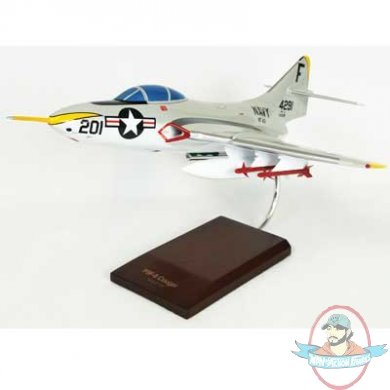
"The F9F-8 Cougar, manufactured by Grumman, was designed to serve as an aircraft carrier-based fighter aircraft for the United States Navy. Based on the earlier Grumman F9F Panther, the Cougar replaced the Panther's straight wing with a more modern swept wing. The Navy considered the Cougar a mere new version of the Panther (despite adopting a different official name) and thus Cougars started off as F9F-6 and upwards. On January 18, 1954, the F9F-8 had its first flight. A total of 601 F9F-8s were delivered to the Navy between April 1954 and March 1957. During the course of production, a fixed in-flight refueling probe was added to the nose. Most F9F-8s were fitted with Ultra High Frequency (UHF) homing antenna in a fairing underneath the nose. Late production F9F-8s were fitted with the capability of carrying two Sidewinder infrared-homing air-to-air missiles underneath each wing. This feature was retrofitted to many earlier F9F-8s. In 1962, the F9F-8 was redesignated F-9J under the new Defense Department Tri-Service designation scheme. The F9F-8B fighter-bomber became AF-9J. Later, when used as advanced trainers, some of these aircraft became TAF-9J. "
Scale: 1/32 scale model
Wing Span: 13.65
Length: 17.63
CF009NCT
|
"The F9F Panther is a fighter-bomber aircraft manufactured by Grumman. It was widely used during the Korean War. The Panther have been notable for its prominent role in the 1954 movie Men of the FIghting Lady and was also featured in the flying sequences in the 1955 movie The Bridges at Toko-Ri. The prototype Panther first flew on November 24, 1947. F9F-5s, together with F9F-2s and F9F-5s have distinctively served in the Korean war, having downed two Yak-9s and five Mikoyan-Gurevich, with only one loss of F9F. In 1956, Panthers were withdrawn from front-line service, but remained as trainers and with Reserve units until 1958 and some continued to serve in small numbers into the 1960s. The only foreign Panther buyer was the Argentine Navy, having bought 24 ex-USN aircraft in 1958. The Argentine Panthers were involved in general mobilization during the 1965 border clash between Argentina and Chile, but there wasn't any combat that occurred. In 1969, Panthers were removed from active service due to lack spare parts and was replaced with A-4Q Skyhawks. The F9F-5 Panther is a variant of the F9F-5 but is powered by Pratt & Whitney J48 engine. There were 616 F9F-5s built. "
Scale: 1/32 scale model
Wing Span: 13.63
Length: 13.5
CF009NPT
|
"The Grumman F-14 Tomcat is a supersonic, twin engine, two-seat, variable sweep wing, two-place strike fighter manufactured by Grumman Aircraft Corporation. F-14 was the United States Navy's primary maritime air superiority fighter, fleet defense interceptor and tactical reconnaissance platform from 1974 to 2006. The F-14 first entered service in 1972 with the U.S. Navy, replacing the F-4 Phantom II. The F-14A variant is a a two-set all-weather interceptor fighter version for the US Navy and modifications late in its service life added precision strike munitions to its armament. There were 545 F-14A delivered to the US Navy and 79 to Iran. The final 102 F-14As were delivered with improved TF30-P-414A engines. An additional F-14A was manufactured for Iran, but was delivered to the US Navy. The Tomcat is capable of deploying air-to-ground ordnance in various configurations, while simultaneously carrying the AIM-7, AIM-9 and AIM-54 air-to-air missiles. The F-14 has an airspeed of Mach 2+ and it was scheduled to remain in service through at least 2008. On September 22, 2006, the F-14 retired from the U.S. Navy fleet and was replaced by the F/A-18E/F Super Hornet. As of 2007, it remains in service only with the Islamic Republic of Iran Air Force. "
Scale: 1/48 scale model
Wing Span: 16
Length: 16
CF014ST
|