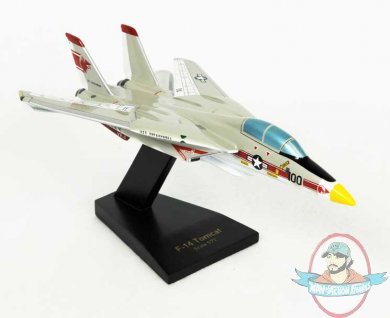
"The F-14A Tomcat was the United States Navy's primary maritime air superiority fighter, fleet defense interceptor and tactical reconnaissance. The aircraft was originally designed as the successor of the F-4 Phantom in the fleet defense roll. The aircraft was designed to provide the Fleet with a Mach 2.0 (twice the speed of sound) air superiority fighter capable of fleet defense at both long and short range. The aircraft was the 59th built and the 57th to be delivered to the Navy on February 20, 1974. It first served with the VF-1 ""Wolfpack"" aboard the USS Enterprise from May 1974 through July 1976. During this time, the aircraft flew missions during a WestPac cruise under the code name Operation Frequent Wind, the evacuation of Saigon, South Vietnam. This makes the Tomcat a true Vietnam veteran. The F-14A Tomcat was transferred to the training squadron VF-124 ""Gunfighters"" in July of 1976 where it spent approximately 1 year. In June of 1977, it was transferred to VF-2 ""Bounty Hunters"", the sister squadron to VF-1 aboard the Enterprise again. While it was with the VF-2, this aircraft also flew off the USS Ranger and USS Kitty Hawk. The Tomcat's combat initiation occurred in a successful encounter with Libyan Air Force Sukhoi Fighters in August 1981. The F-14 has undergone considerable upgrading and modification during its life and has been continuously tested at Patuxent River since 1972. The mission expansion of this aircraft includes tactical air reconnaissance and delivery of laser guided air-to-ground weapons and it also ensures the Tomcat's value to the Fleet well into the 21st century. "
Scale: 1/72 scale model
Wing Span: 10
Length: 6.25
CF014TR
|
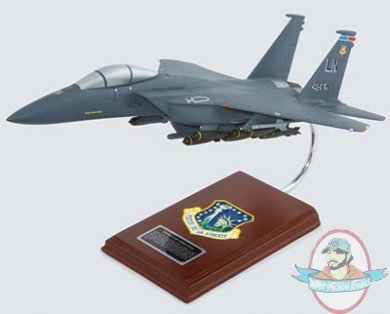
"The F-15E Strike Eagle is a dual-role fighter designed for long range interdiction of enemy ground targets deep behind enemy lines. An array of avionics and electronics systems gives the aircraft the capability to fly at low altitude, day or night, and in any weather condition. Derived from the F-15 Eagle, the Strike Eagle has proved its worth in various operations, carrying out deep strikes against high value targets and providing close air support for coalition troops. The F-15E can be distinguished from the F-15 by its darker camouflage and the conformal fuel tanks attached to the fuselage. In March 1981, the United States Air Force (USAF) announced the Enhanced Tactical Fighter program to procure a replacement for the F-111 Aardvark. General Dynamics and McDonnell Douglas submitted proposals, and in February 1984, the contract was awarded to McDonnell Douglas. The F-15E had its maiden flight on December 11, 1986. While designed for ground attack, the versatile Strike Eagle retains much of the air-to-air lethality of the F-15 and can defend itself against enemy aircraft. The F-15E saw combat during Operations Desert Shield and Desert Storm after Iraq invaded Kuwait in August 1990. On February 14, 1991, an F-15E scored an air-to-air kill, a Mil Mi-24 Hind helicopter. The attack was in response to a request for help by US Special Forces. Following Desert Storm, two no-fly zones were set up over Iraq and policed mainly by US and UK aircraft. The Strike Eagle would fly into combat on many occasions over the next decade and was the most highly-tasked of all USAF tactical fighters. The F-15E usually attacked ammunition bunkers, command and control facilities, towed anti-aircraft batteries and launchers. It also cooperated with other aircraft in strikes. "
Scale: 1/42 scale model
Wing Span: 12.25
Length: 18.25
CF015ETS
|
"The F-15E Strike Eagle, manufactured by McDonnell Douglas / Boeing IDS, is a modern United States all-weather strike fighter, designed for long-range interdiction of enemy ground targets deep behind enemy lines. On December 11, 1986, the F-15E had its first flight. The F-15E became the newest fighter in Tactical Air Command when the 405th Tactical Training Wing, Luke Air Force Base, Ariz., accepted delivery of the first production model in April 1988. The 4th Fighter Wing at Seymour Johnson Air Force Base, N.C., was the first operational F-15E Strike Eagle wing in the Air Force. A derivative of the F-15 Eagle air superiority fighter, the Strike Eagle proved its worth in Desert Storm, carrying out deep strikes against high-value targets and providing close air support for coalition troops. The F-15E Strike Eagle can be distinguished from the F-15 Eagle by its darker camouflage and the presence of the conformal fuel tanks attached to the aircraft's fuselage. This new version was designed to penetrate deep into enemy territory unescorted, and strike military targets with pinpoint accuracy. The strike eagle employs two highly reliable Pratt & Whitney F100-PW-229 engines and was designed specifically as a two-person crew of pilot and weapons system officer. The LANTRIN (Low Altitude Navigation and Targeting Infra-Red for Night) system enables the Strike Eagle to operate at night and in bad weather. The Strike Eagle can also be employed with up to an 11-ton payload and can carry the GBU-28 Bunker Buster, a guided bomb developed to destroy strengthened underground bunkers. The Strike Eagle was first deployed in December 1989. During the Gulf War in 1991, 2 squadrons of 48 F-15E Strike Eagles demonstrated their power as multi-purpose fighter/attack planes. "
Scale: 1/72 scale model
Wing Span: 7.5
Length: 13
CF015ETR
|
"The F-15E Strike Eagle is a strike fighter, designed for long range interdiction of enemy ground targets deep behind enemy lies. The F-15E carried our deep strikes against high value targets and provided close air support for coalition troops. The F-15E is different from the F-15 in a way that the F-15 Eagle has darker camouflage and the presence of the conformal fuel tanks attached to the aircraft’s fuselage. The F-15E Strike Eagle used two crew members, a pilot and a weapon systems officer. Previous models of F-15E are assigned to air to air roles. The Strike Eagle’s way to fight it is to a target over long ranges, destroy enemy ground positions and fight its way out. The navigation system of Strike Eagle used a laser gyro and a Global Positioning System to monitor the aircrafts position as well as to provide information. APG-70 radar system detects ground targets for long ranges. Another feature of the system of F-15E Strike Eagle is that after a sweep of a target area, the crew freezes the air ground to clear air threats. Thus, the pilot is capable of detecting, targeting and engaging air to air targets. The rear cockpit and the weapons systems are the most important additions to the F-15E. The officer of Strike Eagle has four screens where in formation can be display from the radar, electronic warfare or infrared sensors, monitor aircraft or weapons status and possible threats, select targets and use an electronic to find the way. To select new displays, the f-15E has two hand controls. Displays can be moved from one screen to another. On April 1988, the first production of F-15E was delivered to the 405th Tactical Training Wing, Luke AFB, Ariz. The Strike Eagle was the first US operational aircraft whose engines’ thrust exceeded the plane’s loaded weight. Thus, permitting it to accelerate even in a vertical climb. "
LENGTH 8.5 INCHES
WINGSPAN 5.375 INCHES
|
"The F15A Eagle sometimes called “YF-15A”. There were 384 F15As that were built in history including 18 full scale development aircrafts. The serial number of the first produced F-15A was 71-0280 and it was used in the ceremony in St. Louis way back June 26, 1972. The F15A made its first flight on July 27, 1972 by company test pilot Irving Burrows. On March 1973, there was a production of thirty F15A and B aircrafts. The first F15, TF-15A 73-0108 was for an operational USAF unit. The said F15 was a replacement training unit for F15 operations during the first stage of the introduction of the Eagle into service. Winter of year 1974 to 1975, McDonnell altered the F-15A serial number 72-0119 to set the world time in order for him to climb records. The said project was called Streak Eagle. To rid of some weight for this project, all non important systems were deleted including the flap, speed brake, armament, radar and fire control system. The paint of the F15A was also ripped of, resulting a bare metal aircraft. The F-15A was 1800 pound less than the others. This F15A which was produced by the Streak Eagle project is now on outdoor display at the USAF Museum inside the Wright Patterson AFB in Dayton, Ohio. The F15A’s that were received by the USAF were used for testing. The testing of F15A went smoothly though there were structural changes including a notched stabilator and rake wingtips for production aircraft. The USAF ordered more 350 F15A models for their operational service. The F15A models were also used by Israel, Japan and Saudi Arabia. "
Scale: 1/48 scale model
Wing Span: 11.25
Length: 16
CF015T
|
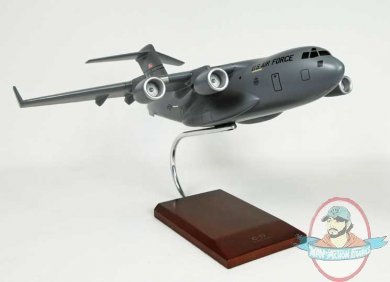
"The Boeing C-17 Globemaster III is the newest, most flexible airlift aircraft to enter the United States and Western Air Forces. This aircraft is designed to fulfill airlift needs well into the next century - carrying large combat equipment and troops or humanitarian aid across international distances directly to small austere airfields anywhere in the world. The C-17 is also able to perform theater airlift and airdrop missions when required. The C-17 takes its name from two previous heavy lifter aircraft, the C-74 Globemaster and the C-124 Globemaster II. In January 1995, the Air Force declared the first C-17 squadron operational. Since then the fleet has amassed more than 200,000 flying hours. In May 1995, the C-17 received the prestigious Collier Trophy, symbolizing the top aeronautical achievement of 1994. In 1998, eight C-17s completed the longest airdrop mission in history, flying more than 8,000 nautical miles from the United States to Central Asia, dropping troops and equipment after more than 19 hours in the air. In February 1999, President Bill Clinton presented the Malcolm Baldrige National Quality Award for business excellence to Boeing Airlift and Tanker Programs, maker of the C-17. During normal testing, C-17s set 22 world records, including payload to altitude time-to-climb and the short takeoff and landing mark, in which the C-17 took off in less than 1,400 feet, carried a payload of 44,000 pounds to altitude, and landed in less than 1,400 feet. "
Scale: 1/164 scale model
Wing Span: 12.25
Length: 12.75
CC017T
|
"The C-21A is a military variant of the Learjet 35A business jet. It is a twin turbofan engine aircraft for cargo and passenger airlift and is also capable of transporting litters during medical evacuations. In April 1984, the delivery of the C-21A fleet began and was completed in October 1985 for deployment. On April 1, 1997, all continental US-based C-21s were realigned under Air Mobility Command, with the 375th Airlift Wing at Scott Air Force Base, Ill. as the lead command. C-21s stationed outside the continental United States are assigned to theater commanders. The C-21A has a maximum speed of 530 mph and a maximum range of 2,306 miles. It has a crew of two, a pilot and a co-pilot. The C-21A has a capacity of carrying eight passengers. The aircraft is equipped with an automatic navigation system and four cathode ray tubes display for enhanced pilot crew efficiency. There are 38 C-21As in active duty with the Air Force. "
Scale: 1/48 scale model
Wing Span: 9.5
Length: 12
CC021ATR
|
"The C-141 Starlifter, also known as “Hanoi Taxi”, was manufactured by Lockhead Corporation. This military strategic airlift aircraft was the world's first turbofan-powered transport and it served as a major component of the U.S. strategic airlift force since it entered operational service in 1965. The aircraft recorded more than 10.6 million operational hours in over four decades of service. In 2005, Hanoi Taxi was one of the aircraft marshaled by the Air Force to provide evacuation for those seeking refuge from Hurricane Katrina. This aircraft and others evacuated thousands of people, including the medical evacuation (MEDEVAC) of hundreds of ill & injured. At the end of its career as at the beginning, this aircraft brought Americans out of a hostile environment and back to safety. On May 6, 2006 at 9:30 AM, the Hanoi Taxi touched down for the last time and was received in a formal retirement ceremony at the National Museum of the United States Air Force, located at Wright Patterson Air Force Base (WPAFB) in Riverside, Ohio near Dayton. Hanoi Taxi is now part of the permanent static display collection of the Museum. "
Scale: 1/104 scale model
Wing Span: 19.25
Length: 20.25
CC141HT
Pre-Order! Available: 3rd Quarter, 2026
|
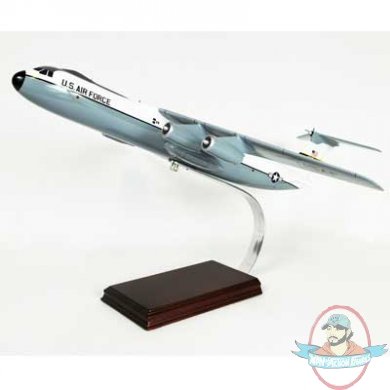
"After the inauguration of President John F. Kennedy, his first official act was the ordering of the development of an all-jet transport to extend the reach of US military forces. The new aircraft was to replace slower piston-engined cargo planes such as the Douglas C-124 Globemaster II. The Lockheed C-141 Starlifter was the result of this requirement. It served with the United States Air Force (USAF) as a military strategic airlifter and first flew in 1963. It was the first jet aircraft designed to meet military standards as a troop and cargo carrier. Operated by the Air Mobility Command (AMC) of the USAF, the C-141 can airlift and airdrop equipment, supplies and paratroops, whether at low or high altitudes. A total of 285 planes have been built, 284 for the Air Force and one for NASA. The Starlifter, which was designed to meet both military and civilian airworthiness standards, was the workhorse of the AMC. It fulfilled a vast array of requirements, including airlifting combat forces over long distances, re-supplying employed forces and providing rapid transfer of the sick and wounded from remote areas overseas to hospitals in the United States. The C-141 had an all-weather landing system, pressurized cabin and crew station. Rollers in the aircraft floor allowed quick and easy cargo pallet loading. When palletized cargo was not being carried, the rollers could be turned over to leave a smooth, flat surface for loading vehicles. Later on it was discovered that the Starlifter's volume capacity was relatively low in comparison to its lifting capacity, generally running out of physical space long before it reached its weight limit. To correct the deficiencies and utilize the aircraft to the fullest of its capabilities, 270 C-141As were stretched by about one third, adding needed payload volume. The new variant was designated C-141B. Increasing the aircraft's cargo capacity was the equivalent of buying 90 new planes. The C-141B also had in-flight refueling capability, which allowed longer non-stop flights and fewer fuel stops during worldwide airlift missions. "
Scale: 1/100 scale model
Wing Span: 19.25
Length: 20.25
CC141T
|
The USAF's C-27 Spartan is a twin turboprop engine aircraft modified from the G222 airframe manufactured in Naples, Italy, by Alenia, S.P.A. Chrysler Technologies Airborne Systems, Inc. and is modified by installing upgraded navigation, communication and mission systems required for C-27A operation.
Scale: 1/72 scale model
Wing Span: 15.75
Length: 11.5
CC27ST
|
"The C-32A is a specially configured version of the Boeing 757-200 intercontinental airliner, selected along with the C-37A to replace the aging fleet of VC-137 aircraft. Active-duty aircrews from the 1st Airlift Squadron, 89th Airlift Wing at Andrews Air Force Base, Md., fly the aircraft. The contract was awarded for the C-32A in August 1996. By using commercial off-the-shelf acquisition practices, a new record has been set from contract award to aircraft delivery – in less than two years. The C-32A is the first military aircraft ever to be acquired in this manner. The 89th Airlift Wing acquired the first of four aircrafts in 19 June 1998, and the second aircraft arrived in Andrews three days later. The remaining two C-32As arrived in November and December. The C-32A is configured for 45 passengers and 16 crews, and was designed for a 4,150 nautical mile mission, roughly the distance from Andrews to Frankfurt, Germany. The aircraft is also Stage III noise level compliant. Inside the C-32A, communications are paramount. The heads of the state and other decision-makers can conduct business anywhere around the world. The C-32 has state-of-the-art avionics equipment. The C-32A is far more fuel efficient and quieter than the 707-based C-137s they are replacing. Each engine of the C-32A has 40,000 pounds of thrust, compared to the VC-137 engine that delivers 14,000 pounds. Yet, the C-32A's high-bypass-ratio engines, combined with an advanced wing design, help make the plane one of the quietest, most fuel-efficient jetliners in the world."
Wing Span: 19
Length: 19
CC37T
|
"The C-40B was built for the U.S. Air Force as a military version of the Boeing 737-700 Boeing Business Jet. The aircraft was created to replace the aging fleet of the C-137 aircraft for U.S. combatant commanders and other government leaders. The Air Force awarded the medium lift contract in August 2000. The 89th Airlift Wing acquired its first C-40B aircraft in December 2002. The aircraft is based in Andrews Air Force Base, Maryland. The 15th Airlift Wing, Hickam AFB, Hawaii acquired its C-40B for U.S. Pacific Command in February 2003. The C-40B is created to be an ""office in the sky"" for senior military and government officials. The C-40Bs are equipped with the Connexion by Boeing system, providing secure in-flight broadband connectivity -- data/video transmit and receive capability -- to enhance communications, productivity and security. This gives U.S. military officials the ability to conduct business anywhere around the world by using on-board Internet and local area network connections, telephones, satellites, television monitors, facsimile and copy machines. The C-40B has a computer-based passenger data system."
Scale: 1/100 scale model
Wing Span: 14
Length: 13.25
CC40BTR
|
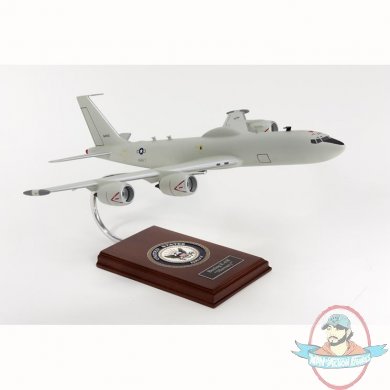
"The Boeing E-3 sentry is a military airborne warning and control system (AWACS) aircraft that provides all-weather surveillance, command, control and communications to the United States, United Kingdom, France, NATO and other air defense forces. The E-3 offers superior surveillance capabilities. The E-3 Sentry is a modified Boeing 707-320B Advanced Commercial Airframe. It is a militarized version of the Boeing 707-320B commercial jetliner airframe. The USAF E-3 fleet completed its largest upgrade which is the Block 30/35 Modification in 2001. The four enhancements were the Electronic Support Measures (ESM) for passive detection, Joint Tactical Information Distribution System (JTIDS) to provide secure, anti-jam communication, memory capability enhancement in the computer and Global Positoning System (GPS). E-3 Sentry aircraft were among the first to deploy during Operation Shield where they immediately established an around-the-clock radar screen to defend against Iraqi forces. In its strategic defense role, the E-3 provides the means to detect, identify, track and intercept airborne threats. The E-10 MC2A, based upon the Boeing 767-400ER airframe, was intended to replace the United States operated E-3 (along with the RC-135 and the E-8 Oint STARS), but budget cutbacks have clouded its future. Production ended in 1992 after 68 had been built. "
Scale: 1/100 scale model
Wing Span: 17.5
Length: 18.5
CE3AT
|
"The supersonic long-range all-weather F-4 Phantom II was designed for the United States Navy (USN) by McDonnell Douglas. It first entered service in 1960. During the Vietnam War, it was the primary air superiority fighter and a workhorse fighter-bomber for the US Air Force (USAF), Navy and Marine Corps. By 1963, it had been adopted by the USAF for the fighter-bomber role. When production ended in 1981, a total of 5,195 F-4s had been built, making it the most numerous American supersonic military aircraft. In 2000, over 1,000 units were in service with 11 nations worldwide. Innovations in the F-4 included an advanced pulse-doppler radar and extensive use of titanium in the airframe. It could carry up to 8,480 kg of weapons such as air-to-air and air-to-ground missiles, as well as unguided, guided and nuclear bombs. The F-4E is the leading Phantom model, with 1,389 planes built. It took its maiden flight on June 30, 1967. The F-4E had an additional fuselage fuel tank, leading-edge slats for increased maneuverability, an improved engine, and an internally mounted 20 mm multibarrel gun with an improved fire-control system. The slats, weapons and radar controls were optimized for dogfighting, thus improving the aircraft's air-to-air capabilities. In air combat, the F-4's greatest advantage was its thrust, which permitted a skilled pilot to engage and disengage from the fight at will. Due to its distinctive appearance and its widespread service with various militaries, the F-4 is one of the best known icons of the Cold War. It performed well in the Vietnam War and Arab-Israeli conflicts, with F-4 crews achieving 393 aerial victories and completing countless ground attack sorties. The Phantom II has the distinction of being the last US fighter to attain ace status in the 20th century. It has also set 16 world records, and was the only aircraft used by both the USAF Thunderbirds and the USN Blue Angels. "
Scale: 1/48 scale model
Wing Span: 10
Length: 16.5
CF004ACT
|
"The Northrop Grumman B-2 Spirit is a multi-role stealth heavy bomber, capable of deploying both conventional and nuclear weapons. It is operated exclusively by the United States Air Force. The B-2 Spirit or stealth bomber was developed and built by an industry team consisting of Northrop Grumman, Boeing and Vought Aircraft Industries. The B-2 started life as a black project known as the High Altitude Penetrating Bomber (HAPB), then became the Advanced Technology Bomber (ATB), and later became the B-2 Spirit. The B-2s primary mission is to attack time-critical targets early in a conflict to minimize an enemy's war-making potential. The B-2 bomber aircraft features incorporates advanced designs and technologies that make unprecedented use of composite materials, product assembly and finishing that meet extraordinary tolerances and quality standards and it doesn't use development tooling since it incorporates final production tooling implemented directly from the computer-aided design (CAD) system. The first B-2 was publicly displayed on November 22, 1988, when it was rolled out of its hangar at Air Force Plant 42, Palmdale, California, where it was built. Its first public flight was on July 17, 1989. In 1991, the USAF and B-2 industry team received the Collier Trophy. It will be unlikely that any B-2 will be placed on permanent display in the future (or anytime before airtime retirement)."
|
The first B-47E flew on 30 January 1953. Four "blocks" or "phases" of the B-47E were built, each incorporating refinements on the previous block, and also sometimes featuring production changes within a block. Older blocks were generally brought up to the specifications of later blocks as they were introduced. Early production "B-47E-Is" also known featured J47-GE-25 turbojets with 27 kN (5,970 lbf) thrust, but they were quickly changed to J47-GE-25A engines, which featured a significant improvement in the form of water-methanol injection. This was a scheme in which a water-methanol mix was dumped into the engines at takeoff, increasing mass flow and so temporarily kicking the thrust up to 32 kN (7,200 lbf). Methanol was apparently added to the water as an anti-freezing agent. The engines left a trail of black smoke behind them when water-methanol injection was on.
Scale: 1/100 scale model
Wing Span: 14.38
Length: 13
CB47T
|
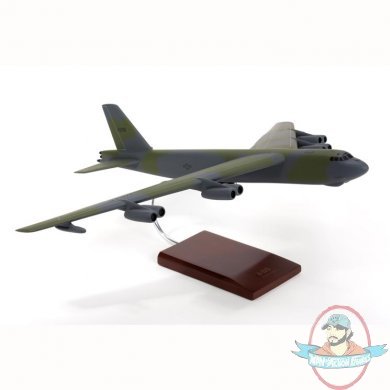
"The B-52 Stratofortress is a long-range, jet strategic bomber that replaced the Convair B-36 and the Boeing B-47. Built by Boeing Aircraft CB-52G Stratofortressorporation in Wichita, Kansas, it has been operated by the United States Air Force (USAF) since 1955. Rarely called by its official name Stratofortress, it is more commonly referred to as BUFF (Big Ugly Fat Fellow). On November 23, 1945, Air Materiel Command, a former USAF command, issued desired performance characteristics for a new strategic bomber. Boeing, Consolidated Aircraft and Glenn L. Martin Company all submitted proposals, with Boeing winning the design competition. The primary nuclear-roled bomber in the USAF inventory, the B-52 was designed to reduce the overall aircraft weight in an effort to improve performance and has the longest unrefueled range of any bomber. It can carry up to 60,000 pounds of nuclear or conventional ordnance and can fly at high subsonic speeds and altitudes with worldwide precision navigation capability. The first B-52G aircraft rolled out of the production plant in the summer of 1958. The “G” model was heavier than earlier variants and had increased unrefueled range. Other changes included an enlarged nose radome, a reduced vertical fin size, a modified tail cone and removed ailerons. "
Scale: 1/100 scale model
Wing Span: 22.25
Length: 19
CB52GT
|
"The Convair B-58 Hustler was the first operational jet bomber capable of Mach 2 supersonic flight and was developed for the United States Air Force Strategic Air Command in the late 1950s. The B-58 program started in February 1949. The B-58 design was the first ""true"" USAF supersonic bomber program. Its design was based on a delta wing with a leading-edge sweep of 60 degrees with four General Electric J79-GE-1 turbojet loading. It has a crew of three, the pilot, bombardier, navigator and defensive systems operator. The B-58 carries a single nuclear weapon in a streamlined MB-1C pod under the fuselage. The B-58 has a crew of three and has a maximum speed of Mach 2.1 The B-58 is extremely expensive and was reported that each B-58As costs much more than its weight in gold. It is a complex aircraft requiring considerable maintenance, requiring specialized equipment. On January 16, 1970, the last B-58s in operational service retired and was replaced by the FB-111A. A total of 116 B-58s were produced; 30 trial aircraft and 86 production B-58A models. A number of B-58s were used for special trials of various kinds and several variants such as the B-58B and B-58C were proposed by Convair, but were never built. "
|
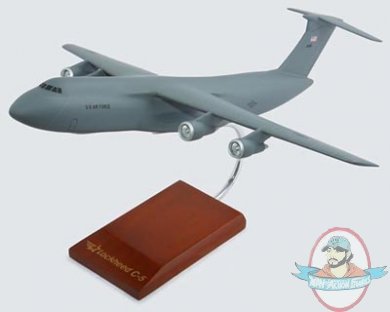
"The C-5 Galaxy is a strategic airlifter type of aircraft manufactured by Lockheed-Georgia Co. Its maiden flight was on the 30th of June 1968 and was introduced commercially in 1970. Its primary user was the United States Air Force and it is still operational up to this date with 52 produced aircrafts active and 42 reserved. It is one of the largest aircrafts in the world and the largest American military transport. It was designed to carry oversized cargo. The C-5A was produced during 1968 to 1973. It was the original version of the C-5 Galaxy. In 1970s a crack on its wings was found that caused its cargo weight restriction. The C-5A was redesigned to install new strengthened wings. The new set of wings is made of an aluminum alloy that didn’t exist during its first production. The C-5B was produced on 1985 to 1989.It was an improved version of the original variant of C-5 Galaxy. It allows four minimum flight crews including the Pilot, co-pilot, and two flight engineers. It has a payload of 270,000 lb; length of 247 feet 1 inches; wingspan of 222 feet 9 inches; height of 65 feet 1 inches. It has a maximum speed of Mach 0.79; cruise speed of Mach 0.77; range of 2,400 nmi; and service ceiling of 34,000 feet. Fifty new variants of C-5B were delivered to the United States Air Force from 1986 to 1989. "
Scale: 1/150 scale model
Wing Span: 18
Length: 20
CC005ET
|
"The Lockheed C-5 Galaxy is a military transport aircraft, the largest in the American military and one of the largest in the world. It was designed to carry outsize and oversize cargo, providing strategic heavy airlift over intercontinental distances. Operated by the United States Air Force (USAF), it is one of the physically largest aircraft in the world that is capable of flying on a regular basis. In 1964, design proposals for a heavy jet transport were submitted by various companies in response to a US Army requirement. The new aircraft was set to replace the Douglas C-133 Cargomaster and complement the Lockheed C-141 Starlifter. In 1965, Lockheed's aircraft design and General Electric's engine design were selected. The first C-5A Galaxy rolled out of the manufacturing plant on March 2, 1968 and the aircraft's maiden flight was on June 30. The first operational Galaxy was delivered in June 1970. The C-5 has a distinctive high T-tail and is similar in appearance to its smaller sister transport the C-141. It is equipped for aerial refueling, giving it an extended range. Nose and aft doors permit “drive-through” loading and unloading of cargo. The Galaxy is capable of carrying nearly all of the Army's combat equipment, including the 74-ton armored vehicle launched bridge, from the United States to any location in the world. In the early 1970s, the C-5 was considered by NASA for the role of Shuttle Carrier Aircraft, which was tasked to transport the Space Shuttle to Kennedy Space Center. However, the Boeing 747 was chosen instead due in part to its low-wing design. From 1981 to 1987, 77 C-5As underwent a re-winging program to increase their lifting capability and service life after wing cracks were found throughout the fleet. The redesigned wings were made of a new aluminum alloy that did not exist during the original production. "
Scale: 1/150 scale model
Wing Span: 18
Length: 20
CC005GT
Pre-Order! Available: September
|
"The C-5 Galaxy, manufactured by Lockheed-Georgia Co., is a military heavy-cargo transport aircraft designed to provide strategic airlift for deployment and supply of combat and support forces over intercontinental distances. It is the largest American military transport and one of the largest military aircraft in the world, designed to carry outsize and oversize cargo. The C-5 is operated by the United States Air Force. The C-5 Galaxy is one of the physically largest aircraft in the world with the ability to fly on a regular basis. The original version of the C-5 is the C-5A. From 1969 to 1973, 81 C-5As were delivered to US Air Forces bases. Due to cracks found in the wings in the mid-1970s, the cargo weight was restricted. To restore the plane's full capability, the wing structure was redesigned. A program to install new strengthened wings on 77 C-5As was conducted from 1981 to 1987. The redesigned wing made use of a new aluminum alloy that didn't exist during the original production. An improved version of the C-5A is the C-5B. It incorporated all modifications and improvements made to the C-5A with improved wings, upgraded TF-39-GE-1C turbofan engines and updated avionics. From 1986 to 1989, 50 of the new variant were delivered to the US Air Force. "
Scale: 1/150 scale model
Wing Span: 18
Length: 20
CC005T
|
Scale: 1/100 scale model
Wing Span: 17.5
Length: 18.5
CE6BT
|
"The T-6 Texan is a single-engine advanced trainer aircraft used to train fighter pilots of the United States Army Air Forces, United States Navy, Royal Air Force and other air forces of the British Commonwealth during World War II. The T-6 is known by a variety of designations depending on the model and operating air force such as the ""AT-6"", the ""SNJ"" and ""Harvard"". The T-6 originates from the North American NA-16 prototype which was first sloen on April 1, 1935. The T-6 originated from the American NA-16 prototype which was modified as the NA-26 and entered USAC ""Basic Combat"" aircraft competition in March 1937. Production of the first model began and there were 180 supplied to the USAAC as the BC-1 and 400 to the RAF as the Harvard I. The US Navy received 16 modified aircraft, designated as the SNJ-1, and the 61 as the SNJ-2 with a different engine. The AT-6, which was equivalent to the BC-1A was designated as the Harvard II for RAF/RCAF orders and 1,173 were supplied by purchase or Lend Lease, mostly operating in Canada. Next comes the AT-6A, based on the NA-77 design powered by Pratt & Whitney R-1340-49 Wasp radial engine. The USAAF received 1,549 and the US Navy 270 (as the SNJ-3). It has a maximum speed of 208 mph at 5,000 ft and a range of 730 miles. The Texans were put into service during the Korean War and the Vietnam War. Texans had also been a regular participant in air shows and was used in many movies. "
Scale: 1/32 scale model
Wing Span: 10.75
Length: 15.75
AT06NYT
|
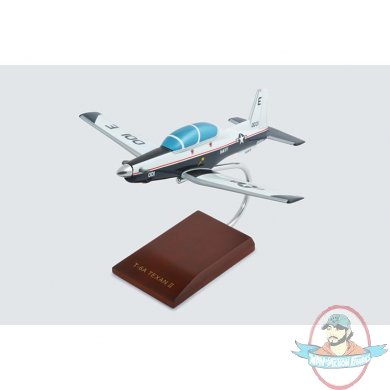
"Built by Raytheon, the T-6A Texan II is a turboprop aircraft of World War II used by the U.S. Air Force and U. S. Navy for their basic pilot training. Since World War II, the Texan has been a popular war bird and is a regular participant at air shows. The T-6A Texan II was manufactured by Raytheon Aircraft Company and Hawker Beechcraft. It is a single-engine with two seats designed to be a trainer aircraft. Its primary users are United States Air Force and Navy; Canadian Forces, and Greek Air Force. It entered development flight in July 1998, production line on the 30th of July 1999, and flight test program and full rate production decision in December 2001. The T-6A was primarily designed to train JPPT or Joint Primary Pilot Training students in basic flying skills common in the United States Air Force and Navy pilots. It was a military trainer version of the Beech/Pilatus PC-9 Mk II by Raytheon. The single cockpit with two seats placed one crewmember in front of the other. The students and the instructor’s positions can be interchangeable. Pilots can enter the T-6A cockpit through a side opening. The T-6A has a Pratt and Whitney Canada PT6A-68 turbo-prop that delivers 1,100 horsepower. It is fully aerobatic aircraft with a pressurized cockpit and an anti-G system. It also has an ejection seat and advanced avionics package with sunlight-readable liquid crystal displays. Since World War II the Texan has been known as a war bird and a regular participant in air shows"
Scale: 1/32 scale model
Wing Span: 12.38
Length: 12
AT06NYTR
|
"When the United States Air Force (USAF) set out to replace the aging T-6 Texan trainer, North American Aviation (NAA) was hired to do the job. The design presented by NAA was so successful that a contract for two prototypes was awarded. The USAF was impressed with the prototypes after an evaluation and an initial flight on September 24, 1949. The new aircraft, designated the T-28 Trojan, entered prodution the following year, becoming the first all-new post World War II trainer. It had a frameless canopy and piston engine, with a top speed that often exceeded 280 mph. It was the first trainer designed to transition pilots to jet aircraft. However, plans to utilize it for both basic and advanced training had to be changed when it turned out that the speed and power of the Trojan challenged new cadets too soon. After it became evident that the Air Force had found a very successful design, the US Navy and the US Marine Corps adopted the T-28 military trainer aircraft as well. It was used by the US armed forces from the 1950s to the 1980s. The Air Force has supplied T-28 planes to the Vietnam Air Force, the Royal Laotian Air Force and the Royal Thai Air Force. The Trojan served with the USAF as a tactical fighter-bomber for counter insurgency warfare in Southeast Asia, particularly in Vietnam and Laos, and proved to be an effective close air support weapon against enemy ground forces. The T-28 was the first US attack fixed wing aircraft that was lost in South Vietnam during the Vietnam War. Captain Robert L. Simpson and Lieutenant Hoa were shot down by ground fire on August 28, 1962 while flying close air support; neither survived. The USAF lost 23 Trojans to all causes during the war, with the last two losses occurring in 1968. "
Scale: 1/32 scale model
Wing Span: 15
Length: 12.25
AT28AT
|
"The T-28 Trojan was the basic trainer for both the Navy and Air Force. Like the T-6 Texan that it replaced in the early 50s, many were converted to ground attack variants and saw action in Vietnam. The T-28 Trojan, manufactured by North American Aviation (NAA), was designed as a piston-engined military trainer aircraft. The T-28 was flown for the first time, designed to replace the T-6 Texan, on September 24 1949. The first of two prototypes was flown on September 26, 1949. Found satisfactory, a contract was issued and between 1950 and 1957. There were a total of 1,948 aircrafts built. A number of these aircraft were later supplied to Air Forces in South America and South East Asia particularly in Japan, Argentina, Thailand, Laos, Philippines, and Brazil. The Trojan, as it became known, had a frameless canopy and a Wright R-1300 engine that, when combined, and gave it a top speed that often exceeded 280 mph. First orders of 266 planes in 1950 eventually grew to 1,194. After it became evident that the Air Force had found a very successful design, the United Sates Navy and Marine Corps adopted it as well. Two years later, 489 standardized versions (T-28Bs) were ordered by the Navy, mainly differing from the T-28A in its use of the more-powerful Wright R-1820-86 engine. Following this, 299 T-28Cs were produced, which were fitted with an arrester gear for carrier-deck landing training. "
Scale: 1/32 scale model
Wing Span: 15
Length: 12.25
AT28NT
|
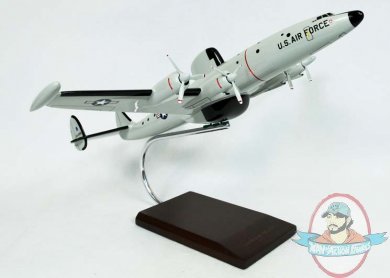
"The Warning Star is a US Air Force/US Navy airborne early warning radar surveillance aircraft manufactured by Lockheed, designed to serve as an airborne early warning system to supplement the Distant Early Warning Line. The RC-121D is the designation of EC-121D before 1962. The USAF operated three wings of EC-121s between 1954 and 1978. Its primary mission until the Vietnam War was to provide complementary early warning radar coverage to the Pacific and Atlantic barriers by flying orbits 300 miles offshore of the continental United States. The initial deployment of EC-121Cs began with the 551st Airborne Early Warning and Control Wing based at Otis Air Force Base, Massachusetts. The EC-121 Warning Star became operational on December 21, 1954 and was subsequently upgraded to EC-121D and later EC-121H. The EC-121s were used extensively in support of Operation Rolling Thunder and Operation Linebacker/Linebacker II, to provide radar early warning and limited airborne control of USAF fighter forces engaging MiG interceptors. The EC-121s were designed to detect aircraft flying over water and ground clutter caused interference with their radar pictures. The RC-121D has a typical flight crew of 6, with 11-25 radar crew. It has a maximum speed of 299 mph and a range of 4,250 mi. An RC-121D is currently on display at the Chanute Air Museum in Rantoul, IL. "
Scale: 1/72 scale model
Wing Span: 20.5
Length: 19.25
AVC121DT
|
The CG-4A Glider was the most widely used U.S. troop/cargo glider of WW II. Flight testing began in 1942 and eventually more than 12,000 CG-4As were procured. Fifteen companies manufactured CG-4As.
Scale: 1/56 scale model
Wing Span: 18
Length: 10
AWG
|
"The brainchild of Charles H. Zimmerman, the F5U was intended to perform well as a fighter plane while being able to remain in flight at extremely low airspeed, making it easier to operate from carriers. The F5U's unusual appearance owed to a very low aspect ratio wing without a fuselage, which resulted in something looking like a flying saucer. This shape, combined with powerful engines driving large propellers, could plow through the air at low speed (40 mph!), since the whole airframe is immersed in the prop wash. The XF5U Flying Pancake was manufactured by Vought. It was a fighter aircraft and the brainchild of Charles Zimmerman during World War II. Its maiden flight was on the 23rd of November 1942 and its production was cancelled on the 17th of March 1947. The XF5U was the most unusual aircraft designed for the U. S. Navy. It consists of a flat, somewhat disk-shaped body with a very low aspect ratio wing without fuselage that looks like a flying saucer. The Xf5U has two 1,600hp Pratt and Whitney R-2000 radial engines. Its configuration was designed to have a low aspect ratio aircraft that will have a low takeoff and landing speed and high top speed. It can accommodate only one, the pilot; it has a length of 28 ft 7 in; wingspan of 32 ft 6 in; height of 14 ft 9 in; empty weight of 13 107 lb, loaded weight of 16,722 lb. and max takeoff weight of 18,772 lb. It has a maximum speed of 425 mph; range of 1,064 miles; rate of climb 718 ft per minute; and service ceiling of 34,492 ft. It has 6 x .50 machine guns or 4 x 20 mm machine guns or 2 x 1000 lb bombs. Charles Lindbergh has successfully flown the first flight of the V-173 and he was surprised that it was easy to handle. The aircraft’s main problem was its gearbox which produces unacceptable amounts of vibration. Even the design was really promising. The U.S. Navy came to a point where they had to switch from propeller driven planes to jet propelled planes. "
Scale: 1/27 scale model
Wing Span: 14
Length: 12
AXF5U
|
"The Blue Angels chose the A-4 in the early '70s, replacing the thundering F-4. By adopting the Skyhawk, the team now had an aircraft that was much more aerobatic than before. This allowed for a tighter display and the ability to keep much of the performance in front of the audience. The A-4 Skyhawk was manufactured by Douglas Aircraft Corporation and was designed by Ed Heinemann. Its primary users are United States Navy and United States Marine Corps. Its maiden flight happened on the 22nd of June 1954 but it was introduced in 1956. The A-4 Skyhawk is a lightweight, single engine attack aircraft. It is said to be one of the most famous attack aircrafts ever designed. The short range attack and close support aircraft was originally intended for the U.S. Navy and Marine forces. The A-4F variant was a refinement of A-4E. It has extra avionics housed in a hump on the fuselage spine. Some of this variant served with Blue Angels acrobatic team during 1973 to 1986. The Blue Angels are the best U.S. military aerobatic team. They fly different kind of aircrafts including Grumman Hellcats, Bearcat, Panther, and the Skyhawk. The A-4 Skyhawk was chosen in the early 70s over F-4 as Skyhawk is said to be more fuel efficient than the Phantom. It was chosen because it was the aircraft that was more appropriate that time in the midst of an oil crisis. With the A-4 used by the team, different display was done. The Skyhawk was more aerobatic than the other aircraft. This allowed them to have a tighter display and be able to keep their performance in front of the audience. The pilots of the Blue Angels enjoyed flying the A-4 Skyhawk because it is easy to maintain and the accident rate was quite low. Eventually, there were new aircrafts that replaced the Skyhawk. It retired in 1976 for the U.S. Navy while in 1998 in U.S. Marine Corps. However it is still active in other countries."
Scale: 1/40 scale model
Wing Span: 11.75
Length: 17.25
CA04BA
|