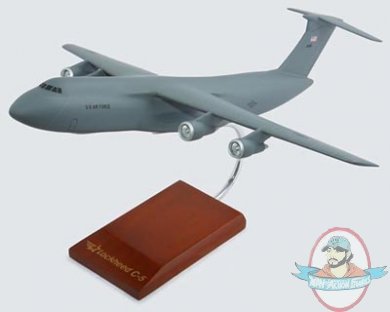
"The Lockheed C-5 Galaxy is a military transport aircraft, the largest in the American military and one of the largest in the world. It was designed to carry outsize and oversize cargo, providing strategic heavy airlift over intercontinental distances. Operated by the United States Air Force (USAF), it is one of the physically largest aircraft in the world that is capable of flying on a regular basis. In 1964, design proposals for a heavy jet transport were submitted by various companies in response to a US Army requirement. The new aircraft was set to replace the Douglas C-133 Cargomaster and complement the Lockheed C-141 Starlifter. In 1965, Lockheed's aircraft design and General Electric's engine design were selected. The first C-5A Galaxy rolled out of the manufacturing plant on March 2, 1968 and the aircraft's maiden flight was on June 30. The first operational Galaxy was delivered in June 1970. The C-5 has a distinctive high T-tail and is similar in appearance to its smaller sister transport the C-141. It is equipped for aerial refueling, giving it an extended range. Nose and aft doors permit “drive-through” loading and unloading of cargo. The Galaxy is capable of carrying nearly all of the Army's combat equipment, including the 74-ton armored vehicle launched bridge, from the United States to any location in the world. In the early 1970s, the C-5 was considered by NASA for the role of Shuttle Carrier Aircraft, which was tasked to transport the Space Shuttle to Kennedy Space Center. However, the Boeing 747 was chosen instead due in part to its low-wing design. From 1981 to 1987, 77 C-5As underwent a re-winging program to increase their lifting capability and service life after wing cracks were found throughout the fleet. The redesigned wings were made of a new aluminum alloy that did not exist during the original production. "
Scale: 1/150 scale model
Wing Span: 18
Length: 20
CC005GT
Pre-Order! Available: November
|
"The C-5 Galaxy, manufactured by Lockheed-Georgia Co., is a military heavy-cargo transport aircraft designed to provide strategic airlift for deployment and supply of combat and support forces over intercontinental distances. It is the largest American military transport and one of the largest military aircraft in the world, designed to carry outsize and oversize cargo. The C-5 is operated by the United States Air Force. The C-5 Galaxy is one of the physically largest aircraft in the world with the ability to fly on a regular basis. The original version of the C-5 is the C-5A. From 1969 to 1973, 81 C-5As were delivered to US Air Forces bases. Due to cracks found in the wings in the mid-1970s, the cargo weight was restricted. To restore the plane's full capability, the wing structure was redesigned. A program to install new strengthened wings on 77 C-5As was conducted from 1981 to 1987. The redesigned wing made use of a new aluminum alloy that didn't exist during the original production. An improved version of the C-5A is the C-5B. It incorporated all modifications and improvements made to the C-5A with improved wings, upgraded TF-39-GE-1C turbofan engines and updated avionics. From 1986 to 1989, 50 of the new variant were delivered to the US Air Force. "
Scale: 1/150 scale model
Wing Span: 18
Length: 20
CC005T
|
Scale: 1/100 scale model
Wing Span: 17.5
Length: 18.5
CE6BT
|
"The T-6 Texan is a single-engine advanced trainer aircraft used to train fighter pilots of the United States Army Air Forces, United States Navy, Royal Air Force and other air forces of the British Commonwealth during World War II. The T-6 is known by a variety of designations depending on the model and operating air force such as the ""AT-6"", the ""SNJ"" and ""Harvard"". The T-6 originates from the North American NA-16 prototype which was first sloen on April 1, 1935. The T-6 originated from the American NA-16 prototype which was modified as the NA-26 and entered USAC ""Basic Combat"" aircraft competition in March 1937. Production of the first model began and there were 180 supplied to the USAAC as the BC-1 and 400 to the RAF as the Harvard I. The US Navy received 16 modified aircraft, designated as the SNJ-1, and the 61 as the SNJ-2 with a different engine. The AT-6, which was equivalent to the BC-1A was designated as the Harvard II for RAF/RCAF orders and 1,173 were supplied by purchase or Lend Lease, mostly operating in Canada. Next comes the AT-6A, based on the NA-77 design powered by Pratt & Whitney R-1340-49 Wasp radial engine. The USAAF received 1,549 and the US Navy 270 (as the SNJ-3). It has a maximum speed of 208 mph at 5,000 ft and a range of 730 miles. The Texans were put into service during the Korean War and the Vietnam War. Texans had also been a regular participant in air shows and was used in many movies. "
Scale: 1/32 scale model
Wing Span: 10.75
Length: 15.75
AT06NYT
|
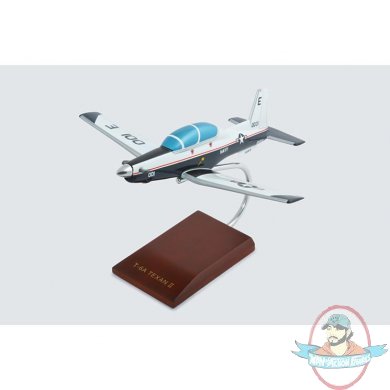
"Built by Raytheon, the T-6A Texan II is a turboprop aircraft of World War II used by the U.S. Air Force and U. S. Navy for their basic pilot training. Since World War II, the Texan has been a popular war bird and is a regular participant at air shows. The T-6A Texan II was manufactured by Raytheon Aircraft Company and Hawker Beechcraft. It is a single-engine with two seats designed to be a trainer aircraft. Its primary users are United States Air Force and Navy; Canadian Forces, and Greek Air Force. It entered development flight in July 1998, production line on the 30th of July 1999, and flight test program and full rate production decision in December 2001. The T-6A was primarily designed to train JPPT or Joint Primary Pilot Training students in basic flying skills common in the United States Air Force and Navy pilots. It was a military trainer version of the Beech/Pilatus PC-9 Mk II by Raytheon. The single cockpit with two seats placed one crewmember in front of the other. The students and the instructor’s positions can be interchangeable. Pilots can enter the T-6A cockpit through a side opening. The T-6A has a Pratt and Whitney Canada PT6A-68 turbo-prop that delivers 1,100 horsepower. It is fully aerobatic aircraft with a pressurized cockpit and an anti-G system. It also has an ejection seat and advanced avionics package with sunlight-readable liquid crystal displays. Since World War II the Texan has been known as a war bird and a regular participant in air shows"
Scale: 1/32 scale model
Wing Span: 12.38
Length: 12
AT06NYTR
|
"When the United States Air Force (USAF) set out to replace the aging T-6 Texan trainer, North American Aviation (NAA) was hired to do the job. The design presented by NAA was so successful that a contract for two prototypes was awarded. The USAF was impressed with the prototypes after an evaluation and an initial flight on September 24, 1949. The new aircraft, designated the T-28 Trojan, entered prodution the following year, becoming the first all-new post World War II trainer. It had a frameless canopy and piston engine, with a top speed that often exceeded 280 mph. It was the first trainer designed to transition pilots to jet aircraft. However, plans to utilize it for both basic and advanced training had to be changed when it turned out that the speed and power of the Trojan challenged new cadets too soon. After it became evident that the Air Force had found a very successful design, the US Navy and the US Marine Corps adopted the T-28 military trainer aircraft as well. It was used by the US armed forces from the 1950s to the 1980s. The Air Force has supplied T-28 planes to the Vietnam Air Force, the Royal Laotian Air Force and the Royal Thai Air Force. The Trojan served with the USAF as a tactical fighter-bomber for counter insurgency warfare in Southeast Asia, particularly in Vietnam and Laos, and proved to be an effective close air support weapon against enemy ground forces. The T-28 was the first US attack fixed wing aircraft that was lost in South Vietnam during the Vietnam War. Captain Robert L. Simpson and Lieutenant Hoa were shot down by ground fire on August 28, 1962 while flying close air support; neither survived. The USAF lost 23 Trojans to all causes during the war, with the last two losses occurring in 1968. "
Scale: 1/32 scale model
Wing Span: 15
Length: 12.25
AT28AT
|
"The T-28 Trojan was the basic trainer for both the Navy and Air Force. Like the T-6 Texan that it replaced in the early 50s, many were converted to ground attack variants and saw action in Vietnam. The T-28 Trojan, manufactured by North American Aviation (NAA), was designed as a piston-engined military trainer aircraft. The T-28 was flown for the first time, designed to replace the T-6 Texan, on September 24 1949. The first of two prototypes was flown on September 26, 1949. Found satisfactory, a contract was issued and between 1950 and 1957. There were a total of 1,948 aircrafts built. A number of these aircraft were later supplied to Air Forces in South America and South East Asia particularly in Japan, Argentina, Thailand, Laos, Philippines, and Brazil. The Trojan, as it became known, had a frameless canopy and a Wright R-1300 engine that, when combined, and gave it a top speed that often exceeded 280 mph. First orders of 266 planes in 1950 eventually grew to 1,194. After it became evident that the Air Force had found a very successful design, the United Sates Navy and Marine Corps adopted it as well. Two years later, 489 standardized versions (T-28Bs) were ordered by the Navy, mainly differing from the T-28A in its use of the more-powerful Wright R-1820-86 engine. Following this, 299 T-28Cs were produced, which were fitted with an arrester gear for carrier-deck landing training. "
Scale: 1/32 scale model
Wing Span: 15
Length: 12.25
AT28NT
|
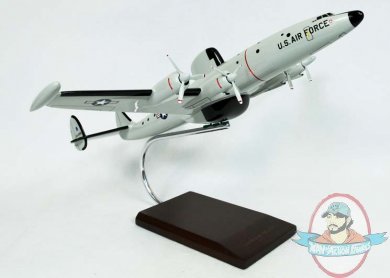
"The Warning Star is a US Air Force/US Navy airborne early warning radar surveillance aircraft manufactured by Lockheed, designed to serve as an airborne early warning system to supplement the Distant Early Warning Line. The RC-121D is the designation of EC-121D before 1962. The USAF operated three wings of EC-121s between 1954 and 1978. Its primary mission until the Vietnam War was to provide complementary early warning radar coverage to the Pacific and Atlantic barriers by flying orbits 300 miles offshore of the continental United States. The initial deployment of EC-121Cs began with the 551st Airborne Early Warning and Control Wing based at Otis Air Force Base, Massachusetts. The EC-121 Warning Star became operational on December 21, 1954 and was subsequently upgraded to EC-121D and later EC-121H. The EC-121s were used extensively in support of Operation Rolling Thunder and Operation Linebacker/Linebacker II, to provide radar early warning and limited airborne control of USAF fighter forces engaging MiG interceptors. The EC-121s were designed to detect aircraft flying over water and ground clutter caused interference with their radar pictures. The RC-121D has a typical flight crew of 6, with 11-25 radar crew. It has a maximum speed of 299 mph and a range of 4,250 mi. An RC-121D is currently on display at the Chanute Air Museum in Rantoul, IL. "
Scale: 1/72 scale model
Wing Span: 20.5
Length: 19.25
AVC121DT
|
The CG-4A Glider was the most widely used U.S. troop/cargo glider of WW II. Flight testing began in 1942 and eventually more than 12,000 CG-4As were procured. Fifteen companies manufactured CG-4As.
Scale: 1/56 scale model
Wing Span: 18
Length: 10
AWG
|
"The brainchild of Charles H. Zimmerman, the F5U was intended to perform well as a fighter plane while being able to remain in flight at extremely low airspeed, making it easier to operate from carriers. The F5U's unusual appearance owed to a very low aspect ratio wing without a fuselage, which resulted in something looking like a flying saucer. This shape, combined with powerful engines driving large propellers, could plow through the air at low speed (40 mph!), since the whole airframe is immersed in the prop wash. The XF5U Flying Pancake was manufactured by Vought. It was a fighter aircraft and the brainchild of Charles Zimmerman during World War II. Its maiden flight was on the 23rd of November 1942 and its production was cancelled on the 17th of March 1947. The XF5U was the most unusual aircraft designed for the U. S. Navy. It consists of a flat, somewhat disk-shaped body with a very low aspect ratio wing without fuselage that looks like a flying saucer. The Xf5U has two 1,600hp Pratt and Whitney R-2000 radial engines. Its configuration was designed to have a low aspect ratio aircraft that will have a low takeoff and landing speed and high top speed. It can accommodate only one, the pilot; it has a length of 28 ft 7 in; wingspan of 32 ft 6 in; height of 14 ft 9 in; empty weight of 13 107 lb, loaded weight of 16,722 lb. and max takeoff weight of 18,772 lb. It has a maximum speed of 425 mph; range of 1,064 miles; rate of climb 718 ft per minute; and service ceiling of 34,492 ft. It has 6 x .50 machine guns or 4 x 20 mm machine guns or 2 x 1000 lb bombs. Charles Lindbergh has successfully flown the first flight of the V-173 and he was surprised that it was easy to handle. The aircraft’s main problem was its gearbox which produces unacceptable amounts of vibration. Even the design was really promising. The U.S. Navy came to a point where they had to switch from propeller driven planes to jet propelled planes. "
Scale: 1/27 scale model
Wing Span: 14
Length: 12
AXF5U
|
"The Blue Angels chose the A-4 in the early '70s, replacing the thundering F-4. By adopting the Skyhawk, the team now had an aircraft that was much more aerobatic than before. This allowed for a tighter display and the ability to keep much of the performance in front of the audience. The A-4 Skyhawk was manufactured by Douglas Aircraft Corporation and was designed by Ed Heinemann. Its primary users are United States Navy and United States Marine Corps. Its maiden flight happened on the 22nd of June 1954 but it was introduced in 1956. The A-4 Skyhawk is a lightweight, single engine attack aircraft. It is said to be one of the most famous attack aircrafts ever designed. The short range attack and close support aircraft was originally intended for the U.S. Navy and Marine forces. The A-4F variant was a refinement of A-4E. It has extra avionics housed in a hump on the fuselage spine. Some of this variant served with Blue Angels acrobatic team during 1973 to 1986. The Blue Angels are the best U.S. military aerobatic team. They fly different kind of aircrafts including Grumman Hellcats, Bearcat, Panther, and the Skyhawk. The A-4 Skyhawk was chosen in the early 70s over F-4 as Skyhawk is said to be more fuel efficient than the Phantom. It was chosen because it was the aircraft that was more appropriate that time in the midst of an oil crisis. With the A-4 used by the team, different display was done. The Skyhawk was more aerobatic than the other aircraft. This allowed them to have a tighter display and be able to keep their performance in front of the audience. The pilots of the Blue Angels enjoyed flying the A-4 Skyhawk because it is easy to maintain and the accident rate was quite low. Eventually, there were new aircrafts that replaced the Skyhawk. It retired in 1976 for the U.S. Navy while in 1998 in U.S. Marine Corps. However it is still active in other countries."
Scale: 1/40 scale model
Wing Span: 11.75
Length: 17.25
CA04BA
|
"Manufactured by Douglas Aircraft Corporation and originally intended to operate from United States Navy (USN) aircraft carriers, the A-4 Skyhawk was designed by Ed Heinemann in response to the Navy's request for a jet-powered attack aircraft that would replace the A-1 Skyraider. Heinemann chose a design that would minimize size, weight and complexity. The result was an aircraft that weighed only half of the Navy's specification and had wings so compact that need not be folded for carrier stowage. The petite aircraft soon received the nicknames “Scooter”, “Bantam Bomber”, “Tinker Toy Bomber” and, in reference to its agility, “Heinemann's Hot-Rod”. The first prototype flew on June 22, 1954, and deliveries to the USN and US Marine Corps (USMC) began in late 1965. Production of the Skyhawk was put to a halt in 1979, and by then, a total of 2,960 aircraft had been built. The design of the Skyhawk is not uncommon among post-World War II planes. It had a delta wing, a tricycle undercarriage, a single turbojet engine in the rear fuselage and a cruciform tail. Armament included cannons and a large variety of bombs, rockets and missiles. The A-4 was the pioneer of the “buddy” self air-to-air refueling concept. This allows aircraft to supply fuel to others of the same type without the need for a dedicated tanker, and was particularly handy for small air arms or when operating in remote locations. In case of any hydraulic failure, the Skyhawk was also capable of emergency landing on drop tanks that were almost always carried by the aircraft. "
Scale: 1/32 scale model
Wing Span: 15.25
Length: 10.25
CA04MTE
|
"When the United States Navy (USN) set out to replace the piston-engined World War II-era A-1 Skyraider, the new attack aircraft needed to be all-weather and carrier-based. In 1957, the contract was awarded to Grumman, and the twin-engined A-6 Intruder was developed. The prototype made its first flight on April 19, 1960. The Intruder's career began in 1963 and would carry on for 34 more years. The A-6 was capable of low-level flying in all weather conditions, and its wings were very efficient at subsonic speeds. The aircraft's large, blunt nose and slender tail earned it a string of nicknames, including Double Ugly, The Mighty Alpha Six, Iron Tadpol, Drumstick and Pregnant Guppy. The Intruder was redesignated A-6A in the fall of 1962 and entered squadron service in February 1963. The A-6 became the Navy's and Marine Corps' principal medium and all-weather/night attack aircraft from the mid-1960s until the 1990s. The Intruder first saw combat during the Vietnam War, where it was used extensively against targets in Vietnam. The aircraft's ability to fly in any weather condition, long range and heavy payload of 8,170 kg made it invaluable during the war. However, its effectiveness in flying low and delivering its payload made it especially vulnerable to anti-aircraft fire. In the eight years that the A-6 was used during the war, the USN and USMC (United States Marine Corps) lost 84 aircraft to all causes. Ten were shot down by surface-to-air missiles, 2 were destroyed by Red Chinese Shenyang J-6s, 16 were lost to operational causes, and the remaining 56 were lost to conventional ground fire and anti-aircraft artillery. "
Scale: 1/48 scale model
Wing Span: 13.5
Length: 13.25
CA06NHVTR
|
"The A-7 Corsair II is a carrier-based subsonic light attack aircraft and was one of the first combat aircraft produced by Chance Vought. The A-7 was one of the first combat aircraft featuring a head-up display (HUD), doppler-bounded inertial navigation system and a turbofan engine. The A-7 first entered service with the US Navy during the Vietnam conflict and was then adopted by the United States Air Force. The A-7 Corsair II was nicknamed as ""SLUF"" (Short Little Ugly Feller) by pilots. The A-7s were used as a deception aircraft by the group between 1981 and 1989. The A-7B has a general ease of flying and excellent forward visibility but lacks in engine thrust. The A-7B incorporates a TF30-P-8 engine with 12,190 lbf of thrust. An A-7 donated from the National Museum of Naval Aviation at Pensacola Florida is located on the side of the road just outside Lake City, Florida. An A-7 can also be found at at Akron-Canton airport hangar at MAPS air museum in Akron, Ohio. There is also one mounted at the Atlanta Road side of Naval Air Station Atlanta in Marietta, Georgia. Another A-7 is on display at Tillamook Air Museum and another A-7 is located behind a fence in the parking lot of the Evergreen Aviation Museum in McMinnville, Oregon. There were many A-7s which survived. In 1971, A-7Bs which survived were further upgraded to TF30-P-408 with 13,390 lbf of thrust and there were 196 A-7Bs built. "
Scale: 1/40 scale model
Wing Span: 13.88
Length: 11.5
CA07NTE
|
"The American-manufactured AV-8B Harrier jet fighter of British design is on active duty with the Marines. It can take off vertically from the deck of a ship or forest clearing, and then accelerate to nearly the speed of sound. The AV-8B Harrier was a Short Take Off and Vertical Landing strike aircraft. It was manufactured by McDonnell Douglas, Boeing and BAE Systems. Its maiden flight was on the 09th of November 1978 and introduced on the 12th of January 1985. Its primary users are U.S. Marine Corps; Royal Air Force and Navy; Spanish Navy; and the Italian Navy. This aircraft was developed from Hawker Siddeley Harrier and BAE Sea Harrier. The AV-8B was a single-seat, light attack aircraft that provide offensive air support to the Marine Air-Ground Task Force or MAGTF. Its primary function was to attack and destroy surface targets under day and night visual conditions. It can operate from a variety of ships, forward sites such as roads, and many others. The AV-8B Harrier only accommodates one flight crew. It has a length of 46.3 ft; wingspan of 30.3 ft; cruise speed of Subsonic to transonic; and ferry range of 2100 nautical miles. It has armament of one fuselage-mounted 25 mm gun system; Standard air-to ground load: six Mk 82,500 pound bombs; standard air-to-air load: four AIM-9L/M sidewinder missiles; and provisions for carrying up to 9,000 pounds of ordinance on seven stations. The AV-8B tasks includes the conducting of close air support using conventional and specific weapons; to conduct deep air support; to conduct offensive and defensive antiair warfare; and many others."
Scale: 1/30 scale model
Wing Span: 12
Length: 18.4
CAH1
|
"The McDonnell Douglas AV-8B Harrier II is a family of second-generation vertical/short takeoff and landing jet multirole aircraft of the late 20th century. Developed from the earlier Hawker Siddeley Harriers, it is primarily used for light attack or multi-role tasks, typically operated from small aircraft carriers. Versions are used by several NATO countries, including the United Kingdom, Spain, Italy, and the United States. Though it shares the designation letter number with the earlier AV-8A Harrier, the AV-8B Harrier II was extensively redesigned by McDonnell Douglas. Both models are commonly referred to as the Harrier Jump-jet. The AV8B had its direct origins in a joint British-US project (Hawker-Siddeley and McDonnell Douglas) for a much-improved Harrier aircraft, the AV-16. However the British later pulled out of the program. Using things learned from AV-16 development, McDonnell continued the development work which lead to the AV-8B for the US Marine Corps. The aircraft was centered on the Marines' need for a light ground attack airplane and focused on payload and range as opposed to speed. The first Harrier IIs produced were commonly known as the Day Attack variant, and are no longer in service. Most were upgraded to Night Attack Harrier or Harrier II Plus standards, with the remainder being withdrawn from service. Several variants of the Harrier are used by four countries' military forces: the United Kingdom, the United States, Spain and Italy. The US Marine Corps has operated the AV-8B since 1985. "
Scale: 1/48 scale model
Wing Span: 7.38
Length: 11.25
CAH1TR
|
"The AT-38B Aggressor Northrop was one of the variants of the Northrop T-38 Talon, the world’s first and most produced supersonic trainer. The T-38 is still in service at present time with the Air Forces. The AT-38B Aggressor Northrop aircraft has a conventional configuration and it has a small, low, long chord wing, a single vertical stabilizer and a tricycle undercarriage. The T-38 first flew in 1959 and there were more than 1100 Talon aircrafts delivered to the Air Force from 1961 to 1972. The AT-38B Aggressor Northrop was used by the Air Educational and Training Command to prepare pilots for front line fighter and bomber aircraft such as the F-15E Strike Eagle, F-15C Eagle, F-16 Fighting Falcon, B-1B Lancer, A-10 Warthog and F/A-22 Raptor. The AT-38B Aggressor Northrop is an advanced and super sonic flight trainer aircraft which was also used as a fighter lead. It is the very first aggressor aircraft. The AT-38B was ordered by the US Air Force in 1950. The AT-38B Aggressor Northrop aircraft was much less expensive to operate because the LIFT program had reduced its cost. The LIFT program ended in 1993 when the USAF integrated the training with the UPT. "
Scale: 1/48 scale model
Wing Span: 5.5
Length: 11.25
CAT38T
|
"The AT-6 ""Texan"" advanced trainer, built by North American, is one of the most widely used aircraft in history. Also known as ""the pilot maker"", 15,495 Texans were built between 1938 and 1945. The U.S.A.A.F. procured 10,057 AT-6's; others went to the Navy as SNJ's and to more than 30 Allied nations. Most AAF fighter pilots trained in AT-6's prior to graduation from flying school. Many of the ""Spitfire"" and ""Hurricane"" pilots in the Battle of Britain trained in Canada in ""Harvards,"" the British version of the AT-6. To comply with neutrality laws, U.S. built Harvards were flown north to the border and were pushed across. In 1948, Texans still in USAF service were redesignated as T-6's. To meet an urgent need for close air support of ground forces in the Korean Conflict, T-6's flew ""mosquito missions"" spotting enemy troops and guns and marking them with smoke rockets for attack by fighter-bombers. More than 360 T-6's are still flying."
Scale: 1/32 scale model
Wing Span: 15.75
Length: 10.75
AT06AYT
|
"The Curtiss SB2C Helldiver was a single-engine, carrier-based dive bomber produced for the United States Navy (USN). It was the Navy's principal dive bomber during the latter part of World War II. Despite a reputation for being difficult to handle at low speeds, it was responsible for the destruction of more Japanese targets than any other aircraft. The Helldiver's good speed and range made it an essential tool in the far reaches of the Pacific Theater. Developed to replace the Douglas SBD Dauntless in USN service, the SB2C was able to carry a considerable array of armament and featured an internal bomb bay that reduced drag when carrying heavy ordnance. Due to demanding requirements set forth by both the Marines and the Army Air Forces, Curtiss incorporated features of a multi-role aircraft into the design. After the crashing of two prototypes, numerous modifications were specified for the production model. The size of the fin and rudder was enlarged, and fuel capacity and fixed armament were also increased. A total of 7,140 aircraft were produced during World War II. After suffering many delays due to the modifications, the Helldiver finally entered combat on November 11, 1943 on USS Bunker Hill, attacking the Japanese-held port of Rabaul in Papua New Guinea. By mid-1944, it had completely replaced the SBD. Although the SB2C had already entered naval service, it still had structural problems that forbid the aircraft crews from performing one of its main tasks, that is dive bombing in clean conditions. Following the Marianas operation in June and July of 1944, SB2C squadrons participated in the advance through the western Pacific to Okinawa and the Japanese home islands. After the Second World War, the Helldiver continued to serve in USN carrier bombing/attack squadrons until early 1949. Foreign use of the aircraft included employment by the Greek Air Force in the country's civil war of 1949, and carrier operations over Indochina by the French Navy from 1951 to 1954. It also saw service with the Royal Thai Air Force, and with France, Italy and Portugal for anti-submarine warfare. "
Scale: 1/32 scale model
Wing Span: 18.5
Length: 14
ASB2CT
|
"The Douglas SBD Dauntless, nicknamed ""Barge"", ""Clunk"" or ""Slow but Deadly"" and was the standard carrier-borne dive-bomber of the US Navy from mid-1940 until November 1943, when the Curtiss Helldiver replaced it. The SBD was gradually phased out during 1944, and the 20 June 1944 strike against the Japanese Mobile Fleet in the Battle of the Philippine Sea was its last major action as a carrier-borne aircraft. Total of nine Douglas SBD-5 Dauntless Mk 1 were received by the Fleet Air Arm under contract No. The first Dauntless, JS997, was delivered from Speke to the IAD Flight of the Royal Aircraft Establishment (RAE) in November 1943, where it carried out handling and dive bombsight tests (JS997). The Dauntless was subsequently equipped at Wittering by 787 and 700 squadrons from July 1944 till February 1946. The SBD-5 model was the standard aircraft carrier based dive-bomber of the US Navy from mid-1940 until November 1943, when it was replaced by the Curtis SB2C Helldiver. This model of SBD Dauntless was considered obsolete even before the Pacific War started, and was supposed to be retired before Pearl Harbor occurred. Needless to say this did not happen. The SBD went on to be one of the most famous dive bombers in existence (next to the Stuka), and this was mostly due to extreme luck during the Battle of Midway."
Scale: 1/32 scale model
Wing Span: 15.5
Length: 12.5
ASBDT
|
"The SPAD S.XIII was a French biplane fighter aircraft of World War I, developed by Société Pour L'Aviation et ses Dérivés (SPAD) from the earlier highly successful SPAD S.VII. It was one of the most capable fighters of the war, and one of the most-produced, with 8,472 built. The S.XIII first flew on April 4, 1917, and was delivered to the French Air Service the following month. Other Allied forces were quick to adopt the new fighter as well, and nearly half of the 893 purchased for the United States Army Air Service were still in service in 1920. The S.XIII was exported to Japan, Poland, and Czechoslovakia after the war. Famous French fighter pilots such as Georges Guynemer and Rene Fonck flew the S.XIII, as well as Italy's Francesco Baracca and the United States Army Air Service's Eddie Rickenbacker. "
Scale: 1/20 scale model
Wing Span: 15.75
Length: 12.25
ASPRTE
|
"The Texan remains a favorite trainer aircraft among warbird collectors around the world. Texans are manufactured by North American Aviation for training fighter pilots of the United States Army Air Forces, United States Navy, Royal Air Force and other air forces of the British Commonwealth during World War II. The T-6 is has many designations depending on the model and operating air force and the USAAC called it as T-6. The first AT-6 built was in 1938. It incorporates a Pratt & Whitney R-1340-AN-1 Wasp radial engine w/600 h.p. The AT-6 is fitted with a single fixed .30 cal. machine gun, used for basic aerial and air-to-ground gunnery training. The AT-6G has a crew of two, a student and an instructor. It has a maximum speed of 208 mph at 5,000 ft and a range of 730 miles. Ever since World War II, the T-6 has been a regular participant at air shows and was featured in many movies. There are over 15,000 AT-6's built with over 1,200 still in existence. "
Scale: 1/32 scale model
Wing Span: 15.75
Length: 10.75
AT06AY1T
|
"The P-38J Pudgy aircraft was flown by Thomas McGuire and won 38 victories, second to the lightning called “Marge”. The aircraft was developed for the United States Army Air Corps to be one of the American fighter aircrafts during the Second World War. The P-38J Pudgy was designed by Clarence “Kelly” Johnson in response to the Army specification for an aircraft that can reach 20,000 feet in 6 minutes. The P38 had its unique twin booms with forward-mounted engines. It was the only American fighter with twin booms during World War II. It was most used for bombing and reconnaissance missions and in theaters of war such as the Pacific Theater and the China-Burma-India Operations. The P-38 is said to be one of the best American fighter planes of the Second World War. "
Scale: 1/32 scale model
Wing Span: 19.5
Length: 14.25
AP38PUTS
|
"The Curtiss P-40 Warhawk was an American single-engine, single-seat, low-wing, all-metal fighter and ground attack aircraft manufactured by Curtiss-Wright Corporation. In the 1930s and 1940s, the P-40 Warhawk fighter bomber was the last of the famous ""Hawk"" line, and it shared certain design elements with its predecessors, the Hawk and Sparrowhawk. Warhawk was the name the United States Army Air Corps adopted for all models, making it the official name in the United States for all P-40s. It was the third-most numerous US fighter of World War II. An early prototype version of the P-40 was the first American fighter capable of speeds greater than 300 mph. Design work on the aircraft began in 1937, but numerous experimental versions were tested and refined before the first production version of the P40, the Model 81, appeared in May 1940. By September of that year, over 200 had been delivered to the Army Air Corps. 185 more were delivered to the United Kingdom in the fall of 1940, where they were designated the Tomahawk Mk I. P-40s first saw wartime service with the British Commonwealth squadrons of the Desert Air Force in August 1941. The P-40E, also called the ""Kittyhawk"" and ""Tomahawk"" in England and Canada, was a modified version of the earlier P-40 Warhawk. The P-40E had six machine guns and 700 lbs. of external bombs. P-40E was an accurate scale rendition of an actual Flying Tiger aircraft used during World War II, but its realistic scale looks don't hinder its outstanding sport flight performance. In the Philippines, Lt. Boyd D. Wagner became the first American ace of World War II while flying a P-40E when he shot down six Japanese aircraft during mid-December 1941. Produced until 1944, P-40s were used by the Air Forces of 28 nations and gained reputation for its high durability and toughness. A total of 2,320 P-40E Warhawk were built. "
Scale: 1/32 scale model
Wing Span: 14.5
Length: 12.25
AP40T
|
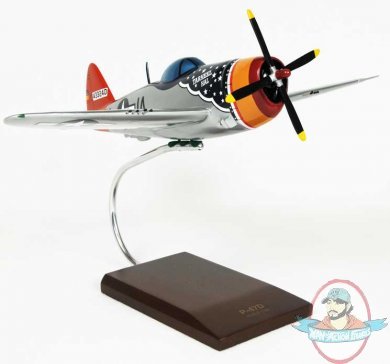
"The P-47 Thunderbolt is the largest single-engined fighter of the United States Army Air Force (USAAF) fighters of World War II and was manufactured by Republic Aviation. The P-47 Thunderbolt was the product of Russian immigrant Alexander de Seversky and Georgian immigrant Alexander Kartveli, who had left their homelands to escape the Bolsheviks. The P-47s maiden flight was on May 6, 1941 and was introduced in 1942. Initial deliveries of the P-47s to the USAAF were to the 56th Fighter Group on Long Island. In 1942, P-47s prepared for combat operations in England. The first P-47 combat mission started in March 10, 1943 and the mission failed due to radio malfucntions. The P-47 gradually became the best fighter-bomber which could carry 500 pound bombs, the triple-tube M-8 4.5 inch rocket launchers and eventually HVARS. P-47s were operated by several Allied air arms during World War II. There's a large number of surviving airframes exist in flying condition as well as in museum collections worldwide. A total of 15,686 P47s built. "
Scale: 1/32 scale model
Wing Span: 15.5
Length: 14
AP47T
|
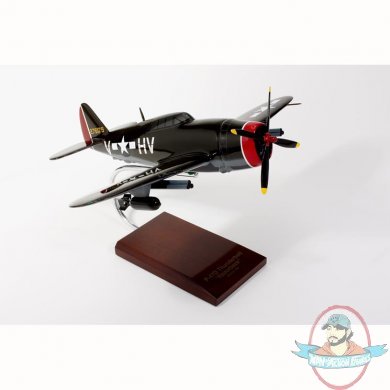
"The P-47 Thunderbolt is the largest single-engined fighter of the United States Army Air Force (USAAF) fighters of World War II and was manufactured by Republic Aviation. The P-47 Thunderbolt was the product of Russian immigrant Alexander de Seversky and Georgian immigrant Alexander Kartveli, who had left their homelands to escape the Bolsheviks. The P-47s maiden flight was on May 6, 1941 and was introduced in 1942. Initial deliveries of the P-47s to the USAAF were to the 56th Fighter Group on Long Island. In 1942, P-47s prepared for combat operations in England. The first P-47 combat mission started in March 10, 1943 and the mission failed due to radio malfucntions. The P-47 gradually became the best fighter-bomber which could carry 500 pound bombs, the triple-tube M-8 4.5 inch rocket launchers and eventually HVARS. P-47s were operated by several Allied air arms during World War II. There's a large number of surviving airframes exist in flying condition as well as in museum collections worldwide. A total of 15,686 P47s built. "
Scale: 1/32 scale model
Wing Span: 13.63
Length: 15.5
AP47TE
|
"The P-51D Mustang Old Crow was an American fighter aircraft which was most widely produced by Mustang. The P-51D was equipped with a larger canopy and an aero products propeller to replace the Hamilton Standard propeller. The Old Crow arrived in Europe in mid 1944 and quickly became the primary USAAF fighter in the theater. In the same year, 1944, Captain Clarence Anderson returned to the 375th Fighter Group for a second combat tour. He was assigned a new P-51D Old Crow in the dark green mask. Captain Bud was on a mission when the first drop of snow in Germany fell. Thus he noted a mixed flight of dark green and silver aluminum Mustangs below him. After his mission, he told his ground crew that the one painted the dark green stood out against the snow background and silver ones appeared to the have the best camouflage. Because of that Bud suggested to paint the Old Crow silver color the next time it was down for heavy maintenance. The next morning, Captain Bud arrived at the station to find his P-51D Old Crow to use for his mission. To his surprise he found the Old Crow in a gleaming aluminum paint scheme ready for flight. Three members of his crew worked on it through the night scrapping, rubbing and remarking. They were all tired and their hands were raw due to the cold and solvents they used. The change made to P-51D Old Crow was dedicated to Bud Anderson and all 357th crew chief and ground support personnel who maintained the P-51 Mustang during World War II. "
Scale: 1/24 scale model
Wing Span: 18.25
Length: 16.2
AP51OCTS
|
This REAL.BIG. Fathead Wall Graphic is a high definition image made of tough high-grade vinyl that's tear and fade resistant, so you can be assured your eye catching Fathead will stay strong. And if the thought of taking down your Fathead makes you want to cry, don't worry, because it uses a low-tack adhesive that can be moved and reused without any damage to your wall. As if it couldn't get any better, your Fathead comes with free separate smaller images (made of the same stuff) to go with your awesome new wall graphic. You can stick ‘em near your REAL.BIG. or use ‘em to decorate another space.
Dimensions : 3'2" W x 7'6" H
|
This REAL.BIG. Fathead Wall Graphic is a high definition image made of tough high-grade vinyl that's tear and fade resistant, so you can be assured your eye catching Fathead will stay strong. And if the thought of taking down your Fathead makes you want to cry, don't worry, because it uses a low-tack adhesive that can be moved and reused without any damage to your wall. As if it couldn't get any better, your Fathead comes with free separate smaller images (made of the same stuff) to go with your awesome new wall graphic. You can stick ‘em near your REAL.BIG. or use ‘em to decorate another space.
Dimensions : 4'7" W x 2'1" H
|
This REAL.BIG. Fathead Wall Graphic is a high definition image made of tough high-grade vinyl that's tear and fade resistant, so you can be assured your eye catching Fathead will stay strong. And if the thought of taking down your Fathead makes you want to cry, don't worry, because it uses a low-tack adhesive that can be moved and reused without any damage to your wall. As if it couldn't get any better, your Fathead comes with free separate smaller images (made of the same stuff) to go with your awesome new wall graphic. You can stick ‘em near your REAL.BIG. or use ‘em to decorate another space.
Dimensions : 3'5" W x 4'2" H
|