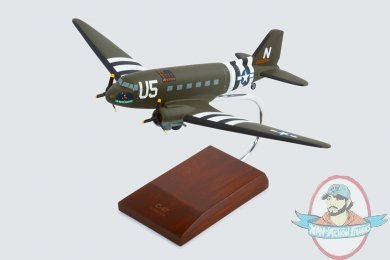
The Douglas C-47 Skytrain is a military transport aircraft that was developed from the Douglas DC-3 airliner. It was used extensively by the Allies during World War II and remained in front line operations through the 1950s with a few remaining in operation to this day.
This model is personally signed by William “Wild Bill” Guarnere from the Band of Brothers. He earned the nickname "Wild Bill" and lived up to it; he was terror on the battlefield and had a reckless attitude towards the Germans. Guarnere received the Silver Star for combat during D-Day, and was later decorated with two Bronze Stars and two Purple Hearts. Certificate of Authenticity included.
This handcrafted model is painstakingly built from Philippine mahogany by our skilled craftsmen with a wealth of detail and makes a great gift for any veteran, aviation enthusiast or history buff.
Scale: 1/62 scale
Wing Span: 18
Length: 13
AC047BBSS
|
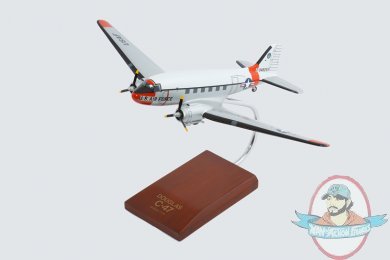
"The C-47 Skytrain is a military transport based and developed from the DC-3 and was used extensively in world War II. It was manufactured by Douglas Aircraft Company. The C-47 has proven itself for the success of many Allied campaigns, including Guadalcanal, New Guinea and Burma with its ability to counter the mobility of the light-traveling Japanese army. The C-47s were also used to airlift supplies to the embattled American forces during the Battle of Bastogne. The C-47 became notable for flying The Hump from India into China. From 1946 to 1947, the C-47s saw service with the USAF Strategic Air Command. The C-47 was also used by the Americans during the initial stages of the Berlin Airlift and subsequently, it was replaced by the C-54. The C-47 also played various roles including the AC-47 gunships and the EC-47 for counterintelligence during the Vietnam War. The C-47 was also acquired by the Royal Canadian Air Force for search and rescue operations in 1940-1950. The C-47A is a variant of the C-47 with a 24-volt electrical system and there were 5,254 C-47As built. The primary users of the C-47 are the U.S. Army Air Force, U.S. Air Force and Royal Air Force."
Scale: 1/72 scale model
Wing Span: 16
Length: 11
|
"The Douglas C-47 Skytrain is a military transport derived from the DC-3 airliner. Considered the greatest airplane of its time, the DC-3 did not go unnoticed by one of Douglas's oldest customers, the United States Army. In 1940, a large order was placed for the military DC-3, which was designated C-47. By 1941, the US Army Air Force had selected the C-47 as its standard transport aircraft. A reinforced fuselage floor and the addition of a large cargo door were the only major modifications. For both airline and military use, the aircraft proved to be tough, flexible, and easy to operate and maintain. As a supply plane, the C-47 can carry up to 6,000 pounds of cargo. It can also hold a fully assembled jeep or a 37 mm cannon. As a troop transport, it can carry 28 soldiers in full combat gear. As a medical airlift plane, it can accommodate 14 stretcher patients and three nurses. The ubiquity of the Skytrain and its ability to operate from very rough forward airstrips made it familiar to Allied forces stationed around the world. It not only pioneered in-theater wartime routes but also served as a VIP transport, general personnel transport, troop carrier, cargo transport, paratroop assault transport, glider tug, airborne ambulance, air-sea rescue craft, and special operations aircraft. "
Scale: 1/72 scale model
Wing Span: 16
Length: 11
AC047ST
|
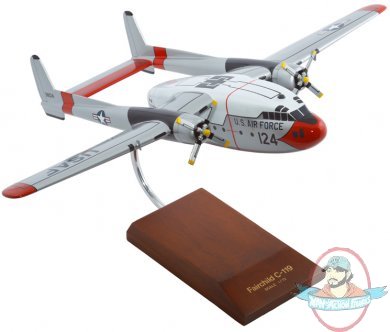
The Fairchild AC-119G Shadow was a twin-engine piston-powered gunship developed by the United States during the Vietnam War. By late 1967, the idea of the fixed-wing gunship had been proven so successful that the United States Air Force was having a difficult time keeping up with demand. These aircraft were primarily intended to replace the AC-47 in the close air support role. and were placed in the 71st Special Operations Squadron (SOW). They were used by the SOW from 1969–1971.
This handcrafted model is painstakingly built from Philippine mahogany by our skilled craftsmen with a wealth of detail and makes a great gift for any veteran, aviation enthusiast or history buff.
Wing Span: 18.75
Length: 14.75
AC119T
|
"The B-26 Marauder is an American Second World War twin engine medium bomber made by the Glenn L. Martin Company. In 1942, it was the first bomber in the Pacific Theater and Aleutian Islands. In 1946, it was the main offensive weapon of the Western Front by the Army Air Force. The B-26B sustained the lowest record of any fighter aircraft during the war. Its loss earned its unofficial nickname “The Widowmaker.” There were 5,288 aircrafts produced between the years 1941 to 1945. The Royal Air Force and the South African Air Force used 522 of them. The B-26B Marauder first came out in May 1942. It was the Marauder model that was built in large numbers. The difference between the B-26B from the earlier versions of the Marauder aircrafts is the two .50 inch machine guns with 1500 rpg placed in a stepped down tail position. It replaced the B26 and B-26A single hand-held guns. The guns are used manually by bead sight and ring. The gunner kneels down to find his targets and shoots his armaments. The ammos are on the cartridge belts standing on a pair of roller tracks. Each of the guns has 800 rounds. The overall length was increased to 58 feet and 3 inches because of its new tail position. The B-26C was similar to the B-26B. But all B-26C aircrafts were made with a larger wing. In fact, it was the first Marauder version to show with a larger wing. The wing was showed on the Omaha line before it showed on the Baltimore line. Its wing span turned to 712 feet and the area of the wing increased to 713 sq. ft. The modifications made, such as the additional weapons and armor and its enlarged wing and tail assembly, increased the weight by 1500 lbs. The top speed at 15,000 feet decreased to 282 miles per hour and cruising speed decreased to 214 miles per hour."
|
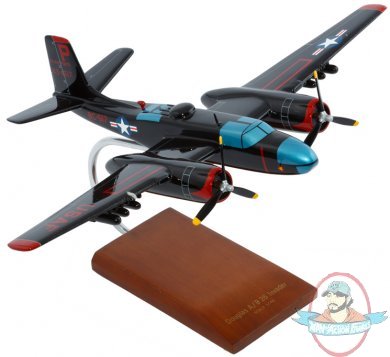
The A-26 Invader (designated B-26 between 1948–1965) was a United States twin-engined light attack bomber built by the Douglas Aircraft Co. during WWII. The B-26 was an unusual design for an attack bomber of the early 1940s period, as it was designed as a single-pilot aircraft. It was found to be a fast aircraft which was capable of carrying twice its specified bomb load.
This handcrafted model is painstakingly built from Philippine mahogany by our skilled craftsmen with a wealth of detail and makes a great gift for any veteran, aviation enthusiast or history buff.
Scale: 1/48 scale model
Wing Span: 16.5
Length: 13.5
AB26T
|
"The B-29 Enola Gay is the most complicated and propeller-driven bomber aircraft in the Second World War. The crew quarters are in the b29's pressurized compartments and the aircraft has highly developed armaments and avionics systems. It brought the first nuclear weapons used in the Pacific Theater war. Colonel Paul W. Tibbets Jr. dropped the first atomic bomb “Little Boy” in Hiroshima, Japan. The strategies for the first atomic bombing were set in August 1945. There were seven Superfortress aircrafts, three of which were to scout in front. One of them is to measure the blast of the bomb, and one photo plane is assigned to be the standby plane and the primary plane. The aircraft’s bombing is visual not radar. They used it to target the cities of Hiroshima, Kokura, Niigata and Nagasaki. Paul Tibbet’s own aircraft decided to name it “Enola Gay” after his loving mother. This gave him inspiration while he was building it. The Enola Gay allows 12 crewmen. In the afternoon of August 5, the Americans placed the bomb into the Enola Gay plane. The “Little Boy” atomic bomb is 12 feet long and 28 inches in diameter. Its power matches up 20,000 tons of TNT or approximately as much as two thousand Superfortress aircrafts could take. They started their engines in August 6, 1945 at 2:30 AM. Three hours after, they flew over Iwo Jima at dawn, where 5,500 Americans and 25,000 Japanese had died, so that the USAAF could use Iwo as an emergency landing field. They altered course and went northwest. They climbed to 30,700 feet for their bombing altitude. And at 8:30 they got a coded message saying Hiroshima was covered with clouds. At 9:15AM they dropped the ""Little Boy"" and made a 155 degree diving turn to the right. "
AB29ET
|
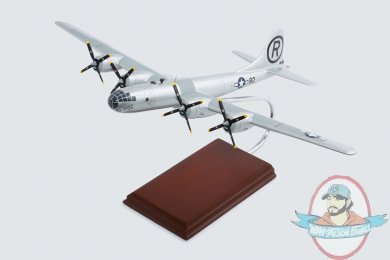
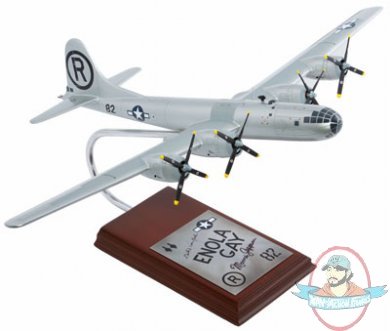
The Boeing B-29 was the most complex aircraft of the first part of the century. Service delivery of the B-29 began in 1944, with the first combat mission flown on June 5, 1944. This specific B29 model is painted as “Enola Gay,” which was the aircraft that dropped the atomic bomb “Little Boy” during the final stages of World War II.
This model is personally signed by Theodore “Dutch” Van Kirk, Enola Gay Navigator, and Morris Jeppson, Weapons Test Officer. Unfortunately Jeppson passed away in March 2010, leaving Van Kirk as the last living survivor from the crew. Certificate of Authenticity included.
This handcrafted model is painstakingly built from Philippine mahogany by our skilled craftsmen with a wealth of detail and makes a great gift for any veteran, aviation enthusiast or history buff.
Scale: 1/72
Wing Span: 23.75
Length: 17.00
AB29TSS
|
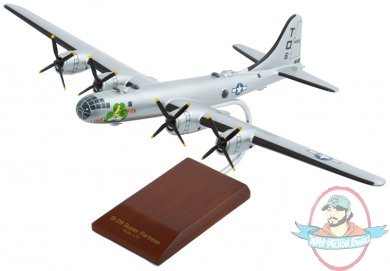
The B-29 Superfortress is a four-engine propeller-driven heavy bomber. It was one of the largest aircraft to see service in World War II and a very advanced bomber for its time, with features such as a pressurized cabin, an electronic fire-control system, and remote-controlled machine-gun turrets. Originally the B-29 was designed as a high-altitude daytime bomber, but it was used extensively in low-altitude night-time incendiary bombing missions. It was the primary aircraft used in the American firebombing campaign against the Empire of Japan in the final months of World War II and was used to carry out the atomic bombings that destroyed Hiroshima and Nagasaki.
This specific B-29 model is painted as "Lucky 'Leven", Clinton Rogers' airplane. He was part of the 73rd Bomb Wing and was stationed on the island of Saipan; Rogers and his crew flew 39 bombing missions over Japan and other Pacific islands.
This handcrafted model is painstakingly built from Philippine mahogany by our skilled craftsmen with a wealth of detail and makes a great gift for any veteran, aviation enthusiast or history buff.
Scale: 1/72 scale model
Wing Span: 23.75
Length: 17
AB29T
|
"Six pusher radial engines, mounted on the trailing edge of the wings, powered this big long-range SAC bomber. The D, ""burn and turn"", model was boosted by a pair of turbojet pods under the outer wings. A strategic bomb built by Convair for the United States Air Force. The Convair B36 Peacemaker is said to be the very first bomber that had intercontinental range and was also the first thermonuclear weapon delivery vehicle. The Peacemaker was the largest combat aircraft ever built. Its 230 foot wingspan is almost fifty percent longer than that of the huge B-52 that replaced it. The B-36 was one of America’s major deterrents to violence by a prospective adversary for eight years. From 1948 to 1958, the B-36 became part of the USAF Strategic Air Command. Major General Henry Arnold described the B-36 as the plane that could “fly the skin off any rivals”. The Peacemaker was also the first Cold War Bomber. Unlike any other aircraft that were seen in wars dropping bombs or firing an enemy, the B-36 was never seen in any of these actions. Instead, the Peacemaker was closest seen during the 1956 Hungarian Revolution and the Suez Crisis where it was dispatched to Turkey and Morocco. Thus, the Peacemaker is famous for never having fired a shot in anger and the plane that kept peace for ten long years. The B-36 Peacemaker was also involved in two aircraft collapse incidents, one was last February 13, 1950 in an unpopulated region of British Columbia and it was the first loss of an American Nuclear Weapon. The other one was on May 22, 1957 when a B-36 accidentally dropped a bomb on a deserted area while landing at Kirtland AFB in Albuquerque. A total of 388 B-36 Peacemakers were produced. The last one was built on August 1954. Then on June 29, 1955 the first B-52 was delivered to SAC. All Peacemaker models were delivered and converted to J models on which two jet engines were added to each wing. The last B-36 Peacemaker made its final flight in 1959."
AB36
|
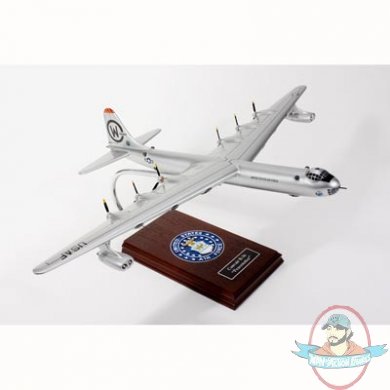
The B-36 "Peacemaker" was a strategic bomber built by Convair and operated solely by the United States Air Force from 1949 to 1959. The B-36 was the largest mass-produced piston engine aircraft ever made. It had the longest wingspan of any combat aircraft ever built, although there have been larger military transports. The B-36 has a range greater than 6,000 mi and a maximum payload of 73,000 lb, which made it the world's first manned bomber with an unrefueled intercontinental range and set the standard for subsequent US intercontinental bombers. The B-36 was the primary nuclear weapons delivery vehicle of the Strategic Air Command, until replaced by the the jet powered Boeing B-52 Stratofortress.
This handcrafted model is painstakingly built from Philippine mahogany by our skilled craftsmen with a wealth of detail and makes a great gift for any veteran, aviation enthusiast or history buff.
Scale: 1/100 scale model
Wing Span: 27.75
Length: 20.25
AB36T
|
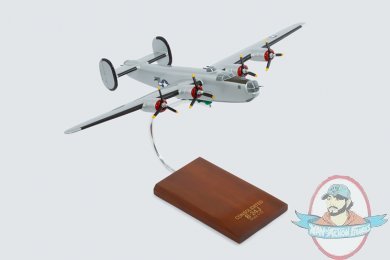
"The B-24 Liberator was a four-engined heavy bomber built by Consolidated Aircraft. It was produced in greater numbers than any other American combat plane during World War II and still holds the record as the most produced US aircraft. It was used by every branch of service during the conflict, earning a distingushed war record with its operations in the European, African, Pacific and Middle Eastern theaters. The PB4Y-1 Liberator was the navalized version of the B-24. The Liberator was notorious among American air crews for its tendency to catch fire from battle damage because of the placement of its fuel tanks and its lightweight construction. It was more difficult to fly as well, with more instruments and switches facing the pilot and more training required before proficiency was achieved. However, the Liberator excelled over other contemporary World War II heavy bombers in versatility. It had a long operating range, which led to it being used for various duties including maritime patrol and anti-submarine work, reconnaissance, tanker, cargo and personnel transport. Winston Churchill used one as his own transport aircraft. A total of 18,482 Liberators were built by September 1945. The US Navy acquired 977 PB4Y-1s, which were used in sinking U-boats, photographic reconnaissance and transport during the war. In 1944, two modified PB4Y-1s were used in Project Anvil as pilotless flying bombs to take out a German V-2 installation in occupied France. The aircraft were fitted with remote control gear, a forward-looking television camera and 25,000 lbs of explosives. "
AB24Y1
|
"The North American B-25J Mitchell was an American twin-engined medium bomber developed by the North American Aviation. The aircraft was used with devastating effect against German and Japanese targets in every battle scenario of World War II. The B-25J Mitchell was named General Billy Mitchell, an American general known as one of the most famous pilots in American airpower history. He was called the Father of the U.S. Air Force. The B-25 Mitchell took its first flight on August 19, 1940. It is powered by two Wright R-2600-9 Cyclone engines which delivered an amount of 3,400 horsepower. The aircraft's highest speed is 355 mph. The original airplane had difficulties during bombing runs, so the dihedral in the outer wing panels was eliminated on the 10th B-25 version onwards. The B-25J has 4,318 units. It is considered to be the most widely produced version of the Mitchell. The B-25 saw many modifications during its operating service. The series ran from the B-25A to B-25J, each type seeing variations to increase its firepower. The first 25 were armed with a. 30-caliber Browning in the nose and one at each waist position. For security, the tail of the aircraft sported a .50-caliber Browning. A Plexiglas nose and a turret gunner originated with the B-25B. The B-25G also had a retractable belly turret. "
AB25EST
|
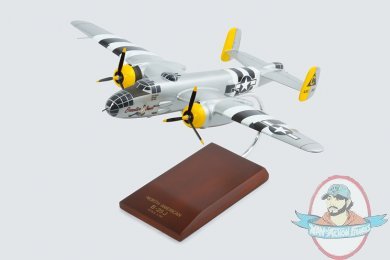
The B-25 Mitchell was an American twin-engined medium bomber manufactured by North American Aviation. The B-25 first gained fame as the bomber used in the 18 April 1942 Doolittle Raid, in which 16 B-25Bs led by Lieutenant Colonel Jimmy Doolittle attacked mainland Japan, four months after the bombing of Pearl Harbor. The mission gave a much-needed lift in spirits to the Americans, and alarmed the Japanese who had believed their home islands were inviolable by enemy forces. It was used by many Allied air forces, in every theater of World War II, as well as many other air forces after the war ended, and saw service across four decades.
This specific B-25 is painted in the Doolittle Raiders' paint scheme. The Doolittle Raid was one of the most daring raids on the empire of Japan during World War II. This attack, America’s first retaliatory strike, would be so decisive that it would ultimately lead to the turning point of the war by provoking the Japanese counter attack and defeat at Midway in June of that same year.
This handcrafted model is painstakingly built from Philippine mahogany by our skilled craftsmen with a wealth of detail and makes a great gift for any veteran, aviation enthusiast or history buff.
Scale: 1/48 scale model
Wing Span: 16.5
Length: 13.5
AB25JDT
|
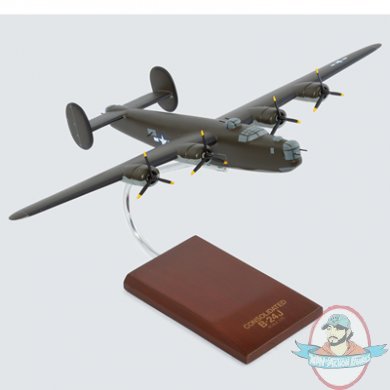
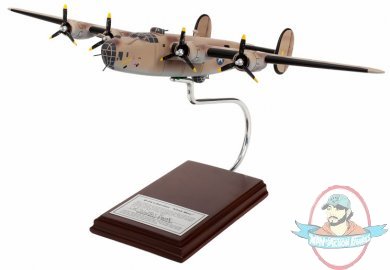
"The B-24 Liberator is an American heavy bomber built by Consolidated Aircraft. It was produced in great numbers during World War II and was used by many Allied air forces and every US branch of service during the war. The B-24 Liberator was first deployed to the United Kingdom to utilize its long-range capabilities. In June 1942, American B-24s entered combat with a raid of 13 aircraft launched from Egypt which targeted the German-built synthetic oil refinery at Ploisti, Romania. Though it was considered unsuccessful. On August 1, 1943, 178 B-24s attacked Ploesti again and 53 failed to return. Liberator squadrons were deployed to theaters in Africa, Europe, the Atlantic, India and the Pacific. In 1942 to 1943, B-24's production increased dramatically. The B-24's long operating range made it suitable for maritime patrol, antisubmarine, reconnaissance, tanker, cargo and personnel transport. By September 1945, there were 18,482 B-24 Liberators built. The B-24J is very similar to the B-24H, although the defensive improvements made in the B-24H weren't incorporated in the B-24J. The B-24J featured an improved autopilot and a bombsight of the M-1 series. B-24H sub-assemblies made by Ford and constructed by other companies and any model with a C-1 or M-1 retrofit, were all designated B-24Js. B-24J has a crew of 7-10. It has a maximum speed of 290 mph and a cruising speed of 215 mph. It has 10x 0.50 in M2 Browning machine guns. "
AB24ODT
|
"This B-24 Liberator was operated by the 15th Air Force in Cyrenaica and flew on raid to the Ploesti oilfieds on August 1, 1943. The bombers were painted in desert pink. The B24D Liberator was the first liberator that was put into mass production by Consolidated. More than 2,700 B-24D was produced. The first production of B-24D was almost similar to B-24C and was delivered to the Army Air Corps. The B-24D’s long deep fuselage enabled the Army Forces to settle in to a continuous diversity of attacks. The B-24D served commendably not only as bombers but also as photo reconnaissance aircraft, anti submarine aircraft and as cargo planes too. In 1943, The B24D Liberator replaced the B-17 Flying Fortress as the heavy bomber in the South Pacific. The liberator was flown by the Army and Navy Aircrews. Five months after the production of the B-24D in San Diego, Consolidated began a new production of the B24D in Forth Worth. The Liberator attained recognition during the WWII as one of the Army Air Force’s most reliable long range bombers. "
AB24PR
|
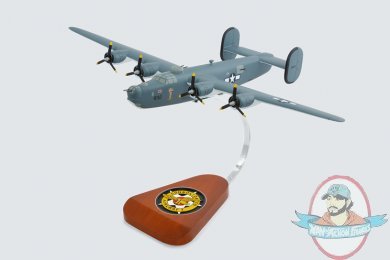
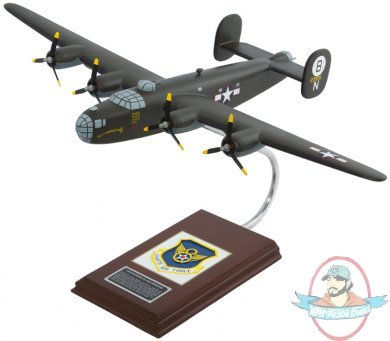
The B-24 Liberator was an American heavy bomber, designed by Consolidated Aircraft of San Diego, CA. The B-24 was used in World War II by several Allied air forces and navies, and by every branch of the American armed forces during the war, attaining a distinguished war record with its operations in the Western European, Pacific, Mediterranean, and China-Burma-India Theaters.
This specific B24 is painted as "Utah Man" or Walter Stewart's airplane. Stewart's most historic mission was the low-level bombing mission to the oil refineries of Ploesti Romania during Operation “Tidal Wave” in August 1943. During the mission, Stewart was assigned as Deputy Lead of the 93rd Bombardment Group because of his reputation and experience. Five groups took off from Libya for the 2,000-mile round trip to their target, which was supplying nearly 1/3 of all oil used by Nazi Germany. The attack turned to chaos with bombers from the different groups attacking from all quadrants, but the oil refineries were severly damaged. Of the 178 aircraft that took off on the most decorated mission of World War II, 54 were shot down; 532 of 1,726 men did not return. Lt. Stewart’s plane, named “Utah Man,” came back with 365 holes in it. Certificate of Authenticity included.
This handcrafted model is painstakingly built by our skilled craftsmen with a wealth of detail and makes a great gift for any veteran, aviation enthusiast or history buff.
AB24PRSS
|
"The B-24J Liberator is one of the variants of the liberators and the largest amount of liberators ever produced. All in all there are 6,678 B-24Js produced. The aircraft is somewhat similar to the B-24G and H models. The only difference between the B-24J and the two models is the autopilot and bombsight feature. The defensive modifications completed in the B-24H were not included in the B-24J model. The B-24J has an improved Type C1 autopilot and an M-1 series bombsight. In 1944, the Army predicts a lesser amount of demands for Liberators. They regulated that the three plants be freed up for new purposes. In 1945, only Ford-Willow Run and Convair-San Diego continued developing B-24 aircrafts. The B-24J Liberator is a heavy bomber aircraft that was produced in large numbers during the Second World War. It served war in the Pacific, Middle Eastern, European and African theaters and gained a record in its action. "
AB24ST
|
"The Boeing B-17 Flying Fortress or the so called ""Sentimental Journey” is a four-engine heavy bomber aircraft developed for the U.S. Army Air Corps (USAAC). The B-17 aircraft was manufactured by Boeing. It has eliminated its competitors and has met the Air Corps' expectations to compete against Douglas and Martin for a contract to build 200 airplanes. The Air Corps was impressed with the B-17s' even though Boeing had lost the contract due to the prototype's crash. This became the reason for the U.S. Army Air Corps to order 13 B-17s. The B-17 Flying Fortress was chosen as the first truly mass-produced large aircraft that participated in full-scale production. The aircraft has then evolved into various design upgrades which started from B-17A to G. On March 13, 1945, the B-17 Flying Fortress ""Sentimental Journey"" was accepted by the U.S. Army Air Corps. The aircraft was produced too late to provide service for the European war. Therefore, it was assigned to the Pacific theater until the end of the war. The aircraft was removed from safety in Japan and was assigned to be a photo-mapping airplane in Clark Field, Manila. The aircraft has flown to all areas of the Pacific for almost three years during the development of the RB-17G."
|
"B-17F Flying Fortress had a nickname which was Memphis Belle during the Second World War. It became the first U.S. Army Air Forces heavy bomber to complete 25 missions over Europe and return to the United States. In September 1942, the Memphis Belle was delivered to the 91st Bomb Group at Dow Field, Bangor, Maine and was deployed to Prestwick, Scotland on September 30. On October 14, the Memphis Belle deployed to its permanent base at Bassingbourn, England. Captain Robert Morgan's crew had flown 25 combat missions with the 324th Bomb Squadron, all but four in the Memphis Belle and on May 19, 1943, Memphis Belle flew its 25th and last mission with a different crew to Kiel, Germany. On JUne 8, 1943, Memphis Belle was flown back to the United States by Morgan's crew for war bond tours. After the war, Memphis Belle was saved from reclamation at Atlus, Oklahoma, where it had been consigned since August 1, 1945, by the efforts of the mayor of Memphis, Walter Chandler. The city bought the plane for $350. In JUly 1946, the plane was flown to Memphis and was stored until summer of 1949 when it was placed on display at the National Guard armory. In the 1980s, it sat out-of-doors, slowly deteriorating due to weather and occasional vandalism. A fictionalized version of the Memphis Belle was made in the 1990 wherein a former firebomber B-17G-85-DL, serial 44-83546, registered N33703G was converted into a B-17F configuration by removing its chin turret and it continued making air show appearances in that guise. The B17, which was owned by David Tallichet, now carries the historic markings found on the actual Memphis Belle. It currently operates out of Floyd Bennett Field, New York. There were other planes also nicknamed as Memphis Belle, such as a Republic F-105D-10-RE Thunderchief (60-0504) from the 357th Tactical Fighter Squadron of the 355th Tactical Fighter Wing, a General Dynamics FB-111 (68-0267), two Boeing B-52 Stratofortress have the name Memphis Belle B-52G (59-2594) was named as Memphis Belle III and took part in the 1991 Gulf War and the first B-52H (60-0001) was named Memphis Belle IV which has seen action in both Iraq and Afghanistan, a Lockheed C-141 Starlifter (67-0024)n became the Memphis Belle V and a Lockheed C-5 Galaxy (69-0025) was named as Memphis Belle X."
AB17MBTS
|
"The Boeing B-17 Flying Fortress is an American four-engine heavy bomber aircraft developed for the U.S. Army Air Corps (USAAC). The B-17 Flying Fortress went on to enter full-scale production and was considered the first truly mass-produced large aircraft, eventually evolving through numerous design advancements, from B-17A to G. The B-17 was primarily employed in the daylight precision strategic bombing campaign of World War II against German industrial and civilian targets. The B-17 also participated, to a lesser extent, in the War in the Pacific.From its pre-war inception, the USAAC touted the B-17 Flying Fortress aircraft as a strategic weapon; it was a potent, high-flying, long-ranging bomber capable of unleashing great destruction yet able to defend itself. The B-17 established itself as a superb weapons system, dropping more bombs than any other U.S. aircraft in World War II. Of the 1.5 million tons of bombs dropped on Germany, 500,000 were dropped from B-17s. Generally considered the defining B-17 design, all changes made in the B-17F production run were incorporated into the final version, the B-17G Fortress. 8,680 B-17G Fortress were built. Eighty-five B-17G Fortress were transferred to the Royal Air Force, where they were used as the Fortress III. They operated with two squadrons of Bomber Command's No. 100 Group RAF at RAF Sculthorpe, where they were used for electronic countermeasures missions to confuse and jam enemy radar. They were also used as decoys during night bombing attacks. They took part in various such operations until they were disbanded in 1945 July. "
AB17ODT
|
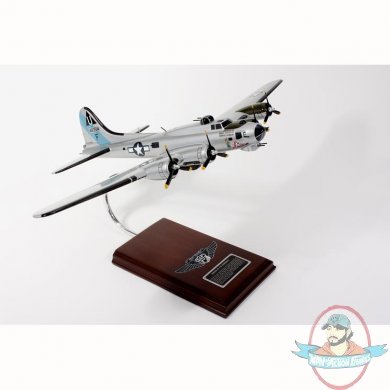
The Boeing B-17 Flying Fortress is a four-engine heavy bomber aircraft developed in the 1930s. The B-17 was primarily employed by the United States Army Air Forces (USAAF) in the daylight precision strategic bombing campaign of World War II against German industrial and military targets. From its pre-war inception, it was touted as a strategic weapon; it was a potent, high-flying, long-range bomber that was able to defend itself, and to return home despite extensive battle damage. The B-17 quickly established itself as an effective weapons system, dropping more bombs than any other U.S. aircraft in World War II.
This specific B-17 model is painted as "Sentimental Journey". Her nose art features Betty Grable, the number-one pin-up girl of the World War II era. "Sentimental Journey" is still in flying condition and is owned by the Commemorative Air Force and is regularly flown to airshows around the country.
This handcrafted model is painstakingly built from Philippine mahogany by our skilled craftsmen with a wealth of detail and makes a great gift for any veteran, aviation enthusiast or history buff.
Scale: 1/62 scale model
Wing Span: 19.9
Length: 14.3
AB17SJ
|
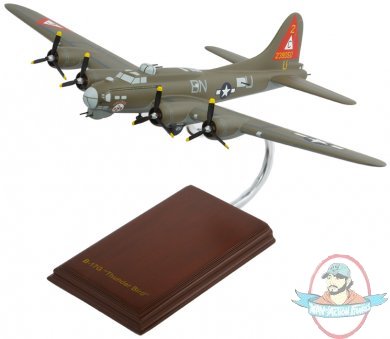
The Boeing B-17 Flying Fortress is a four-engine heavy bomber aircraft developed in the 1930s. The B-17 was primarily employed by the United States Army Air Forces (USAAF) in the daylight precision strategic bombing campaign of World War II against German industrial and military targets. From its pre-war inception, it was touted as a strategic weapon; it was a potent, high-flying, long-range bomber that was able to defend itself, and to return home despite extensive battle damage. The B-17 quickly established itself as an effective weapons system, dropping more bombs than any other U.S. aircraft in World War II.
This handcrafted model is painstakingly built from Philippine mahogany by our skilled craftsmen with a wealth of detail and makes a great gift for any veteran, aviation enthusiast or history buff.
Scale: 1/62 scale model
Wing Span: 19.9
Length: 14.3
AB17TTS
|
The B-24 Liberator was an American heavy bomber, designed by Consolidated Aircraft of San Diego, CA. The B-24 was used in World War II by several Allied air forces and navies, and by every branch of the American armed forces during the war, attaining a distinguished war record with its operations in the Western European, Pacific, Mediterranean, and China-Burma-India Theaters.
This handcrafted model is painstakingly built by our skilled craftsmen with a wealth of detail and makes a great gift for any veteran, aviation enthusiast or history buff.
Scale: 1/62 scale model
Wing Span: 21.3
Length: 12.8
AB24DTS
|
Take home Emma Frost as she stands clear!
San Diego Comic-Con 2011 exclusive!
Limited edition!
Exclusive clear form! Grab this exclusive Kotobukiya Bishoujo statue of Emma Frost as The White Queen! Standing eight-inches tall atop an environmental display base, the X-men mutant is highlighted by a bishoujo-styled face along with Frost's flowing hair and cape. Be sure to add The White Queen to your Marvel X Bishoujo Collection of iconic super heroines and villains! Limited edition of only 1,500 pieces!
|
Green Lantern Bearbrick that lights-up!
Watch the movie, pick up the Bearbrick!
Limited edition San Diego Comic-Con 2011 Exclusive!
As Green Lantern takes to the big screen this Summer, be sure to grab this exclusive Bearbrick equipped with a light-up lantern! Limited edition of only 1,500 copies!
|
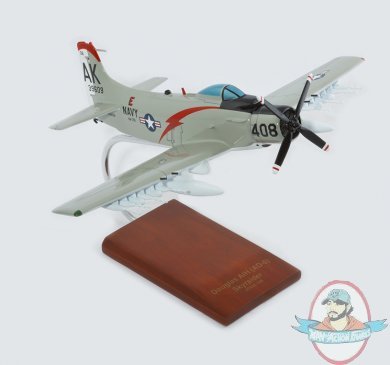
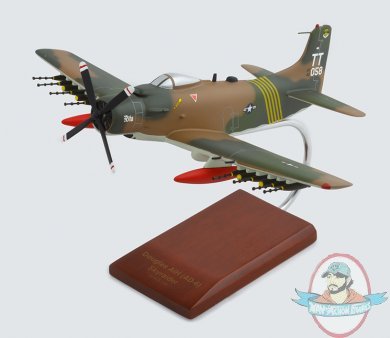
"The AD-6 (A-1H), also known as “SPAD (an acronym, as in ""Single Place Attack, Douglas"")”, was a U.S. single-seat attack bomber manufactured by Douglas Aircraft Company. The prototype of the Skyraider was first flown on March 18 1945 then it was first introduced in the year 1950s. The A1 Skyraider first saw combat in the Korean War, where its long loiter time and heavy load-hauling capability gave it a distinct utility advantage over the jet aircraft of the time. A total of 3,180 Skyraiders were built during its last production in 1957. The A-1H Skyraider version of the A1 Skyraider is equipped with four 20 mm guns. The guns were installed on the wings of the aircraft. The A-1H Skyraider can carry any different types of bombs, gun pods, mines on its external wing stations. It can also have fuel tanks for long range missions. The A-H was one of the last versions of Skyraider aside from the AD-7. A-1H Skyraider is a single-seat aircraft that have three dive breaks. A total of 713 were built. It has a maximum speed of 320 miles per hour and is equipped with 4 x 20 mm of cannons. The primary mission of the A-1H Skyraider is to support the ground forces of the Army. Its compartment in the middle can be equipped with passenger seats and for carrying heavy cargo. In Vietnam War, the United States Army Air Force used it mostly on air support role. It was efficient in giving some back up for rescue tasks. In September 1 1968, Colonel William A. Jones flew an A-1H Skyraider. He was awarded with a Medal of Honor because he had returned to his base and informed the position of a downed flight crew member even he suffered on burns and have damages in his attack bomber. "
AA1NT
|
"The Douglas A-1 Skyraider, known for a lot of nicknames, was a propeller-powered engine, was a U.S. single-seat attack bomber introduced in the year 1950s. The A-1 has nicknames such as: Able Dog, Sandy, Spad, Hobo, Firefly, Zorro, The Big Gun, Old Faithful, Old Miscellaneous, Fat Face (AD-5 version), Guppy (AD-5W version), Q-Bird (AD-1Q/AD-5Q versions), Flying Dumptruck (A-1E), and Crazy Water Buffalo (South Vietnamese nickname). The Skyraider first saw combat in the Korean War, where its long loiter time and heavy load-hauling capability gave it a distinct utility advantage over the jet aircraft of the time. The prototype of the Skyraider was first flown on 18 March 1945. A total of 3,180 Skyraiders were built during its last production in 1957. A-1H model of the A-1 Skyraider was a single-seat attack aircraft with three dive brakes, centerline station stressed for 3,500 lb (1,600 kg) of ordnances, 30 inches (760 mm) in diameter, combination 14/30 inch (360/760 mm) bomb ejector and low/high altitude bomb director. A-1H was a converted AD-6 aircraft and there were 713 built. A-1H has a distinction between the A-1J aircraft variant. The two said variants, A-1H and A-1J, were the final versions of the Skyraider. The H and J models were externally identical; however, the A-1J had strengthened landing gear and wings. The principal mission of the A-1H/J is the destruction of ground targets in support of ground forces. The aircraft's middle compartment can be readily equipped with passenger seats, facilities for litters or provisions for carrying heavy cargo. The USAF used the Skyraider extensively in Vietnam in the close air support role. The aircraft was especially effective in providing cover for combat rescue missions. "
Scale: 1/40 scale model
Wing Span: 15
Length: 11.75
AA1T
|
"The A-20 is a light bomber and night fighter aircraft during world War II and was manufactured by Douglas Company. The A-20G's maiden flight was on January 23, 1938 and was introduced in January 10, 1941. The A-20s were shipped in sections to Casablanca for assembly and service in France and French North Africa. The primary users and operators of the A-20 are the Soviet Air Force, US Army Air Force, Royal Air Force and the Armee de l'Air. The A-20G Havoc is a variant of the A-20 Havoc. It was delivered in February 1943 and was the most produced variant of all the series. The A-20 Havoc has four 20 mm cannon and two 0.50 in (12.7 mm) Colt-Browning machine guns, making it slightly longer than the previous versions. It also has a wider fuselage to accommodate a power driven gun turret. Many A-20Gs were delivered to the Soviet Union. It incorporates 1,600 hp (1,200 kW) R-2600-23. US A-20Gs were used on low-level sorties in the New Guinea theatre. There's a total of 7,478 A-20s built. "
AA20TE
|
Enter the dragon!
Awesome set includes 2 Bruce Lee Action Figures.
Figures feature highly detailed sculpts and signature film outfits.
Take home this martial arts legend!
Enter the dragon! These awesome 5-inch tall vinyl figures feature highly detailed sculpts and signature outfits. Each action figure celebrates one of Bruce Lee's most famous films. Take home this martial arts legend!
This set contains 2 individually packaged Bruce Lee Action Figures (subject to change):
1x Game of Death Bruce Lee
1x Enter the Dragon Bruce Lee
|