"In 1980, the United States Coast Guard chose the SA 366 G1 Dauphin to be its short range recovery air rescue helicopter and it was given the title HH-65A Dolphin. A total of 99 Dolphin helicopters were improved for its function as a rescuer for the United States Coast Guard. The aircraft was the replacement of the Sikorsky HH-52A Sea Guard. In 2002, a total of 94 Dolphin units were used by the United States Coast Guard. Some of its functions were for security patrols, pollution control, enforcement of laws and treaties and missions like search and rescue. It is famous for its autopilot abilities that allow the crew to take on other duties. To meet the United States rules in local content engineering, modifications were made to the helicopter. Its engine was changed to Allied Signal LTS-101-750B-2 power plants. In 2004, the engine problems still continued and they decided to replace it with Arriel 2C2 units. It became a more competent and secured aircraft. The improved HH-65A Dolphins were chosen as HH-65C Dolphins. The HH-65A cannot execute water landings. It typically takes a crew of four. The HH-65 Dolphin was produced by the Aerospatiale Helicopter Corporation in Texas. The LTS-101 750B-2 turbo shaft engines were built by the Textron Lycoming in Pennsylvania and the electronic systems was built by the Rockwell International in Iowa. "
Scale: 1/32 scale model
Wing Span: 15.75
Length: 15
HH65ADT
|
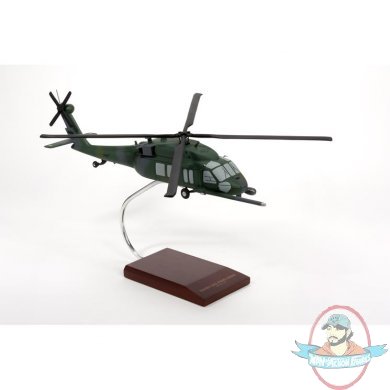
"The HH-60 Pave Hawk is a highly-modified edition of the Sikorsky UH-60 Black Hawk chopper. The aircraft was first developed by the United Technologies and Sikorsky Aircraft Corporation. The Pave Hawk is a twin-engine medium-lift helicopter operated by Air Combat Command, Pacific Air Forces, Air Education and Training Command, Air National Guard and Air Force Reserve Command. The HH-60 was first seen in action in 1982. The HH-60 features an upgraded communications and navigation suite that includes an integrated inertial navigation, global positioning, Doppler navigation systems, satellite communications, secure voice, and quick communications system. The HH-60 Pave Hawks costs an estimated amount of $15.8 million. All HH-60s have an automated flying control system, night vision goggles lighting and forward looking infrared system that improves night low-level operations. In addition, some Pave Hawks have color weather radar and rotor blade anti-ice system that gives the HH-60 an all-weather capability. The main role of the Sikorsky HH-60 Pave Hawk chopper is to perform day or night combat search and rescue (CSAR) operations into irreconcilable territories to recuperate downed aircrew and other isolated air force personnel’s during war. The HH-60 may also perform peace-time operations because of its versatility. "
Scale: 1/40 scale model
Wing Span: 16.25
Length: 18.38
HHMH60T
|
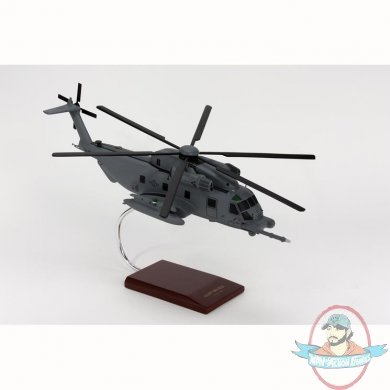
"The MH-53J Pave Low III heavy-lift helicopter is the largest, most powerful and technologically advanced transport helicopter in the US Air Force inventory. Under the Pave Low III program, the Air Force modified nine MH-53Hs and 32 HH-53s for night and adverse weather operations. Modifications included forward-looking infrared, inertial navigation system, global positioning system, Doppler naigations systems, APQ-158 terrain-following and terrain-avoidance radar, an onboard-mission computer, enhanced navigation system and integrated avionics to enable precise navigation to and from target areas. The Air Force designated these modified versions as MH-53Js. The MH-53J Pave Lows main mission is to drop off, supply and pick up special forces who are behind enemy lines. It also can engage in combat search and rescue missions. Low-level penetration is made possible by state-of-the-art terrain following radar, as well as infrared sensors that allow the helicopter to operate in bad weather. The MH-53Js were used in variety of missions during Desert Storm. Pave Lows were also used extensively during Operation Just Cause in Panama. The MH-53M Pave Low IV is a MH-53J model that has been modified with the Interactive Defensive Avionics System/Multi-Mission Advanced Tactical terminal or IDAS/MATT. "
Scale: 1/48 scale model
Wing Span: 19.2
Length: 21
HMH53JT
|
"The RAH-66 Comanche is an advanced U.S. Army military helicopter for reconnaissance, incorporating stealth techniques. The US Army planned to purchase almost 1,300 Commanches for scout and light attack roles and in May 1995, the first of the prototypes rolled out of the Sikorsky Aircraft Corporation's helicopter production facility. The prototypes maiden flight was on January 4, 1996. The RAH-66's very sophisticated design and navigation systems, allowing it to operate at night and in bad weather. Its airframe was designed to fit more easily than the Apache into transport aircraft or into transport ships, enabling it to be deployed to hot spots quickly. The RAH-66A has a crew of 2. It has a maximum speed of 175 knots and a range of 262 nmi. The primary user of the RAH-66 Comanche was the United States Army. On February 23, 2004, the US Army cancelled the Comanche helicopter program to provide funds to renvation with existing helicopter fleet of aging attack, utility and reconnaissance aircraft. Other factor was the growing popularity of Unmanned Aerial Vehicles for reconnaissance purposes and UAVs had proven their worth in Afghanistan and Iraq. Technology incorporated to the Comanche will be integrated into the Apache and other US military helicopter developments and some its roles will be taken over by the Bell ARH-70. "
Scale: 1/48 scale model
Wing Span: 11.5
Length: 9.75
HR66TR
|
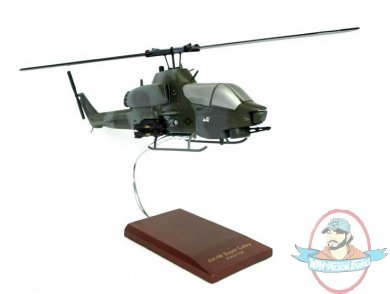
"The AH-1 SuperCobra is a twin-engine attack helicopter based on AH-1 Cobra. The AH-1 Cobra was developed in the mid-1960s as an interim gunship for the U.S. Army. The Cobras and Sea Cobras were deployed in the Gulf War for a support role. The AH-1W Super Cobras destroyed 97 tanks, 104 armored personal carriers and vehiclesand two anti-aircraft artillery sites during the 100-hour ground campaign. The AH-1 was also used by the Pakistan Army as its primary gunship helicopter during the mid- 1970s tribal uprising in Pakistan's Baluchistan province. The AH-1s continued to operate with the U.S. Marine Corps. The AH-1W utilizes a more diverse array of ordnance compared to the Apache. The AH-1W has a crew of 2, one pilot and a co-pilot/gunner (CPG). It has a maximum speed of 190 knots and a range of 317 nm. The primary users of the AH-1 are the U.S. Marine Corps, Islamic Republic of Iran Army, Republic of China Army and the Turkish Army. The AH-1W Super Cobra was considered the backbone of the United States Marine Corp's attack fleet, but it will be replaced by the AH-1Z Viper upgrade in the next decade. "
Scale: 1/32 scale model
Wing Span: 18
Length: 17
HSCT
|
The UH-1C represents the third generation of Bell's iroquois series. Of all Bell's UH-1C machines, this was the most heavily armed. It carried an M-5 40mm grenade launcher on its nose and the M3 Rocket System. Each of the two M3 rocket pods carried twenty-four 2.75 inch rockets and the M-5 grenade launcher held over 300 antipersonnel grenades. Used extensively as escort for unarmed transport helicopters, the Heavy Hog was able to provide especially effective cover and offensive firepower during unloading and recovery operations. The UH-1C saw its combat tour through to the close of the vietnam Conflict, deadly to the enemy and essential to U.S. forces in its capacity as a most formidable gunship.
Scale: 1/48 scale model
Wing Span: 36
Length: 15.5
HUH1C
|
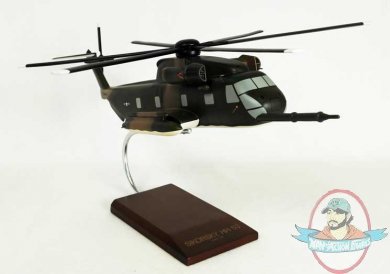
"The Sikorsky HH-53 or the Super Jolly Green Giant was ordered by the USAF for Search and Rescue operations. The Sikorsky HH-53 is the USAF version of the CH-53 Sea Stallion helicopter. The main reason for the development of Sikorsky HH-53 is to replace the HH-3 which is also called the Jolly Green Giant. Later on, the Sikorsky HH-53 was upgraded to MH-53. A lot of Sikorsky HH-53 variants were produced, such as the HH-53B which has a retractable in-flight refueling probe on the right side of the nose, the HH-53C which was an interim type that dispenses with the fuel tank bracing struts, the MH-53H which retained the in-flight refueling probe, external fuel tanks, rescue hoist and three gun armament, the MH-53J which is the largest and most powerful Sikorsky HH-53 variant produced by the US Air Force and the MH-53M has been modified with the Interactive Defensive Avionics System. On March 15, 1967, the Sikorsky HH-53 Super Jolly Green Giant made its first flight at Wright Patterson Air Force Base, Ohio. The Sikorsky HH-53 was faster and had tripled the take off of the HH-3. Other than that, the Sikorsky HH-53 was larger, more heavily armed and with almost double the shaft horsepower. Thus, the Sikorsky HH-53 had better overall performance and hover capability. "
Scale: 1/48 scale model
Wing Span: 18.25
Length: 19.5
HH53DT
|
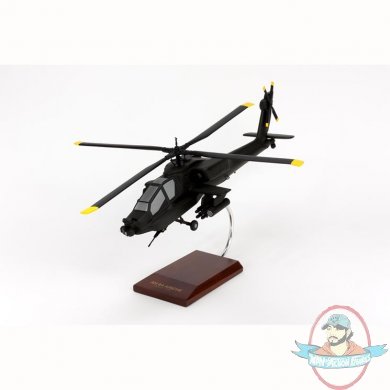
"The AH-64 Apache is the United States Army's main attack helicopter. It conducts rear, close and shaping missions, as well as distributed operations and precision strikes against relocatable targets. It provides armed reconnaissance when required in day, night, obscured battlefield and adverse weather conditions. It was designed by Hughes Helicopters, which in 1984 was purchased by McDonnell Douglas. In August 1997, McDonnell Douglas merged with Boeing. The AH-64D variant is now being produced by Boeing Integrated Defense Systems. After the cancellation of the AH-56 Cheyenne, the US Army sought an aircraft to fill the anti-armor attack role. It was to be better than the AH-1 Cobra in firepower, performance and range, and have the maneuverability to fly nap-of-the-earth missions. Hence, the Army issued a request for proposals for an advanced attack helicopter in 1972. Five manufacturers submitted proposals, and in 1973 the US Department of Defense selected Bell and Hughes as finalists. Each company built prototypes which underwent a flight test program. After evaluating test results, the Army awarded the contract to Hughes. In late 1981, the AH-64 was given the name “Apache” in keeping with the Army's tradition of using Native American tribal names for its helicopters. In 1983, the first production helicopter was rolled out. The AH-64 entered service in 1984 and was first used in combat during the 1989 US invasion of Panama. The AH-64D Apache Longbow, a more advanced model, began service in 1998. Both the AH-64A Apache and the AH-64D Apache Longbow have played important roles in several Middle Eastern wars, including the Gulf War, Operation Enduring Freedom in Afghanistan, and Operation Iraqi Freedom in Iraq. The Apaches proved to be excellent tank hunters and have destroyed hundreds of armored vehicles, mainly of the Iraqi army. The AH-64D has also been deployed in Afghanistan as part of Operation Anaconda, and from June 2003, in South Korea. Both the AH-64A and AH-64D are still in active service in the US Army. "
Scale: 1/32 scale model
Wing Span: 18.25
Length: 18.25
HA64DLT
|
"The AH-64 is an attack helicopter of the United States Army and the AH-1 Cobra successor. It was manufactured by the Hughes, McDonnell Douglas, and Boeing IDS. Its maiden flight was on the 30th of September 1975 and it is still active in service. Its primary users are the United States Army, Israel Air Force, Japan Ground Self-Defense Force, and Royal Netherlands Air Force. This helicopter was produced in 1984 up to the present time. The Apache is a two-seat principal attack helicopter with two General Electric T700 turboshaft engines. It carries a mixture of AGM-114 Hellfire and Hydra 70 rockets mounted on its stub wing pylons. It is also armed of 30 mm M230 chain gun. It is built to operate day or night and even in bad weather with the use of avionics and electronics like Target Acquisition and Designation System to endure the front line environment. In 1989, the Apache was used the first time in combat through the invasion of Panama, known as the Operation Just Cause. Two of its variants, the AH-64A and the AH-64D, have the most important role in some of the wars in the Middle East such as the Gulf War, the Operation Enduring Freedom in Afghanistan, and the Operational Iraqi Freedom in Iraq. These two variants are serving the United States Army. They are the major models of the AH-64. "
Scale: 1/32 scale model
Wing Span: 18.25
Length: 18.25
HA64LT
|
"During 1960, the United States Marine Corps (USMC) developed a need for a medium-lift tandem rotor assault helicopter that would replace the aging piston engine types being used at that time. Boeing Vertol won the design competition and in 1961 the USMC picked up the CH-46 Sea Knight. Since its introduction, the helicopter has served with both the USMC and United States Navy (USN) faithfully. It has been used in all Marine combat and peacetime environments. Sometimes known as the “Phrog”, the Sea Knight is a descendant of Boeing's first turbine-powered helicopter, the Boeing 107. It is used by the USMC to provide all-weather, day-or-night, night vision goggle assault transport of combat troops, supplies and equipment into or within a battle area. Other tasks include combat support, search and rescue, support for forward refueling and rearming points, casualty evacuation and tactical recovery of aircraft and personnel. The unique tandem rotor design of the CH-46 helicopter allows for increased agility and superior handling qualities in strong relative winds from all directions. Because of this feature, tons of cargo and thousands of passengers have safely been transferred over the years. The Sea Knight can stay airborne for 2-3 hours. It has the ability to land and taxi in the water when needed, and stay afloat for up to two hours in light seas. While other helicopters are extremely limited in various flight maneuvers, the Sea Knight can fly rearward or sidewards. "
Scale: 1/32 scale model
Wing Span: 19
Length: 17
HC46
|
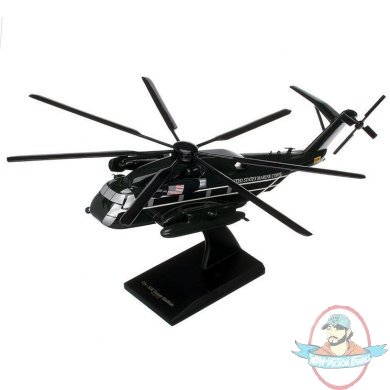
"The CH-53E Super Stallion is the biggest helicopter in the military of the United States. It was built by Sikorsky Aircraft and it is intended for shipping of equipments, goods and personnel in some operations. It is capable in all kinds of weather conditions both day and night. The sailors usually called the CH-53E the “Hurricane Maker” because of the downward force that the helicopter produces. The helicopter can take 37 passengers in its normal design and when it is installed with a centerline seats it can take 55 passengers. The CH-53E is a twin-engined helicopter and can lift 14.5 metric tons of weight. Modifications were made in the helicopter like its defensive electronic countermeasures and its extended fuel tanks. The Navy and Marines was served by the Super Stallion in the role of heavy lift transportation function. A total of 100 CH-53E Super Stallion helicopters are in with the Marines for service. For the US Navy, there are 15 MH-53E helicopters. Some MH-53E helicopters were exported to Japan to be part of the Japan Marines. The usual crew of the Super Stallion is 5. It accommodates two pilots, one right gunner, one left gunner and one tail gunner. Its weight when empty is 33,226 pounds and its maximum weight is 73,500 pounds. It can reach a maximum speed of 196 miles per hour. It is equipped with XM-218 machine guns and GAU-21 with M3M mounted machine gun. Other equipments are chaff and flare dispensers. "
Scale: 1/48 scale model
Wing Span: 19.5
Length: 18.25
HCH53T
|
This handcrafted Tornado 1/48 scale model is painstakingly built by our skilled craftsmen with a wealth of detail. The Panavia Tornado is a family of twin-engine, variable-sweep wing combat aircraft. There are three primary variants of the Tornado; the Tornado IDS (interdictor/strike) fighter-bomber, the suppression of enemy air defenses Tornado ECR (electronic combat/reconnaissance) and the Tornado ADV (air defence variant) interceptor. The Tornados of various operators were used in conflicts in the former Yugoslavia during the Bosnian War and Kosovo War, Iraq during the Gulf War and the Iraq War, Libya during the Libyan civil war, as well as smaller roles in Afghanistan and Yemen. Including all variants, a total of 992 aircraft were built.
This specific Tornado is painted in the German Luftwaffe paint scheme. Deliveries of production Luftwaffe Tornados began in July 1979, and overall they have received a total of 247 Tornados, including 35 ECR variants.
This handcrafted model is painstakingly built from Philippine mahogany by our skilled craftsmen with a wealth of detail and makes a great gift for any veteran, aviation enthusiast or history buff.
Scale: 1/48 scale model
Wing Span: 12.13
Length: 15
FGLTTE
|
This handcrafted Messerschmitt Me-109E 1/24 scale model is painstakingly built by our skilled craftsmen with a wealth of detail. The Messerschmitt Me-109, was a German World War II fighter aircraft. It was one of the first truly modern fighters of the era. The Me-109 first saw operational service during the Spanish Civil War and was still in service at the end of World War II, during which time it was the backbone of the Luftwaffe's fighter force.
This specific Me-109 is the E, which was the first major redesign of the series. The Me-109E, or "Emil", introduced a number of structural changes in order to accommodate the heavier, but significantly more powerful engine, heavier armament and increased fuel capacity. The 109E first saw service with the "Condor Legion" during the last phase of the Spanish Civil War and was the main variant from the beginning of World War II until mid-1941 when the 109F replaced it in the pure fighter role.
This handcrafted model is painstakingly built from Philippine mahogany by our skilled craftsmen with a wealth of detail and makes a great gift for any veteran, aviation enthusiast or history buff.
Scale: 1/24 scale model
Wing Span: 16.25
Length: 14.38
FGM109TE
|
This handcrafted Messerschmitt Bf-110 1/32 scale model is painstakingly built by our skilled craftsmen with a wealth of detail. The Messerschmitt Bf-110, or Me-110, was a twin-engine heavy fighter in the service of the Luftwaffe during World War II. The Bf 110 served with success in the early campaigns, the Polish, Norwegian and Battle of France. However, it's primary weakness was its lack of agility; this flaw was exposed during the Battle of Britain. They were then redeployed as night fighters, a role to which the aircraft was well suited. Later in the war, it was developed into a formidable night fighter, becoming the major night-fighting aircraft of the Luftwaffe. Most of the German night fighter aces flew the Bf 110 at some point during their combat careers, and the top night fighter ace of all time, Major Heinz-Wolfgang Schnaufer, flew it exclusively and claimed 121 victories in 164 combat missions.
This handcrafted model is painstakingly built from Philippine mahogany by our skilled craftsmen with a wealth of detail and makes a great gift for any veteran, aviation enthusiast or history buff.
Scale: 1/32 scale model
Wing Span: 16.25
Length: 14.25
FGM110TE
|
This handcrafted V-2 rocket 1/32 scale model is painstakingly built by our skilled craftsmen with a wealth of detail. The V-2 rocket was a ballistic missile that was developed at the beginning of World War II in Germany. Beginning in September 1944, over 3000 V-2s were launched as military rockets by the German Wehrmacht against Allied targets during the war, mostly London and later Antwerp. The liquid-propellant rocket was the world's first long-range combat-ballistic missile and first known human artifact to enter outer space. It was the progenitor of all modern rockets, including those used by the United States and Soviet Union's space programs. During the aftermath of World War II the American, Soviet and British governments all gained access to the V-2's technical designs and the actual German scientists responsible for creating the rockets.
This handcrafted model is painstakingly built from Philippine mahogany by our skilled craftsmen with a wealth of detail and makes a great gift for any veteran, aviation enthusiast or history buff.
Scale: 1/32 scale model
Wing Span: 17.25
Length: 4
FGV2TE
|
This handcrafted V-1 Flying Bomb 1/20 scale model is painstakingly built by our skilled craftsmen with a wealth of detail. The V-1 Flying Bomb, also known as the Buzz Bomb or Doodlebug, was an early pulse-jet-powered predecessor of the cruise missile. The V-1 was developed by the German Luftwaffe during World War II. At its peak, more than 100 V-1s were fired daily at southeast England, numbers decreased as sites were overrun until October 1944, when the last V-1 site in range of Britain was overrun by Allied forces.
This handcrafted model is painstakingly built from Philippine mahogany by our skilled craftsmen with a wealth of detail and makes a great gift for any veteran, aviation enthusiast or history buff.
Scale: 1/20 scale model
Wing Span: 15.63
Length: 12.38
FGVITE
|
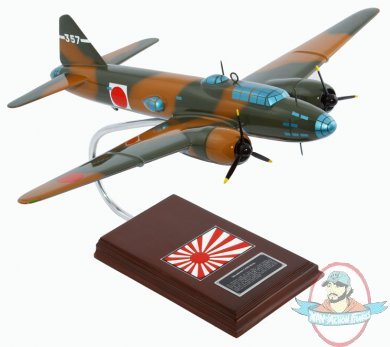
This handcrafted Mitsubishi G4M3 1/48 scale model is painstakingly built by our skilled craftsmen with a wealth of detail. The Mitsubishi G4M was the main twin-engine, land-based bomber used by the Imperial Japanese Navy Air Service in World War II. The Allies gave the G4M the reporting name Betty. The Allies usually gave Japanese fighters and floatplanes male names, while giving female names to bombers and reconnaissance aircraft. The G4M was designed for a long range and high speed at the time of its introduction. Several weight-saving measures were incorporated into the design, such as dispensing with self-sealing fuel tanks, which started nicknames such as "the one-shot lighter", "the flying Zippo" and "the flying cigar" because of their tendency to explode or catch on fire from any slight damage to the fuel tank wings after being hit by aerial machine gun fire or ground antiaircraft fire. The G4M was used for low-altitude torpedo attacks on shipping in which their performance advantages were negated, and the G4M was frequently shot down by antiaircraft artillery fire, and even by small arms. The G4M's relatively large size made it an easy gunnery target, and the predictable approach path required for a torpedo run made for a generally easy interception by Allied fighter aircraft. Towards the end of World War II, the "Betty" bomber was commonly used for carrying and launching kamikaze aircraft, and was the usual aircraft for carrying the Ohka kamikaze manned rocket-powered bombs.
This specific G4M is a G4M3, which is a redesigned G4M2 with added self-sealing fuel tanks, improved armor protection, redesigned wings and an entirely new tail gunner's compartment. The G4M3 entered production in October 1944.
This handcrafted model is painstakingly built from Philippine mahogany by our skilled craftsmen with a wealth of detail and makes a great gift for any veteran, aviation enthusiast or history buff.
Scale: 1/48 scale model
Wing Span: 20.5
Length: 16.5
FJBTE
|
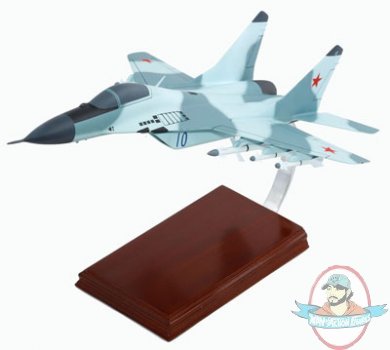
This handcrafted MiG-29 1/48 scale model is painstakingly built by our skilled craftsmen with a wealth of detail. The MiG-29, NATO name "Fulcrum", is a fourth-generation jet fighter aircraft designed in the Soviet Union for an air superiority role. It was developed at the height of the Cold War to counter new American fighters such as the McDonnell Douglas F-15 Eagle, and the General Dynamics F-16 Fighting Falcon. A Soviet response was necessary to avoid the possibility of a new American fighter gaining a serious technological advantage over existing Soviet fighters. The Soviet Union exported MiG-29s to several countries. Because 4th-generation fighter jets require the pilots to have extensive training, air-defense infrastructure, and constant maintenance and upgrades, MiG-29s have had mixed operational history with different air forces. The MiG-29 still remains in use today by the Russian Air Force and many other nations.
This handcrafted model is painstakingly built from Philippine mahogany by our skilled craftsmen with a wealth of detail and makes a great gift for any veteran, aviation enthusiast or history buff.
Scale: 1/48 scale model
Wing Span: 14.75
Length: 10.13
FRM29T
|
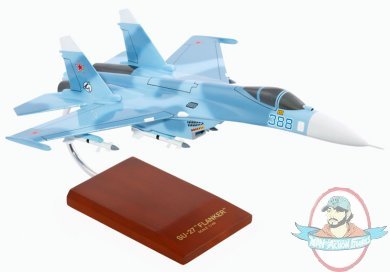
This handcrafted Su-27 "Flanker" 1/48 scale model is painstakingly built by our skilled craftsmen with a wealth of detail. The Su-27, NATO reporting name: Flanker, is a twin-engine supermanoeuverable fighter aircraft designed by Sukhoi. The Su-27 most often flies air superiority missions, but is able to perform almost all combat operations. The Su-27's basic design is aerodynamically similar to the MiG-29, but it is substantially larger. It is a very large aircraft, and to minimize its weight its structure has a high percentage of titanium (about 30%, more than any of its contemporaries). The Su-27 began to enter operational service around 1984, although manufacturing difficulties kept it from appearing in strength until 1986.
This handcrafted model is painstakingly built from Philippine mahogany by our skilled craftsmen with a wealth of detail and makes a great gift for any veteran, aviation enthusiast or history buff.
Scale: 1/48 scale model
Wing Span: 11.75
Length: 12
FRSU27T
|
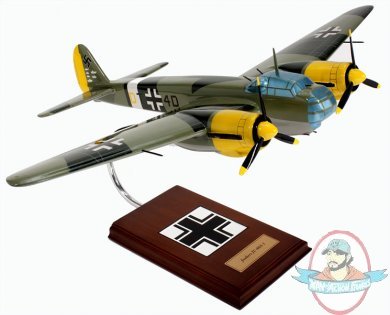
This handcrafted Junkers Ju-88 1/36 scale model is painstakingly built by our skilled craftsmen with a wealth of detail. The Junkers Ju-88 was a World War II German Luftwaffe twin-engine, multi-role aircraft. Affectionately known as "The Maid of all Work" (a feminine version of "jack of all trades"), the Ju-88 proved to be suited to almost any role. Like a number of other Luftwaffe bombers, it was used successfully as a bomber, dive bomber, night fighter, torpedo bomber, reconnaissance aircraft, heavy fighter, and even as a flying bomb during the closing stages of conflict. The assembly line ran constantly from 1936 to 1945, and more than 16,000 Ju-88s were built in dozens of variants, more than any other twin-engine German aircraft of the period. Throughout the production, the basic structure of the aircraft remained unchanged, proof of the outstanding quality of the original design.
This handcrafted model is painstakingly built from Philippine mahogany by our skilled craftsmen with a wealth of detail and makes a great gift for any veteran, aviation enthusiast or history buff.
Scale: 1/36 scale model
Wing Span: 22
Length: 16
FGJ88TE
|
McFarlane SportsPicks is no stranger to recreating some of the NBA’s greatest players as highly detailed action figures and their 20th lineup is no exception.
WARNING: CHOKING HAZARD - Small parts & small ball. Not for children under 3 years.
|
The Saturn V was an American human-rated expendable rocket used by NASA's Apollo and Skylab programs from 1967 until 1973. NASA launched 13 Saturn Vs from the Kennedy Space Center, Florida with no loss of crew or payload. It remains the tallest, heaviest and most powerful rocket ever brought to operational status and still holds the record for the heaviest launch vehicle payload.
This handcrafted model is painstakingly built by our skilled craftsmen with a wealth of detail and makes a great gift for any space buff or history fan.
Scale: 1/200 scale model
Wing Span: 21.75
Length: 3.63
KYNS5T
|
McFarlane SportsPicks is no stranger to recreating some of the NBA’s greatest players as highly detailed action figures and their 20th lineup is no exception.
WARNING: CHOKING HAZARD - Small parts & small ball. Not for children under 3 years.
|
"The Lunar Excursion Module (LEM), also known as the Apollo Lunar Module, is the portion of the Apollo spacecraft that lands on the moon and returns to lunar orbit. The 6.65 m³ module was designed to carry a crew of two. It is 6.4 m high and 4.3 m across, and rests on four legs. During the Cold War, the United States and the Soviet Union were in an astronautical engineering race. President Kennedy made space exploration and lunar landing a top national priority. The LEM came into being out of NASA's choice to reach the moon via a lunar orbit rendezvous (LOR) instead of a direct ascent or Earth orbit rendezvous (EOR). Both a direct ascent and an EOR would have required the entire Apollo spacecraft to land on the moon. Once the decision had been made to proceed using an LOR, it became necessary to produce a separate spacecraft capable of reaching the lunar surface. Out of the eleven firms invited, nine submitted proposals for the LEM. In September 1962, Grumman was awarded the contract. As the program continued, there were numerous redesigns to save weight, improve safety, and fix problems. The LEM is divided into two major parts, the Descent Module and the Ascent Module. The Descent Module contains the landing gear, landing radar antenna, descent rocket engine, and fuel to land on the moon. It also carries the water tank and the majority of the battery power and oxygen. The Ascent Module contains the crew cabin, radar and communications antennas, instrument panels, and guidance and navigation systems. The first LEM flight was on January 22, 1968 when the unmanned LM-1 was launched on a Saturn IB for testing of propulsion systems in orbit. On July 20, 1969, LM-5 Eagle, the LEM of the Apollo 11 mission, landed on the moon. "
Item Number: KYNLEMTP
Scale: 1/48 scale model
Wing Span: 5.75
Length: 5.5
Pre-Order! Available: September
Upc: KYNLEMTP
|
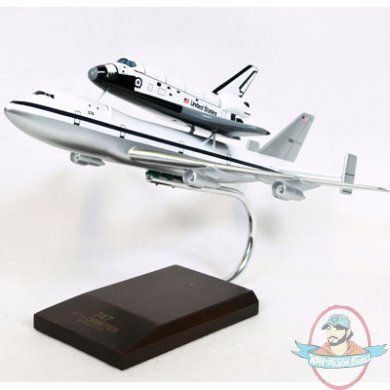
"The Boeing 747 is a long-haul, widebody commercial airliner. Sometimes called the “Jumbo Jet”, it is known for its impressive size and is one of the world's most recognizable aircraft. It has held the passenger capacity record for 37 years and was the first commercial wide-body aicraft. It uses a double decker configuration for part of its length, and the hump created by the upper deck has made the plane a highly recognizable icon of air travel. The 747 was expected to become obsolete after sales of 400 units, but it has outlived many of its critics' expectations. As of June 2007, 1,387 planes had been built, with 120 more on order. Throughout its history, the National Aeronautics and Space Administration or NASA has used several different types of aircraft on a permanent, semi-permanent, or short-term basis. The agency has three 747s: a 747-100, a 747-100SR, and a 747SP. The 747-100 and 747-100SR are currently used as Shuttle Carrier Aircraft (SCA) while the 747SP is in use as Stratospheric Observatory for Infrared Astronomy (SOFIA). The SCAs are used to ferry space shuttles from landing sites back to the launch complex at the NASA Shuttle Landing Facility at the Kennedy Space Center, and to and from other locations too distant for the orbiters to be delivered by ground transport. The 747-100 was was acquired from American Airlines in 1974 and was extensively modified in 1976. Its cabin was stripped, mounting struts were added, the fuselage was strengthened, and vertical stabilizers were added to the tail. The avionics and engines were also upgraded. In 1988, in the wake of the Challenger accident, NASA procured the 747-100SR from Japan Airlines on recommendation from the review board. It entered service with NASA in 1990 after similar modifications. It was the first used to ferry the new shuttle Endeavour in 1991. "
|
The Antonov AN-225 Mriya (Mriya meaning Dream), is a strategic airlift cargo aircraft designed by the Antonov Design Bureau in the 1980s. It was designed to airlift the Energia rocket's boosters and the Buran space shuttle for the Soviet space program. The first AN-225 was completed in 1988 and a second AN-225 has been partially completed. The completed AN-225 is in commercial operation with Antonov Airlines carrying oversized payloads. The An-225's original mission and objectives are almost identical to that of the United States' Shuttle Carrier Aircraft.
This handcrafted model is painstakingly built by our skilled craftsmen with a wealth of detail and makes a great gift for any space buff or history fan.
Scale: 1/200 scale model
Wing Span: 17.5
Length: 16.5
KYNRAN25
|
McFarlane SportsPicks is no stranger to recreating some of the NBA’s greatest players as highly detailed action figures and their 20th lineup is no exception.
WARNING: CHOKING HAZARD - Small parts & small ball. Not for children under 3 years.
|
"The T-33 Shooting Star is a jet trainer aircraft produced by Lockheed and piloted by Tony Levier. The T-33 was originally designated as the TF-80C and its maiden was on March 22, 1948. In the 1980s, the T-33 served as currency trainers, drone towing, combat and tactical simulation training, ""hack"" aircraft, electronic countermeasures and warfare training and test platforms. There was an attempt to modify and modernize the T-33 as the Boeing Skyfox, but the project was cancelled due to lack orders. The T-33A has a crew of two. It has a maximum speed of 600 mph and a range of 1,275 miles ferry. The T-33 has two 0.50 in Browning M3 machine guns with 350 rounds per gun and has up to 2,000 lb of ordnance on two underwing hardpoints. Weapons carried include bombs and rocket pods. The primary users of the T-33 are the United States Air Force, United States Navy and the Royal Thai Air Force. The T-33 saw service in over 30 nations and still operates as a trainer in smaller air forces. Other operators of the T-33 include Brazil, Turkey and Thailand, using the aircraft extensively. "
Scale: 1/48 scale model
Wing Span: 10.25
Length: 9.5
CT33AT
|
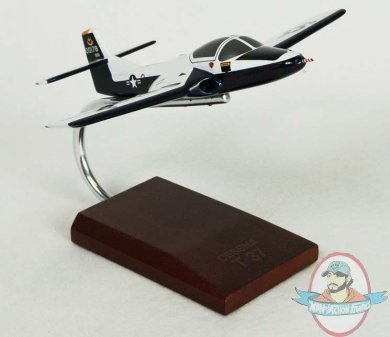
"The Cessna T-37 is a twin-engine trainer used for teaching the fundamentals of jet aircraft operation, and instrument, formation and night flying. Widely known as the Tweety Bird or Tweet, it has been a primary trainer for the United States Air Force (USAF) for decades, and serves in the air forces of several other nations as well. It is the first USAF jet designed originally as a jet trainer, rather than being modified from existing designs. The T-37's flying characteristics help students in transitioning to the faster T-38 Talon in the latter stage of flight training. Its side-by-side seating allows the instructor to observe and train the student pilot easily. In the spring of 1952, the USAF issued a request for proposals for a lightweight two-seat basic trainer for introducing Air Force cadets to jet aircraft. Cessna responded to the request with a twin-jet design that featured side-by-side seating. The USAF liked the design and awarded Cessna the contract in 1954. The XT-37 prototype first flew on October 12, 1954. The first production T-37A was delivered in 1956 and entered operational Air Force service in 1957. Instructors and students considered the T-37A an extremely pleasant aircraft to fly. It was agile, responsive and capable of all traditional aerobatic maneuvers. However, it was very noisy. The intake of air into its small turbojets emitted a high-pitched piercing shriek. The whistling sound quickly gave the T-37 the name “Tweety Bird” or “Tweet”. The USAF spent a lot of time and money sound-proofing buildings at bases where the aircraft was stationed, and ear protection was mandatory for ground crews and pilots when near it. The USAF liked the T-37A but felt that it was underpowered. In 1959, the T-37B joined the Air Force. It had more powerful engines, a redesigned instrument panel, improved avionics, more thrust and better reliability. A total of 552 newly-built T-37Bs were produced through 1973. Eventually all surviving T-37As were upgraded to T-37B standards as well. "
Scale: 1/48 scale model
Wing Span: 8.5
Length: 7.5
CT37BT
|
McFarlane SportsPicks is no stranger to recreating some of the NBA’s greatest players as highly detailed action figures and their 20th lineup is no exception.
WARNING: CHOKING HAZARD - Small parts & small ball. Not for children under 3 years.
Pre-Order, Sold Out Available: September
|
"The Cessna T-37 is an Air Force's dual-engine and dual-purpose jet. It is also popularly known in various forms: Dragonfly, Tweety Bird, Tweet, or Super Tweet. The A-37 combat version was developed from the T-37 trainer, which was the standard jet trainer form the mid-'50s into the '70s. As A-37, it served with distinction in an attack role during the Vietnam War and, in its larger role, flew for decades as a primary trainer for the USAF. A-37 provided a wide range of services in the air forces of other nations. The first T-37 Tweet flew in October 1954. Fifty-two years after its first flight, the T-37 is still serving the U.S. military, giving the United States Air Force-trained primary pilot training students the necessary experience needed before moving on to the Northrop T-38 Talon, Beechcraft T-1A Jayhawk, Bell UH-1 Huey, United States Navy Beech T-44 Pegasus, or other advanced Navy, Marine Corps or Allied trainers. The T-37A version of the Tweety Bird made its first flight in 1955 and went into service with the Air Force in June 1956. The production T-37A was similar to the XT-37 prototypes, except for minor changes to fix problems revealed by the flight test program. The USAF began cadet training in the T-37A during 1957. The Air Force ordered 444 T-37As, with the last produced in 1959. During 1957, the US Army evaluated three T-37As for battlefield observation and other combat support roles, but eventually procured the Grumman OV-1 Mohawk for the mission instead. The Air Force liked the T-37A, but felt it was underpowered. As a result, the service ordered an improved version, the T-37B, with uprated J-69-T-25 engines. The new engines provided about 10% more thrust and better reliability. Improved avionics were also specified for the new variant. "
Scale: 1/48 scale model
Wing Span: 8.5
Length: 7.5
CT37T
|
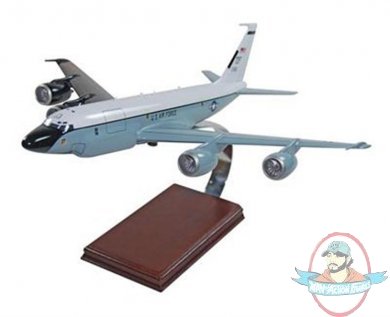
"The USAF RC-135V/W RIVET JOINT surveillance aircraft are equipped with an extensive array of sophisticated intelligence gathering equipment enabling military specialists to monitor the electronic activity of adversaries. Also known as ""RJ"", the aircraft are sometimes called ""hogs"" due to the extended ""hog nose"" and ""hog cheeks"". RIVET JOINT has been widely used in the 1990's -- during Desert Storm, the occupation of Haiti, and most recently over Bosnia. Using automated and manual equipment, electronic and intelligence specialists can precisely locate, record and analyse much of what is being done in the electromagnetic spectrum. The fleet of 14 RIVET JOINT aircraft increased to 15 in late 1999 with the addition of a converted C-135B. The jet's conversion cost about $90 million. The Rivet Joint fleet is currently undergoing significant airframe, navigational and powerplant upgrades which include re-engining from the TF-33 to the CFM-56 engines used on the KC-135R and upgrade of the flight deck instrumentation and navigational systems to the AMP standard. The AMP standard includes conversion from analog readouts to a digital glass cockpit configuration. The Air Force plans to spend at least $1.4 billion to keep the RC-135 Rivet Joint (RJ) fleet flying through 2018. The service also plans to modify a recently retired Air National Guard KC-135 tanker, turning it into the Air Forces 17th RJ signals-intelligence aircraft. "
Scale: 1/100 scale model
Wing Span: 16.63
Length: 16.75
CRC135RJT
|
"The RC-135S Cobra Ball is a MASINT aircraft designed to observe ballistic missile flights at long range. The RC-135S was used primarily as a traditional mission in the past against Russia. It performed numerous aerial reconnaissance missions of national-level significance. The aircraft is equipped with special optical instruments. The RC-135S Cobra Ball is an extensively modified C-135. It tracks missile systems for treaty verifications and has a growing role in theater missile defense. Cobra Ball's specialized employs sensitive telescopic monitoring device, advanced optics and infrared sensors, providing national and theater command authorities with intercontinental ballistic missile treaty verification data and Theater Air Defense warning. There are four RC-135S in service and they are part of the 55th Wing, 45th Reconnaissance Squadron based at Offutt Air Force Base, Nebraska. The RC-135S was originally assigned to Shemya and was used for observation of ballistic missile tests on the Kamchatka peninsula in conjunction with Cobra Dane and Cobra Judy. "
Scale: 1/100 scale model
Wing Span: 16
Length: 16.5
CK135ST
|
"The RC-135U Combat Sent is an electronic intelligence reconnaissance and surveillance aircraft in use by the United States Air Force (USAF). It is employed as a Scientific and Technical ELINT Collection System and designed to collect technical intelligence on adversary systems. The Combat Sent provides strategic electronic reconnaissance information to the president, secretary of defense, Department of Defense leaders, and theater commanders. The RC-135U is equipped with an aerial refueling system, giving it an unlimited flying range. The navigation equipment incorporates ground navigation radar, a solid state Doppler system, and an inertial navigation system that combines celestial observations and Global Positioning System data. Communication equipment includes high frequency, very high frequency, and ultra high frequency radios. The aircraft has distinctive antennae arrays on the “chin” and wing tips, large cheek fairings, and an extended tail. Its crew consists of two pilots, two navigators, two airborne systems engineers, and a minimum of ten electronic warfare officers, also known as “Ravens,” and six or more electronic, technical, and area specialists. There are only two Combat Sents in the USAF, both assigned to the 55th Wing at Offutt Air Force Base, Nebraska. The RC-135U has with a wide array of commercial off-the-shelf and proprietary hardware and software. Its current configuration allows for both manual and automatic analysis of electronic signals. It locates and identifies foreign military land, naval and airborne radar signals to collect and examine each system, providing analysis for warfighters. Collected data is recorded for future reference or for extensive analysis by electronic systems theorists. Any information gathered from the data will help determine detailed operating characteristics and capabilities of foreign systems. Evasion techniques and equipment are then developed from this knowledge that will detect, warn of, or defeat these electronic systems. The Combat Sent deploys worldwide and is employed in peacetime and contingency operations. "
Scale: 1/100 scale model
Wing Span: 16.25
Length: 17
CRC135UT
|
"S-3B aircraft manned and operated by an aircrew of four and is tasked to provide Anti-Submarine Warfare (ASW) and Anti-Surface Warfare (ASUW), surveillance and intelligence collection, electronic warfare, mine warfare, coordinated search and rescue and fleet support missions, including air wing tanking. Between July 1991, all east coast S-3A aircraft were modified by a contractor field team at the Naval Air Station (NAS) Cecil Field, Florida. In March 1992, west coast S-3A aircraft were modified to the S-3B aircraft configuration and was completed in September 1994. In 1995, Communications Control Groups (CCGs) were installed in approximately 40 of the S-3B aircraft at NAS North Island. In MArch 1997, installation of the remaining CCGs began and is scheduled for completion in the first quarter of Fiscal Year 2000. The S-3B aircraft is in Phase III, Production, Fielding, Deployment and Operational Support phase of the weapon System Acquisition Process. In fiscal year 1992, ten aircraft S-3B squadrons were reduced to six. In 1993, aircraft assets for deployed squadrons were increased to eight, to meet increased operational requirements caused by retirement of the A-6E from the Navy inventory. All S-3B squadrons are currently configured and manned for eight aircraft. The Underwater Warfare Systems (USW) have been removed from the S-3B Viking aircraft providing an ideal opportunity for improved technologies to be developed in the S-3B aircraft. "
Scale: 1/72 scale model
Wing Span: 9
Length: 11.75
CS3TR
|
"The Lockheed SR-71 is an advanced, long range, Mach 3 Strategic reconnaisance aircraft developed from the Lockheed YF-12A and A-12 aircraft by the Lockheed Skunk works. The SR-71 was considered the world's fastest and highest flying piloted aircraft 30 years ago up till now. The SR-71 was unofficially named as Blackbird and was called Habu (snake) by its crews. the SR-71 was the first aircraft shaped to reduce its radar cross selection, although its radar signature could be tracked by contemporary systems unlike later stealth aircraft. The defensive feature of the SR-71 aircraft is its high-speed and operating altitude. the SR-71 has a predecessor, the A-12 OXCART which was designed for the CIA bu Kelly Johnson at the Lockheed Skunk Works and he later renamed it ""Archangel"" for its design, but many documents use Johnsn's preferred name for the aircraft, the ""Article"". The USAF had planned to redesignate the A-12 aircraft as the B-71 which was the B-70 Valkyrie's successor. The public disclosure of the program and its and renaming came as a shock to everyone at the Skunk Works and to Air-Force personnel involved in the program. Although the predecessor A-12 first flew in 1962, the first flight of an SR-71 took place on december 22, 1964 at the airforce plant 42 in Palmdale, california. The first SR-71 to enter service was delivered to the 4200th Strategic Reconnaisance Wing at Beale Air Force Base, California in January 1966. A total of 32 SR-71 aircrafts were built. "
Scale: 1/63 scale model
Wing Span: 10.5
Length: 20.25
CS71TS
|
"T-1 Jayhawk is a medium-range, twin-engine jet aircraft used by the United States Air Force's Air Education and Training Command for advanced pilot training. In January 1992, the first T-1A was delivered to Reese Air Force Base, Texasand in 1993, student training began. Since the late 1950's, Air Force undergraduate pilot training students have trained in two aircraft, the T-37 Tweet and the T-38 Talon, with the former as the primary trainer and the latter was the advanced trainer. In 1993, with the introduction of specialized undergraduate pilot training, the T-37 still continued to be the student's primary training aircraft, and later, the T-6 Texan II, but the advanced phase was tailored for students' follow-on assignments. Advanced training is conducted in the T-38 for students going to bombers and fighters and the T-44 or TC-12B for students who are selected for airlift. The T-1A incorporates two Pratt and Whitney JT15D-5 turbofan engines. The T-1A has a crew for 3; one for the instructor pilot and two for student pilots. It has a maximum speed of 468 knots and a range of 2,100 nm. The T-1A is used at Columbus AFB, Miss., Laughlin AFB, Texas and Vance AFB, Okla and is also used at Randolph AFB, Texas, for training instructor pilots. "
Scale: 1/48 scale model
Wing Span: 10.88
Length: 12
CT1JT
|
"The Boeing KC-135 Stratotanker is a United States aerial refueling tanker aircraft. It has been in service with the United States Air Force since 1957. Besides its primary role as an inflight aircraft refueler, the KC-135, designated NKC-135, has assisted in several research projects at the NASA Dryden Flight Research Center at Edwards Air Force Base, California. One such project occurred between 1979 and 1980 when special wingtip ""winglets"", developed by Richard Whitcomb of the Langley Research Center, were tested at Dryden, using an NKC-135A tanker loaned to NASA by the Air Force. Winglets are small, nearly vertical fins installed on an aircraft's wing tips. The results of the research showed that drag was reduced and range could be increased by as much as 7 percent at cruise speeds. Winglets are now being incorporated into most new commercial and military transport jets, as well as business aviation jets. NASA also has operated several KC-135 aircraft (without the tanker equipment installed) as their infamous Vomit Comet zero-gravity simulator aircraft. The longest-serving (1973 to 1995) version was KC-135A 59-1481, named Weightless Wonder IV registered N930NA. "
Scale: 1/100 scale model
Wing Span: 16
Length: 16.5
CK135ET
Pre-Order! Available: September
|
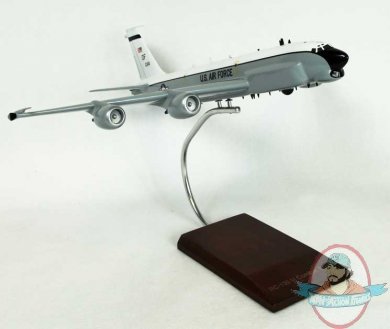
"The RC-135 is a reconnaissance aircraft used to support theater and national level consumers with near real-time on-scene intelligence collection, analysis and dissemination capabilities. The RC-135 is an extensively modified C-135, allowing the mission crews to detect, identify and geolocate signals throughout the electromagnetic spectrum. The current fleet of the RC-135 was initially employed by Strategic Air Command, satisfying nationally tasked reconnaissance requirements. The RC-135U Combat Sent is a reconnaissance aircraft used by the United States Air Force and was designed to collect technical intelligence on adversary systems. Currently, only two Combat Sents in the USAF, both based at Offutt AFB, Nebraska under the 55th Wing. The RC-135 participated in every armed conflict which involves U.S. assets during its tenure. The aircraft supported operations in Vietnam, the Mediterranean for Operation El Dorado Canyon, Grenada for Operation Urgent Fury, Operation Just Cause, Operations Deliberate Force and Allied Force and Southwest Asia for Operations Desert Shield, Desert Storm, Enduring Freedom and Iraqi Freedom. All RC-135s are assigned to Air Command and is permanently based at Offutt Air Force Base, Nebraska. The RC-135 is operated by the 55th Wing using various forward operating locations worldwide. "
Scale: 1/100 scale model
Wing Span: 16.25
Length: 17
CK135UT
|
"The USAF RC-135V/W RIVET JOINT surveillance aircraft are equipped with an extensive array of sophisticated intelligence gathering equipment enabling military specialists to monitor the electronic activity of adversaries. Also known as ""RJ"", the aircraft are sometimes called ""hogs"" due to the extended ""hog nose"" and ""hog cheeks"". RIVET JOINT has been widely used in the 1990's -- during Desert Storm, the occupation of Haiti, and most recently over Bosnia. Using automated and manual equipment, electronic and intelligence specialists can precisely locate, record and analyse much of what is being done in the electromagnetic spectrum. The fleet of 14 RIVET JOINT aircraft increased to 15 in late 1999 with the addition of a converted C-135B. The jet's conversion cost about $90 million. The Rivet Joint fleet is currently undergoing significant airframe, navigational and powerplant upgrades which include re-engining from the TF-33 to the CFM-56 engines used on the KC-135R and upgrade of the flight deck instrumentation and navigational systems to the AMP standard. The AMP standard includes conversion from analog readouts to a digital “glass cockpit” configuration. The Air Force plans to spend at least $1.4 billion to keep the RC-135 Rivet Joint (RJ) fleet flying through 2018. The service also plans to modify a recently retired Air National Guard KC-135 tanker, turning it into the Air Force’s 17th RJ signals-intelligence aircraft. "
Scale: 1/100 scale model
Wing Span: 16.63
Length: 16.75
CK135VT
|
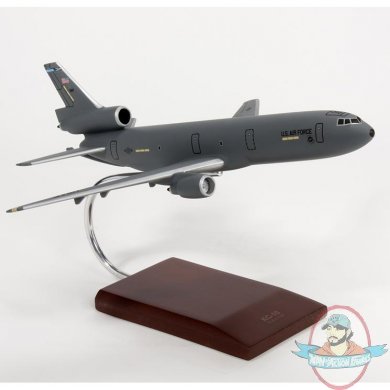
"The KC-10A Extender is an air mobility command advanced tanker and cargo aircraft designed to provide increased global mobility for US armed forces. Its primary mission is aerial refueling but it is capable of simultaneously carrying fighter support personnel and equipment on overseas deployments. It can also transport litter and ambulatory patients using patient support pallets during aeromedical evacuations. The KC-10A was the second consecutive McDonnell Douglas transport aircraft to be selected by the US Air Force following the C-9 Nightingale. The KC-10A was derived from the civilian DC-10 airliner and entered service in 1981. Although it retains 88 percent of the DC-10, it has additional systems and equipment necessary for its Air Force mission. These include military avionics, seated aerial refueling operator station, and aerial refueling receptacle and satellite communications. It also has three more large fuel tanks. Using either an advanced aerial refueling boom, or a hose and drogue centerline refueling system, the KC-10A can refuel a wide variety of US and allied military aircraft within the same mission. The aircraft is equipped with lighting for night operations. During Operations Desert Shield and Desert Storm in 1991, the KC-10A provided in-flight refueling to aircraft from the US armed forces and other coalition forces. In-flight refueling was vital to rapid airlift of materiel and forces in the early stages of Desert Shield. Furthermore, the KC-10A, along with the KC-135, transported tons of cargo and thousands of troops in support of the Persian Gulf buildup. The KC-10A and the KC-135 conducted approximately 51,700 separate refueling operations and delivered 475 million liters of fuel without missing a single schedule. "
Scale: 1/150 scale model
Wing Span: 13
Length: 14.5
CKC102T
|
"The KC-10A version of the Extender had its first flight on July 12, 1980. The aircraft is an Air Mobility Command advanced tanker and cargo aircraft designed to provide increased global mobility for U.S. armed forces. The first KC-10A was delivered to the Air Force on March 17 1981. The KC-10A force of 60 aircraft is based with the Air Combat Command at Barksdale AFB, La., and at March AFB, CA, beginning in the fall of 1982. The KC-10A is operated by the 305th Air Mobility Wing, McGuire Air Force Base, N.J.; and the 60th Air Mobility Wing, Travis AFB, Calif. Air Force Reserve Associate units are assigned to the 349th Air Mobility Wing at Travis, and the 514th Air Mobility Wing at McGuire. The KC-10A's primary mission is aerial refueling, and it can also combine the tasks of a tanker and cargo aircraft by refueling fighters and simultaneously carry the fighter support personnel and equipment on overseas deployments. The KC-10A can transport up to 75 people and nearly 170,000 pounds (76,560 kilograms) of cargo a distance of about 4,400 miles (7,040 kilometers) unrefueled. Since Sept. 11, 2001, KC-10s have played a prominent role in the on-going Global War on Terrorism. The KC-10 has flown more than 350 missions guarding U.S. skies as a part of Operation Noble Eagle. During operations Enduring Freedom and Iraqi Freedom, KC-10s have flown more than 1,390 missions delivering critical air refueling support to numerous joint and coalition receiver aircraft. "
Scale: 1/150 scale model
Wing Span: 13
Length: 14.5
CKC10T
|
"The Martin P6M Seamaster prototype first flew on July 14 1955. During flight testing, speeds in excess of 600 mph (966 km/h) were claimed. It embodied all the design features developed during World War II and immediately after the war. In 1952 Martin was awarded a contract, first, for a design study, and then a production contract for two prototypes known as Model '275. They would be modern in almost every way, despite their untimely destruction during tests. In the early 1950s, the Martin Seamaster was designed as a jet-powered seaplane bomber which could carry a nuclear weapon from virtually any body of water; lack of super-carriers at the time prevented the U.S. Navy from having a major strategic weapons strike force to compete with the Air Force and its long-range bombers. "
Scale: 1/72 scale model
Wing Span: 10.5
Length: 16.5
CP06M
|
"The first successful run of the P-59A jet engine was in April of 1937. The engine was designed in Britain by Sir Frank Whittle. Two years later in 1939, the Germans flew the first jet propelled aircraft. The “Whittle” technology was passed to the United States in late 1941. General Electric was awarded the contract to build the engines. And the Bell Aircraft was given the task of building an airframe suitable for the new engines. The P-59A planes were built by Bell Aircraft in Wheatfield, New York. The P-59A Airacomet was accepted from Bell Aircraft on the 25th of September, 1944, and was assigned to the 412th Fighter Group, located sequentially at Muroc, Bakersfield, and Santa Maria Army Air Fields in California. In October of 1945, the unit was stationed at March Field, and in 1946 the plane was retired. After service with the Air Force, the Airacomet was used as an instructional airframe at a technical school in Santa Maria, California. Sometime later it went into storage at Edwards AFB. "
Scale: 1/48 scale model
Wing Span: 11.13
Length: 9.25
CP59TR
|
McFarlane SportsPicks is no stranger to recreating some of the NBA’s greatest players as highly detailed action figures and their 20th lineup is no exception.
WARNING: CHOKING HAZARD - Small parts & small ball. Not for children under 3 years.
|
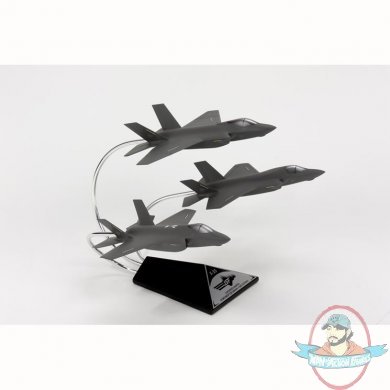
"The Joint Strike Fighter (JSF) is a joint, multinational acquisition program for the United States Air Force, Navy, Marine Corps and eight cooperative international partners. It was created to replace various aircraft while keeping development, production and operating costs down. The objective is to develop a technically superior and affordable fleet of aircraft that would be capable of a wide range of missions in a variety of theaters. On October 26, 2001, the contract was awarded to Lockheed Martin, whose X-35 experimental aircraft outperformed Boeing's X-32. The F-35 Lightning II, which is descended from the X-35, has become synonymous with the JSF program. It is a single-seat, single-engine, stealth-capable military strike fighter that can perform multiple roles such as close air support, tactical bombing and air-to-air combat. Expected to be the largest military aircraft procurement ever, the F-35 will replace a wide range of aging fighter and strike aircraft. The JSF aircraft design has three variants: conventional takeoff and landing (F-35A), short takeoff and vertical landing (F-35B), and carrier-based (F-35C). The F-35C naval variant will have a larger, folding wing and larger control surfaces for improved low-speed control, and stronger landing gear for the stresses of carrier landings. The larger wing area provides increased range and payload, with twice the range on internal fuel compared with the F/A-18C Hornet, achieving the same goal as the heavier F/A-18E/F Super Hornet. The US Navy intends to buy 480 F-35Cs to replace the Hornets. It will also serve as a stealthier complement to the Super Hornet. The F-35C is expected to be available beginning in 2012. Our F-35C Lightning II JSF/CV scale model is a faithful reproduction of the original aircraft. Handcrafted and hand-painted, it boasts of accurate details that are protected by a coat of clear lacquer. All models undergo various stages of quality control before reaching our customers. More than just a replica, it is a true work of art. The F-35C JSF/CV model aircraft is perfect as an addition to a growing collection or as an exquisite gift to a loved one. "
|
Scale: 1/40 scale model
Wing Span: 11.63
Length: 15
CF100TS
|
Scale: 1/40 scale model
Wing Span: 8.75
Length: 18
CF107AT
|
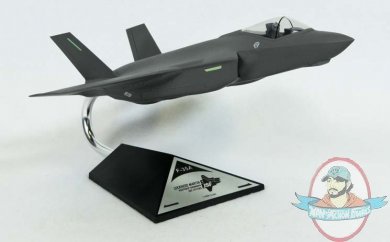
"The F-35A is the conventional takeoff and landing (CTOL) variant and is primarily used by the United States Air Force and other air forces. The F-35A is the smallest, lightest F-35 version and is the only variant equipped with an internal cannon. The F-35A can mathc the F-16 in terms of maneuverability, instantaneous and high-g performance and outperform it when it comes to stealth, range on internal fuel, avionics, operational effectiveness, supportability and survivability. It also has an internal laser designator and infrared sensors. In 2013, the A variant will be replacing the USAF's F-16 Fighting Falcons and on 2028, to replace the A-10 Thunderbolt II. "
Scale: 1/48 scale model
Wing Span: 8.75
Length: 12.75
CF035CNCCTP
|
"The North American F-86 Sabre is an American transonic jet combat aircraft developed in 1940 and was one of the most-produced Western jet fighters of the Cold War era. In 1949, the F-86 entered service with the United States Air Force, joining the 1st Fighter Wing's 94th Fighter Squadron ""Hat-in-the-Ring"" and became the primary air-to-air jet fighter used in the Korean War. F-86 pilots were credited to have shot down 792 MiGs with a loss of only 78 Sabres, a victory ratio of 10:1. Among the first recipients of surplus USAF Sabres was the Republic of China Air Force of Taiwan. In one month of air battles over Quemoy and Matsu, Nationalist pilots tallied a score of no less than 29 MiGs destroyed and eight probables. In 1954, the F-86 entered service with the Pakistan Air Force with the first batch of 120 aircraft. Pakistan Air Force F-86 Flying Ace Squadron Leader Muhammad Mahmood Alam officially credited with five kills in air-to-air combat and destroyed five more enemy Hunter aircraft in less than a minute. Mahmood Alam had a total of nine kills and two damaged to his credit. At the beginning of the war, Pakistani Air Force had eight squadrons of F-86 Sabres. The F-86s downed 31 Indian aircraft in air-to-air-combat. After the war, Pakistan slowly phased out the F-86 Sabres and replaced them with Chinese F-6 fighters. In 1980, the last of the Sabres were withdrawn from service in Pakistan Air Force. The F-86 are currently displayed in Pakistan Air Force Museum and in the cities to which their pilots lived. The F-86F is furnished with the J47-GE-27 engine with about 700 additional pounds of thrust, which increased its top speed about 15 mph to 695 mph. Combat range was increased from 660 miles to 923 miles. It was the first Sabre to haul a 1,200 lb. nuclear bomb , which was carried under the port wing. The F-86F was also furnished with a LABS which allowed the aircraft to escape the blast."
Scale: 1/48 scale model
Wing Span: 9.25
Length: 9.5
CF086FT
|
"The North American F-86 Sabre is an American transonic jet combat aircraft developed in the late 1940s and was considered the most produced Western jet fighters of the Cold War era. The F-86 was produced as both a fighter-interceptor and fighter-bomber and several variants were introduced, with improvements and different armament implemented. Inn 1949, the F-86 entered service with the United States Air Force, joining the 1st Fighter Wing's 94th Fighter Squadron ""Hat-in-the-Ring"" and it became the primary air-to-air jet fighter in the Korean War. Recent USAF records show that 224 F-86s were lost to all causes, including non-combat losses. Only one USAF pilot had flown the F-86 Sabre of the 40 other pilots earned the designation of ace during the Korean War. In 1954, 120 F-86 entered service with the Pakistan Air Force and it became the mainstay of the PAF and provided a qualitative edge against a larger Indian Air Force. During the Indo-Pakistani was of 1965, the PAF claimed to have shot sown 15 IAF aircraft, having a loss of 14 combat aircraft to the PAF's F-86s. During the Indo-Pakistani war in 1971, PAF had eight squadrons of F-86 Sabres and it performed well, downing 31 Indian aircraft in air-to-air combat, with a loss of seven F-86s. After the war, Pakistan replaced the F-86 Sabres with Chinese F-6 (Russian MiG-19) fighters and the remaining Sabres were withdrawn from service in 1980. The primary users of the F-86 are the United States Air Force, Pakistan Air Force and Portuguese Air Force. There are 9,680 F-86s built with 2,239 F-86Fs built. "
Scale: 1/32 scale model
Wing Span: 14.13
Length: 13.75
CF086TE
|
"The Northrop F-89 Scorpion is a twin-engine, all-weather fighter-interceptor designed to locate, intercept, and destroy enemy aircraft by day or night under all types of weather conditions. One of the most heavily armed fighter aircraft, it was the backbone of the United States Air Force's (USAF) Air Defense Command (ADC) for over 17 years, helping patrol the skies during the period when Soviet intercontinental bombers first became a threat. The F-89 was the first aircraft armed with nuclear weapons (the MB-1 Genie rocket) for air-to-air use. The Scorpion was a result of a 1945 US Army Air Forces specification for a jet-powered night fighter to replace the P-61 Black Widow. It was the first multi-seat, all-weather jet interceptor and the first aircraft designed to carry an all-rocket armament. Its advanced radar system was capable of tracking and engaging hostile bombers in any weather. A unique feature added to the prototype during development was the deceleron, a two-part aileron that could split open to act as an air brake. This feature became Northrop's trademark and is still being used today, as can be seen on the B-2 Spirit. The F-89's name came from its resemblance to a scorpion ready to strike. The name stuck and was later officially recognized by the Air Force. The aircraft made its maiden flight on August 16, 1948. The first production F-89A was accepted by the USAF on September 28, 1950. Only eight aircraft were completed before the type was upgraded to the F-89B, with new avionics. Unfortunately, these had considerable problems with engines and other systems, and soon gave way to the F-89C. The first major production model was the F-89D, which first flew on October 23, 1951 and entered service in 1954. On July 19, 1957, a Genie test rocket was fired from an F-89J, the first time in history that an air-to-air rocket with a nuclear warhead was launched and detonated. There were no new-build F-89Js, but 350 F-89Ds were modified to this standard. These served with the ADC through 1959 and with the Air National Guard through 1969. "
Scale: 1/48 scale model
Wing Span: 15.5
Length: 13.5
CF089T
|
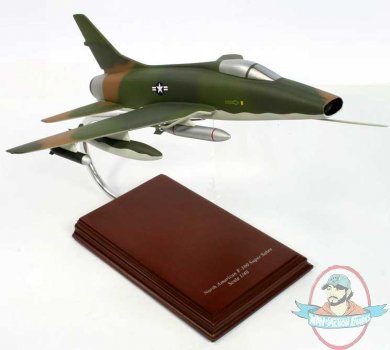
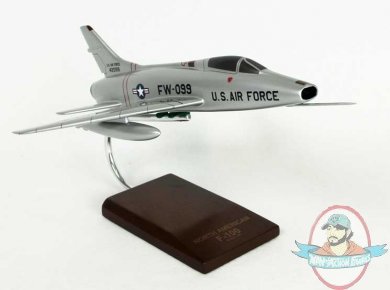
"The North American F-100 Super Sabre, affectionately known as “The Hun”, was a jetfighter aircraft that served with the United States Air Force (USAF) from 1954 to 1971 and with the Air National Guard (ANG) until 1979. The F-100 is one of those classics that rely on sheer power and good looks. F-100 Super Sabre first flew on May 25, 1953. The F-100D model of the Super Sabre was single-seat fighter-bomber, more advanced avionics, larger wing and tail fin, landing flaps. The F-100D first flew on January 24 1956, piloted by Dan Darnell. Late production models of the F-100D had the capability of being launched from remote areas in the manner of manned missiles. An F-100D Super Sabre became the first supersonic aircraft to be ""boosted"" airborne without use of a runway in successful Zero Length Launch (ZEL) tests at Edwards Air Force Base, California, in 1958. The F-100D Super Sabre featured many additional capabilities needed by the USAF, including a flapped wing, provisions for internal Electronic Counter-Measures (ECM) equipment and introduction of a Low-Altitude Bombing System (LABS). A total of 1,274 F-100D Super Sabre were built. One of these aircrafts is preserved at the Carolinas Aviation Museum. "
Scale: 1/48 scale model
Wing Span: 10
Length: 12.5
CF100T
|
"The F-111 is a twin-engine swing-wing aircraft which can take-off and land at relatively low speeds with the wings swept forward and can fly close to the ground a supersonic speeds. The General Dynamics F-111 is an American medium-range strategic bomber, reconnaissance and tactical strike aircraft designed in the 1960s. On July 27, 1996, the F-111 was officially named as Aardvark. The F-111 was affectionately called the ""Pig"". The F-111A was the initial production version of the F-111. It incorporates TF30-P-3 engines with 12,000 lbf dry and afterburning thrust and ""Triple Plow I"" variable intakes. There's a 158 total production of the F-111A, including 17 preproduction aircraft that were later brought up to production standards. In 1977, the remaining F-111As were transferred to the 366 TFW based at Mountain Home AFB, equipping the 389th, 390th and 391st TFS. There were four F-111As converted to F-111C standard and provided to Australia as attrition replacements. Some of the F-111As delivered to the Royal Australian Air Force were Vietnam veterans. In USAF service, the F-111 was replaced by the F-15E Strike Eagle for medium-range precision strike missions. In 2010, the Royal Australian Air Force will replace its F-111s with 24 F/A-18F Super Hornets. "
Scale: 1/48 scale model
Wing Span: 10
Length: 18.5
CF111TR
|
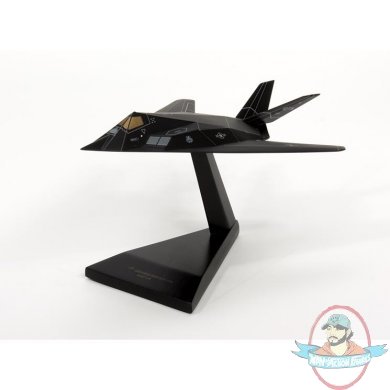
"The F-117 Black Jet, also known as the “Nighthawk”, was manufactured by Lockheed Martin. The F-117 was built to be used by the U.S Air Force. The U.S decided to develop a full-scale, radar-evading fighter. The F-117 had its first flight in June 1981. The F-117A, a Black Jet variant, may look as if it were built for use by alien beings, but it is actually flown by flesh-and-blood humans like Capt. Phil McDaniel, a pilot with the 37th Tactical Fighter Wing. Any way you look at it, the F-117A is an unusual aircraft. Its design and development were also out of the ordinary. The F-117A is equipped with sophisticated navigation and attack systems integrated into a digital avionics suite. It carries no radar, which lowers emissions and cross-section. It navigates primarily by GPS and high-accuracy inertial navigation. Missions are coordinated by an automated planning system that can automatically perform all aspects of a strike mission, including weapons release. Targets are acquired by a thermal imaging infrared system, slaved to a laser that finds the range and designates targets for laser-guided bombs. "
Scale: 1/72 scale model
Wing Span: 6.63
Length: 11
CF117TP
|
This great collection spans the history of the Blue Angels. Mounted on a beautiful mahogany base all eight model aircrafts are precisely hand finished to exact detail, from F-6F Hellcat to the currently used F/A-18 Hornet. Complete with the Blue Angels logo and brass plaques indicating the aircraft type and years flown.
Scale: 1/72 scale model
Wing Span: 36
Length: 13
CFBAC
Pre-Order! Available: September
|
|
|
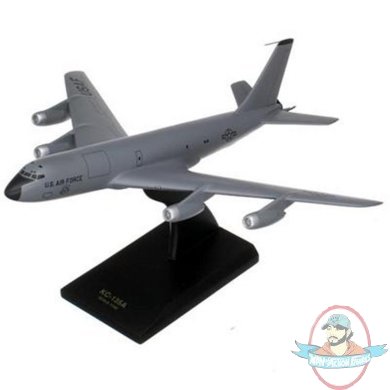
"The Boeing KC-135 Stratotanker is the only aerial refueling tanker and transport aircraft. The aircraft can also carry passengers or cargo as all the refueling equipment is below the main cabin deck. KC-135 made its first flight on August 17, 1956. The KC-135 served in combat during the Vietnam Conflict and Desert Storm. It also provided refueling support for many operations, both military and humanitarian, such as Operation Restore Hope in Somalia. It has been in service with the U.S. Air Force since 1957 and still serves as the backbone of America's tanker fleet. The KC-135A variant first flew on August 31, 1956 and the initial production Stratotanker was delivered to Castle Air Force Base, Calif., in June 1957. The KC-135A entered service with the U.S. Air Force on 28 June 1957. The last KC-135 was delivered to the Air Force in 1965. Of the original KC-135A's, more than 410 have been modified with new CFM-56 engines produced by CFM-International. The re-engined tanker, designated either the KC-135R or KC-135T, can offload 50 percent more fuel, is 25 percent more fuel efficient, costs 25 percent less to operate and is 96 percent quieter than the KC-135A. "
Scale: 1/100 scale model
Wing Span: 16
Length: 16.5
CK135AT
|
"The F-22 Raptor is the newest fighter aircraft of the United States Air Force (USAF). Originally an air superiority fighter for use against the Soviet Air Force, it is also capable of ground attack, electronic warfare and signals intelligence roles. The F-22 is a combination of stealth, supercruise, maneuverability, integrated avionics and improved supportability. It performs both air-to-air and air-to-ground missions, making it vital to the USAF. The Raptor is capable of providing first-kill opportunities against threats. Its sophisticated aerodesign, advanced flight controls, thrust vectoring and high thrust-to-weight ratio provide the capability to outmaneuver all current and projected aircraft. Intended to be the leading American advanced tactical fighter in the early part of the 21st century, the Raptor is the world's most expensive fighter to date. The F-22 was born out of the Advanced Tactical Fighter (ATF) demonstration and validation program to develop a next-generation air superiority fighter to counter emerging worldwide threats, inlcuding development and proliferation of Soviet-era Su-27 Flanker type aircraft. In 1981, the Air Force put out a requirement for a new air superiority fighter that would replace the capability of the F-15 Eagle, incorporating emerging technologies such as advanced alloys, fly-by-wire flight control systems and stealth technology. In October 1986, two contractor teams, Lockheed/Boeing/General Dynamics and Northrop/McDonnell Douglas, were selected to build prototypes. In August 1991, after a fly-off competition, Lockheed's YF-22 was declared the winner and the company was awarded the contract to produce the ATF. "
Scale: 1/72 scale model
Wing Span: 7.5
Length: 10.13
CF0222TR
|
"The F-22 Raptor was born out of the Advanced Tactical Fighter (ATF) demonstration and validation program to develop a next-generation air superiority fighter to counter emerging worldwide threats. It is the newest fighter aircraft of the United States Air Force (USAF). Though originally an air superiority fighter for use against the Soviet Air Force, it is also capable of ground attack, electronic warfare and signals intelligence roles. The F-22 is a combination of stealth, supercruise, maneuverability, integrated avionics and improved supportability. It performs both air-to-air and air-to-ground missions, making it vital to the USAF. The Raptor is capable of providing first-kill opportunities against threats. Its sophisticated aerodesign, advanced flight controls, thrust vectoring and high thrust-to-weight ratio provide the capability to outmaneuver all current and projected aircraft. Intended to be the leading American advanced tactical fighter in the early part of the 21st century, the Raptor is the world's most expensive fighter to date. In 1981, the Air Force put out a requirement for a new air superiority fighter that would replace the capability of the F-15 Eagle, incorporating emerging technologies such as advanced alloys, fly-by-wire flight control systems and stealth technology. In October 1986, two contractor teams, Lockheed/Boeing/General Dynamics and Northrop/McDonnell Douglas, were selected to build prototypes. In August 1991, after a fly-off competition, Lockheed's YF-22 was declared the winner and the company was awarded the contract to produce the ATF. In April 1992, during flight testing, the first YF-22 prototype crashed while landing. The test pilot was able to escape uninjured. When the first production model was unveiled, the plane was formally named F-22 Raptor. The F-22's maiden flight was on September 7, 1997. In September 2002, USAF leaders gave the redesignation F/A-22, but on December 12, 2005, it was changed back to F-22. On December 15, 2005, the Raptor entered service. Air Education and Training Command and Air Combat Command are the primary Air Force organizations operating the aircraft. In 2006, the Raptor's development team won the Collier Trophy, the most prestigious American aviation award. There are currently 91 F-22s in active service. "
|
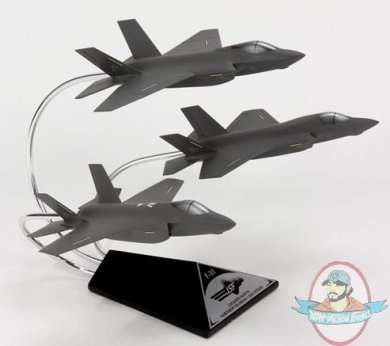
"The Joint Strike Fighter (JSF) is a joint, multinational acquisition program for the United States Air Force (USAF), Navy, Marine Corps and eight cooperative international partners. It was created to replace various aircraft while keeping development, production and operating costs down. The objective is to develop a technically superior and affordable fleet of aircraft that would be capable of a wide range of missions in a variety of theaters. The F-35 Lightning II, which is descended from the X-35, has become synonymous with the JSF program. I The JSF program's hallmark of affordability is achieved through a high degree of commonality among its three variants: conventional takeoff and landing (CTOL), short takeoff and vertical landing (STOVL), and carrier-based. The CTOL variant is designated F-35A, and the first aircraft rolled off the assembly line on February 19, 2006. After undergoing extensive ground testing, it completed its maiden flight on December 15, 2006. The F-35A is the smallest, lightest version and is the only one equipped with an internal gun. It is intended to replace the F-16 Fighting Falcons and A-10 Thunderbolts of the Air Force beginning in 2011. The F-35A matches or exceeds F-16 performance levels and goes beyond with increased range on internal fuel and advanced avionics. As a result, operational effectiveness, supportability, and survivability are greatly enhanced. Unlike the F-16, the aircraft is stealthy, enabling first-look, first-shot capability. It is equipped with internal laser designators and infrared sensors as well. As of 2004, requirements called for 1,763 F-35As, making it the most-produced variant. The Air Force is tentatively scheduled to receive its first aircraft in 2008, but initial operational capability for the service is set for 2011. The Lightning II is expected to be the world's premier strike aircraft through 2040. It will provide air-to-air capability second only to the F-22 Raptor. "
Scale: 1/48 scale model
Wing Span: 8.5
Length: 12.75
CF035AAFCCT
|
"The F-35B, a variant of the F-35 Lightning II, is the Short Takeoff and Vertical Landing (STOVL) aircraft. This takeoff and landing operation succeeds through a very innovative technology known as the shaft-driven lift fan propulsion system. Besides the propulsion system, the STOVL variant differs only slightly from the US Air Force variant. The short takeoff/vertical landing (STOVL) F-35B will replace the aging AV-8B Harrier STOVL attack jets (which have also proven increasingly difficult to support) of the US Marine Corps, as well as its F/A-18s. The F-35B will have a stealthy, belly-mounted 25 mm missionized gun pod and a combat radius of more than 450 NM- nearly two times that of legacy STOVL strike fighters. A shaft-driven lift fan, in combination with a vectoring rear exhaust nozzle, gives this fighter the ability to take off in short distances, accelerate to supersonic speeds in level flight, and land vertically. Thanks to the lift-fan system, the F-35B's total vertical lifting thrust is about 39,700 pounds (the aircraft weighs about 30,000 pounds)- more than 14,000 pounds greater than the engine alone would produce without the lift fan. The F-35B will be the world's first operational supersonic STOVL aircraft. The F-35B is similar in size to the Air Force F-35A, trading fuel volume for vertical flight systems. Like the AV-8 Harrier II, guns will be carried in a ventral pod. Vertical flight is by far the riskiest, and in the end, a decisive factor in design. "
Scale: 1/48 scale model
Wing Span: 8.5
Length: 12.75
CF035B1TR
|
"The F-35B JSF STOVL is a single-seat, single-engine, stealth-capable military strike fighter, a short takeoff and vertical landing (STOVL) variant aircraft that can perform close air support, tactical bombing, and air-to-air combat. The F-35B was developed by an aerospace industry team led by Lockheed Martin, with Northrop Grumman and BAE Systems as major partners. It took its first flight on December 15, 2006. The F-35B was the result of the Joint Strike Fighter (JSF) program created by the U.S. Defense Department, out of a requirement for a multi-role fighter aircraft capable of both air-to-ground and air-to-air missions. The F-35B replaced the AV-8B Harrier STOVL and F/A-18 fighter planes of the US Marine Corps. The F-35B's advantage over other legacy STOVL strike fighters is its concealed belly-mounted 25 mm gun pod and combat radius of more than 450 NM, which is two times greater than the latter. The U.S. Air Force (USAF) requested to acquire hundreds of F-35B STOVL for the battlefield close support role in 2004. JSF program officials insisted that they do not want to build a fourth JSF variant despite the USAF's interest in acquiring a new STOVL model. However, Lockheed Martin still developed the fourth version of the Joint Strike Fighter to satisfy the needs of the Navy, Marine Corps and Air Force of the United States, and the Royal Air Force and Navy of the United Kingdom. "
Scale: 1/72 scale model
Wing Span: 5.75
Length: 8.5
CF035B2TR
|
"Known as the Joint Strike Fighter (previously the Joint Advanced Strike Technology) program, the F-35 Lightning II is a family of multi-role aircraft developed under a multinational acquisition program. In cooperation with BAE Systems and Northrop Grumman, the F-35 is currently under development and production by Lockheed Martin. Lockheed Martin was selected by the Department of Defense (DOD) on October 26, 2001 after beating out competition from McDonnell Douglas and then Boeing in the design and demonstration phases of the program (1994-2001). The aircraft will be powered by the Pratt & Whitney F135 engine. The distinguishing feature of the United States Marine Corps (USMC) version of the JSF is its short takeoff/vertical landing capability (STOVL). There will not be an internally mounted machine gun, but an external gun can be fitted. This version requires controllability on all axes while hovering. Another critical design feature is its impact on the ground surface beneath it during hover. The USMC expects their version of the JSF will replace the F/A-18 Hornet and the AV-8 Harrier. The Marine Corps expects to purchase 480 STOVL versions of the F-35. "
Scale: 1/40 scale model
Wing Span: 10.75
Length: 15
CF035B3TR
|
Scale: 1/40 scale model
Wing Span: 10.75
Length: 15
CF035A2TR
|
Model Description
The F-35 is descended from the X-35, the product of the Joint Strike Fighter (JSF) program. JSF development is being principally funded by the United States, with the United Kingdom and other partner governments providing additional funding. The partner nations are either NATO members or close U.S. allies. It is being designed and built by an aerospace industry team led by Lockheed Martin. The F-35 took its first flight on 15 December 2006. This specific F-35A is painted in the Thunderbird paint scheme. The Thunderbirds are the air demonstration squadron of the U.S. Air Force (USAF), based at Nellis AFB in Las Vegas, Nevada. The squadron tours the United States and much of the world, performing aerobatic formation and solo flying in specially-marked USAF jet aircraft. The name is taken from the legendary creature that appears in the mythology of several indigenous North American cultures.
Scale: 1/40 scale model
Wing Span: 10.75
Length: 15
CF035TBR
|
An STOVL is an acronym for Short Take Off and Vertical Landing. It is an ability of some aircraft like the F35B to take off from a short runway or take off verticalyy if it doesn't have a very heavy payload and land vertically. This is often accomplished on aircraft carriers through the use of "ski-jump" runways, instead of the conventional catapult system. STOVL use tends to allow aircraft to carry a larger payload as compared to during the VTOL use, while still only requiring a short runway.
Scale: 1/48
Wing Span: 8.50
Length: 12.75
CF035BMCCTP
|
"The Boeing F/A-18F Super Hornet is a carrier-based multi-mission strike fighter that entered service with the United States Navy (USN) in 1999. It is a larger and more advanced version of the night strike F/A-18C/D Hornet. The Super Hornet prodvides the battle group commander with a platform that has range, endurance, and ordnance carriage capabilities comparable to those of the retired A-6 Intruder. Ordered from McDonnell Douglas by the USN in 1992, the Super Hornet first flew in November 1995. It is informally referred to as the Rhino, to distinguish it from earlier model legacy Hornets. Initial production began in 1995. Flight testing started in 1996 and ended in 1999. Testing involved 3,100 test flights covering 4,600 flight hours. The aircraft passed the Navy's operational tests and evaluations in February 2000, and has replaced the A-6 Intruder, S-3 Viking and KA-6D. The Super Hornet is capable of performing a broad spectrum of roles, including day/night strikes with precision-guided weapons, anti-air warfare, fighter escort, reconnaissance, forward air control, close air support, suppression of enemy air defense (SEAD), maritime strike and air-to-air refueling. During Operation Iraqi Freedom, the Super Hornet flew close air support, strike, escort SEAD and aerial refueling roles. Two F/A-18Fs were forward deployed to USS Abraham Lincoln (CVN-72). On September 8, 2006, an F/A-18F from the Navy's Strike Fighter Squadron 211 expended GBU-12 and GBU-38 bombs against Taliban fighters and Taliban fortifications west and northwest of Kandahar. This was the first time the unit was in combat with the aircraft. By the end of 2010, five F/A-18F squadrons (along with five F/A-18E squadrons) will operate on aircraft carriers in the Atlantic Fleet area of responsibility. "
Scale: 1/48 scale model
Wing Span: 10.25
Length: 14
CF018FTR
|
"The Boeing EA-18G Growler is a carrier-based electronic warfare aircraft based on the two-seat F/A-18F Super Hornet. It began production in 2007 and is scheduled for fleet deployment in 2009. The EA-18G will serve as the United States Navy's replacement for the EA-6B Prowler, providing a capability to detect, identify, locate, and suppress hostile emitters. The Growler will perform full-spectrum electronic surveillance and electronic attack of enemy threat radars and communications nets. It is a highly flexible design that enables the warfighter to perform a broad range of tactical missions, operating from either the deck of an aircraft carrier or land-based fields. Since the EA-18G is a derivative of the F/A-18F, it is expected to significantly reduce support and training costs for the Navy. "
Scale: 1/48 scale model
Wing Span: 14
Length: 10.25
CF018GR
|
"The F/A-18 Hornet is a modern supersonic, carrier-capable fighter and attack aircraft, designed for both air and ground attacks. It was developed in 1970 based upon the experimental YF-17 designed by the McDonnell Douglas Company for the U.S. Navy and U.S. Marine Corps. The F/A-18 has been the aerial show aircraft for the Blue Angels since 1986. Its main missions include fighter escort, fleet air defense, suppression of enemy air defenses, interdiction, close air support and reconnaissance. Its versatility and dependability have proven it to be a useful carrier specialist but has been remarked for its low range and lack of payload compared to other strike fighter aircrafts. The Hornet first flew on November 18 1978, and was introduced to several other nations on January 7, 1983. A total of 1,458 F/A-18A built. In 1970, the F/A-18 Hornet served for the U.S. Navy and U.S. Marine Corps. The Hornet is also used by the air forces of several other nations. The F/A-18A Hornet is a single-seat fighter/attack “Hornet” variant by the U.S. Marine Corps. The U.S Marine Corps is a part of American military which is responsible for providing power projection from the sea, utilizing the mobility of the U.S. Navy to rapidly deliver combined-arms task forces. The F/A-18A was a previously designated F-18A and A-18A. The Hornet has a dual fighter/attack mission capability. The F/A-18A was also used by the U.S. Naval Flight Demonstration Team, the Blue Angels, in their air shows and other special events across the US and worldwide. On November 8 1986, during the 40th anniversary of the Blue Angels, the team unveiled the F/A-18A as their newest aircraft. "
Scale: 1/48 scale model
Wing Span: 14
Length: 10.25
CF018MTP
|
"The F/A-18 Hornet is a single seat or a tandem seat aircraft designed for the US Navy and US Marine Corps. The F/A-18 Hornet can operate from either aircraft carriers or land bases. The F/A-18 Hornet aircraft had diverse roles, such as a fighter escort, suppressing enemy air defenses, reconnaissance, forward air control, close and deep air support and day and night strike missions. Since 1986, the F/A-18 Hornet was used for the aerial demonstration for the Blue Eagles. The versatility of the aircraft proved that the F/A-18 Hornet is a valuable asset. The F/A-18 Hornet aircraft has many features -- a digital control by wire flight control system and a solid thrust to weight ratio and superior turn characteristics with energy sustainability. Moreover, the F/A-18 Hornet was also considered as the Navy’s first tactical jet aircraft to integrate a digital MUX bus architecture for the entire system’s avionics suite. The F/A-18 Hornet is said to be the first tactical aircraft designed to carry out both air to air and air to ground missions. It was used by the US Navy, US Marine Corps, and the Air Forces of Canada, Australia, Spain, Kuwait, Finland, Switzerland and Malaysia. "
Scale: 1/48 scale model
Wing Span: 14
Length: 10.25
CF018TP
|
"The McDonnell Douglas F/A-18 Hornet was a result of the United States Navy's (USN) Naval Fighter Attack Experimental program to procure a multirole aircraft to replace the F-4 Phantom II, A-4 Skyhawk and A-7 Corsair II, and to complement the F-14 Tomcat. Secretary of the Navy W. Graham Claytor, Jr. gave the name “Hornet” on March 1, 1977. The F/A-18 is a twin-engine, multi-mission fighter/attack aircraft that can operate from either aircraft carriers or land bases. It was designed to attack both ground and aerial targets. Developed in the 1970s for service with the Navy and the US Marine Corps, it is also used by the air forces of several other nations. The Hornet fills a vast spectrum of roles, including fleet air defense, interdiction, air superiority, suppression of enemy air defenses, close and deep air support, reconnaissance, forward air control, fighter escort, and day and night strike missions. In addition, it is the aerial demonstration aircraft of the USN's Navy Flight Demonstration Squadron, the Blue Angels. Formed in 1946, the Blue Angels are the world's first officially sanctioned military aerial demonstration team. The group has been using the Hornet since they completed their 40th anniversary year and unveiled the sleek aircraft on November 8, 1986. The power and aerodynamics of the Hornet allows them to perform a slow high angle of attack “tail sitting” maneuver, and to fly a loop with landing gear down in formation, neither of which has been duplicated by the Thunderbirds of the Air Force. The Blue Angels perform more than 70 shows at 34 locations throughout the United States each year, where they still employ many of the same practices and techniques in their aerial displays as in 1946. Since their inception, they have flown for more than 427 million spectators worldwide. "
Scale: 1/38 scale model
Wing Span: 14
Length: 20
CF018BATS
Pre-Order! Available: September
|
"The McDonnell Douglas F/A-18 Hornet is a twin engine, multi-mission fighter/attack aircraft that can operate from either aircraft carriers or land bases. It was designed to attack both ground and aerial targets. Developed in the 1970s for service with the United States Navy (USN) and the US Marine Corps (USMC), it is also used by the air forces of several other nations. The Hornet fills a vast spectrum of roles, including fleet air defense, interdiction, air superiority, suppression of enemy air defenses (SEAD), close and deep air support, reconnaissance, forward air control, fighter escort, and day and night strike missions. In addition, it has been the aerial demonstration aircraft of the USN's Navy Flight Demonstration Squadron, the Blue Angels, since 1986. The F/A-18 was a result of the USN's Naval Fighter Attack Experimental (VFAX) program to procure a multirole aircraft to replace the F-4 Phantom II, A-4 Skyhawk and A-7 Corsair II, and to complement the F-14 Tomcat. Secretary of the Navy W. Graham Claytor, Jr. gave the name “Hornet” on March 1, 1977. The F/A-18 was among the first planes to heavily utilize multi-function displays, which at the switch of a button allow the pilot to perform either fighter or attack roles, or even both. The Hornet is also notable for having been designed with maintenance in mind, hence requiring far less downtime than its counterparts. "
Scale: 1/38 scale model
Wing Span: 11.75
Length: 17.5
CF018CTS
|
"The Boeing F/A-18E Super Hornet is a carrier-based multi-mission strike fighter that entered service with the United States Navy (USN) in 1999. It is a larger and more advanced version of the night strike F/A-18C/D Hornet. The Super Hornet provides the battle group commander with a platform that has range, endurance, and ordnance carriage capabilities comparable to those of the retired A-6 Intruder. Ordered from McDonnell Douglas by the USN in 1992, the Super Hornet first flew in November 1995. It is informally referred to as the Rhino, to distinguish it from earlier model legacy Hornets. Initial production began in 1995. Flight testing started in 1996 and ended in 1999. Testing involved 3,100 test flights covering 4,600 flight hours. The aircraft passed the Navy's operational tests and evaluations in February 2000, and has replaced the A-6 Intruder, S-3 Viking and KA-6D. The Super Hornet is capable of performing a broad spectrum of roles, including day/night strikes with precision-guided weapons, anti-air warfare, fighter escort, reconnaissance, forward air control, close air support, suppression of enemy air defense (SEAD), maritime strike and air-to-air refueling. The Navy's Strike Fighter Squadron 115 was the first unit to bring their Super Hornets to combat. On November 6, 2002, in support of Operation Southern Watch, two F/A-18Es conducted a “Response Option” strike on two surface-to-air missile launchers at Al Kut and an air defense command and control bunker at Tallil Air Base. It was the first time 2,000-pound JDAM bombs were dropped from the F/A-18E in wartime. During Operation Iraqi Freedom, the Super Hornet flew close air support, strike, escort SEAD and aerial refueling roles."
Scale: 1/48 scale model
Wing Span: 11.5
Length: 15
CF018ETR
|
Block 60 - In May 1998 the UAE announced selection of the Block 60 F-16 to be delivered between 2002-2004. The upgrade package consists of a range of modern systems including conformal fuel tanks for greater range, new cockpit displays, an internal sensor suite, a new mission computer and other advanced features including a new agile beam radar.
Wing Span: 6 Inches
Length: 8.5 Inches
|
"The F-16 Fighting Falcon is a compact, single-engined jet fighter aircraft manufactured for the United States Air Force (USAF). Though designed as a lightweight fighter, it has evolved into a successful multirole aircraft. It is highly maneuverable and has proven its worth in air-to-air combat and air-to-surface attack. The Falcon is the largest Western fighter program with over 4,000 aircraft built since its production in 1976. Though no longer produced for the Air Force, it is still being made for export. Its relatively low cost and high performance has made it popular worldwide, serving a total of 24 countries. From the very beginning, the Falcon was intended to be a cost-effective workhorse that could perform various missions. Advanced aerospace science and proven reliable systems from other planes were integrated into the F16. These simplified the aircraft and reduced its size, weight, purchase price and maintenance costs. The F-16 has excellent acceleration, being one of the few jets with a thrust-to-weight ratio greater than one. It can also be armed with a wide variety of air-to-air and air-to-ground missiles, rockets or bombs. An all-weather capability allows it to accurately deliver ordnance during non-visual bombing conditions. The F-16C is the upgraded version of the F-16A, with the latest cockpit control and display technology. The Falcon has participated in numerous conflicts, mostly in the Middle East. Since the end of Operation Desert Storm, it patrolled the Iraqi no-fly zones. Two air-to-air victories were scored in Operation Southern Watch, the first one by an F-16D and the second by an F16C. On January 17, 1993, an F-16C destroyed an Iraqi MiG-23 with an AIM-120 Advanced Medium-Range Air-to-Air Missile (AMRAAM). The F-16 was also employed by NATO during Operation Allied Force over Yugoslavia, conducting air-to-ground sorties and achieving one or two aerial victories, one by a Royal Netherlands Air Force F-16A and another possibly by a USAF F-16C. A Yugoslavian MiG-29 may have been shot down by an F-16C with two AMRAAMs, but the Serbs subsequently found fragments of a Strela-2M MANPAD in the wreckage of the MiG-29. "
Scale: 1/32 scale model
Wing Span: 12.63
Length: 18.5
CF016CTS
|
"The F-16 Fighting Falcon is a compact, single-engined jet fighter aircraft manufactured for the United States Air Force (USAF). Though designed as a lightweight fighter, it has evolved into a successful multirole aircraft. It is highly maneuverable and has proven its worth in air-to-air combat and air-to-surface attack. The Falcon is the largest Western fighter program with over 4,000 aircraft built since its production in 1976. Though no longer produced for the Air Force, it is still being made for export. Its relatively low cost and high performance has made it popular worldwide, serving a total of 24 countries. The F-16C is the upgraded version of the F-16A, with the latest cockpit control and display technology. The Falcon has participated in numerous conflicts, mostly in the Middle East. Since the end of Operation Desert Storm, it patrolled the Iraqi no-fly zones. Two air-to-air victories were scored in Operation Southern Watch, the first one by an F-16D and the second by an F-16C. On January 17, 1993, an F-16C destroyed an Iraqi MiG-23 with an AIM-120 Advanced Medium-Range Air-to-Air Missile (AMRAAM). The F-16 was also employed by NATO during Operation Allied Force over Yugoslavia, conducting air-to-ground sorties and achieving one or two aerial victories, one by a Royal Netherlands Air Force F-16A and another possibly by a USAF F-16C. A Yugoslavian MiG-29 may have been shot down by an F16C with two AMRAAMs, but the Serbs subsequently found fragments of a Strela-2M MANPAD in the wreckage of the MiG-29. The USAF plans to retain the Falcon until 2025. It can be seen in movies such as Blue Thunder, Jewel of the Nile, the Iron Eagle series, X2 and The Sum of All Fears. The aircraft is also a popular model for computer flight simulators, appearing in over twenty games, including F-16 Fighting Falcon, Strike Commander and iF-16. "
Scale: 1/32 scale model
Wing Span: 12.63
Length: 18.5
CF016CT
|
"The F-16 Fighting Falcon is a compact, single-engined jet fighter aircraft manufactured by General Dynamics and later Lockheed Martin for the United States Air Force (USAF). Though designed as a lightweight fighter, it has evolved into a successful multirole aircraft. It is highly maneuverable and has proven its worth in air-to-air combat and air-to-surface attack. The Falcon is the largest Western fighter program with over 4,000 aircraft built since its production in 1976. Though no longer produced for the Air Force, it is still being made for export. Its relatively low cost and high performance has made it popular in the United States and allied nations. USAF pilots gave the F-16 the unofficial nickname of “Viper” in homage to the fictional Battlestar Galactica starfighter. Aside from serving with air forces in 24 different countries, the Falcon is also the current aircraft of choice of the USAF Thunderbirds Air Demonstration Squadron. In March 1982, it was announced that the Thunderbirds would trade in their T-38 Talons for F-16 Falcons. The team sat out the 1982 airshow season to spend the year retraining and transiting over into the new aircraft. Transition to the F16 was completed in November 1982, and the first public demonstration took place in April 1983. In 1992, the squadron switched to the C version of the F-16, being the last active duty unit to use the A model. The F-16C is nearly identical to the F-16A, but has upgraded avionics and radar systems, making it superior to its predecessor. Additionally, it is the only fighter to win both of the Air Force’s premier competitions, namely Gunsmoke (air-to-ground) and William Tell (air-to-air). The Falcon has remained with the Thunderbirds for the last 20 years, the longest performance era of any one aircraft. "
Scale: 1/72 scale model
CF016TF
|
"The F-16 Fighting Falcon is a compact, single-engined jet fighter aircraft manufactured by General Dynamics and later Lockheed Martin for the United States Air Force (USAF). Though designed as a lightweight fighter, it has evolved into a successful multirole aircraft. It is highly maneuverable and has proven its worth in air-to-air combat and air-to-surface attack. The Falcon is the largest Western fighter program with over 4,000 aircraft built since its production in 1976. Though no longer produced for the Air Force, it is still being made for export. Its relatively low cost and high performance has made it popular in the United States and allied nations. USAF pilots gave the F-16 the unofficial nickname of ""Viper"" in homage to the fictional Battlestar Galactica starfighter. From the very beginning, the Falcon was intended to be a cost-effective workhorse that could perform various missions. Advanced aerospace science and proven reliable systems from other planes such as the F-15 and F-111 were integrated into the F-16. These simplified the aircraft and reduced its size, weight, purchase price and maintenance costs. Other innovations include a frameless, bubble canopy for better visibility, a side-mounted control stick to ease control while under high g-forces, and a reclined seat to reduce the effect of g-forces on the pilot. The F-16 has excellent acceleration, being one of the few jets with a thrust-to-weight ratio greater than one. It can also be armed with a wide variety of air-to-air and air-to-ground missiles, rockets or bombs. An all-weather capability allows it to accurately deliver ordnance during non-visual bombing conditions."
Scale: 1/32 scale model
Wing Span: 11.75
Length: 17.75
CF016TTS
Pre-Order, Sold Out Available: September
|
"The McDonnell Douglas F/A-18 Hornet is a twin-engine, multimission and tactical aircraft designed for the offensive, both ground and aerial targets. The F/A-18A entered service on September 13, 1978 and its maiden flight was on November 18. The first production of F/A-18A flew on April 12, 1980. The F/A-18 first saw combat action in April 1986, the time during operation Prairie Fire, when VFA-131 Hornets from USS Coral Sea flew SEAD missions against Libyan air defenses. The aircraft has an M611A1 20-mm gun mounted inside the nose of the craft and carries up to 13,700 pounds of external ordinance and has nine weapon stations. The F/A-18 fulfills these assignments: fighter escort, supression of enemy air defenses, forward air control, close air support and day and night strike missions. The F/A-18A has a maximum speed of 1,190 mph at 40,000 ft. and has a ferry range of 2,070 mi. The F/A-18 utilizes various systems and technologies to minimize the likelihood of detection. It has an APG-73 with increased speed and memory capacity. It also has a laser target designator/ranger which enables it to deliver precision laser-guided bombs accurately. In 2001, four F/A-18A aircrafts were deployed to Diego Garcia during coalition operations against the Taliban in Afghanistan. The F/A-18 has been deployed by the armed services to the United States (NAvy an MArines), Canada, Australia, Spain, Kuwait, Finland, Switzerland and Malaysia."
Scale: 1/48 scale model
Wing Span: 10.25
Length: 14
CF018BATP
|
"The Wild Weasel was derived from the Project Wild Weasel. The Wild Weasel is an aircraft designed to identify, locate and physically suppress or destroy ground-based enemy air defense systems. By 1975, the F-4G Phantom became the Wild Weasel. There are about 116 F-4Es rebuilt as F-4Gs. The F-4G Wild Weasels were stationed at George AFB, Victorville, CA. and were deployed to four active wings; one wing was assigned to USAFE (US Air Forces Europe) at Spangdahlem AB, Germany and the other was assigned to PACAF (Pacific Air Forces) at Clark AFB, Philippines. The F-4G saw combat during the Gulf War and was reported to have only lost a single aircraft. After the Gulf War, the George AFB aircraft were assigned to the Air National Guard at Boise, ID. In 1991, the F-4G Phantom Wild Weasel was deployed in Operation Desert Storm in Iraq and its EW System had been upgraded to an AN/APR-47 configuration. The F-4G fired more than 1,000 air-to-ground missiles and destroyed more than 200 targets. On January 2, 1996, the F-4G Wild Weasel flew its last combat mission to Southern Iraq and shortly, it retired from active service. The F-4G was also the last operational variant of the Phantom II in the US Forces. "
Scale: 1/48 scale model
Wing Span: 10
Length: 16.5
CF004AWWT
|
"The F-4N Phantom II was used by the U.S. military as the primary air fighter and a fighter-bomber for the US Air Force, Navy and Marines during the Vietnam War. The F-4N upgrade program began in 1970, as response to Navy concerns about the condition of the F-4B aircraft, which by that time were over a decade old and rather the worse for wear. In that year, a program named Bee Line was initiated in which the F-4Bs were refurbished and modernized. The aircraft were sent to NAS North Island, California, where they were stripped and inspected. They were then completely rebuilt using new parts. The changes included a structural strengthening to extend the fatigue life, plus a complete rewiring. The electrical generating system was upgraded with 30-kVA constant speed alternators. The F-4N retained the thin wings and tires, the main radar, and the undernose infrared search and track detector of the F-4B. The first F-4N flew on June 4, 1972, and the first rebuilt F-4N entered service in February 1973. By 1983, the F-4Ns had been completely replaced by F-14 Tomcats."
Scale: 1/48 scale model
Wing Span: 10
Length: 16.5
CF004NT
|
"F4D-1 Skyray is a carrier-based fighter built and manufactured by Douglas Aircraft Company. It became notable for being the first carrier-launched aircraft to hold the world's absolute speed record and was the first US Navy fighter to exceed Mach 1 in level flight. The US Marine Corps also flew the Skyray. The F4D-1 Skyray was designed for high-altitude interception role, though it was unsuited to the multi-mission capabilities that became in demand, so it had a short life in Navy and Marine Corps service. In 1964, the last aircraft was withdrawn from service. Four Skyrays were used by NACA (shortly it became NASA) until 1969. The F4D has a wide delta wing design with long, sharply swept, rounded wings. The F4D-1 has a crew of 1. It incorporates Pratt & Whitney J57-P-8A. It has a maximum speed of 722 mph and a range of 700 mi. The primary users and operators of the F4D-1 were the United States Navy and the United States Marine Corps. The Skyray was one of the best-remembeed early jet fighters and was affectionately called as the Ford. There's a total of 422 F4D-1s built. "
Scale: 1/32 scale model
Wing Span: 16.75
Length: 12.88
CF004SDTE
|
Scale: 1/32 scale model
Wing Span: 16.75
Length: 13.5
CF084GTE
|
"The F-4 Phantom II is a fighter-bomber manufactured by McDonnell Aircraft and was originally developed for the US Navy. The Phantom was used extensively in the Vietnam War and was utilized for ground-attack and reconnaissance roles. The initial F4H-1 (later F-4B) entered service in 1961. The USAF evaluated it for close air support, interdiction, and counter-air operations. Operational squadrons flew navy F-4Bs until the late 1960s. During the early 1970s, 228 F-4Bs were upgraded as F-4N under Project Bee Line. The primary users and operators of the Phantom are the United States Air Force, United States Navy and the United states Marine Corps. There are several number of F-4 Phantom IIs on display in the USA and worldwide. As of 2001, there are 744 active in non-US service and as drones."
Scale: 1/48 scale model
Wing Span: 11.5
Length: 17.5
CF004TE
|
"The F-5E Tiger II is a single-seat version for the Tunisian Air Force. In 1950, the F-5 started its life as a privately-funded light fighter program by Northrop. The first generation F-5A Freedom Fighter entered service in 1960. During the Cold War, there were over 800 produced through 1972 for US Allies. The F-5 proved to be a successful combat aircraft for US Allies, but it didn't entered front-line service with the US due to diverging priorities of the US services. A few surplus F-5As and F-5Es have been sold to private owners. In 1970, Northrop's F-5A-21, which subsequently became the F-5E, was designated to replace the F-5A. It was lengthened and enlarged, with increased wing area and more sophisticated avionics, and was initially having an Emerson AN/APQ-153 radar. The F-5E eventually acquired its official name Tiger II. In its service life, the F-5E experienced numerous upgrades. The F-5E Tiger II has a crew capacity of 1. It has a maximum speed of 917 kn and a ferry range of 2,010 nmi. The F-5E Tiger II production amounted to 1,400 including all versions and production ended in 1987. Various F-5 versions remain in service with many other nations. Singapore has approximately 49 modernized and re-designated F-5S and F-5T aircraft. The F-5 was also developed into a reconnaissance version, the RF-5 Tigereye."
Scale: 1/40 scale model
Wing Span: 8.25
Length: 14.5
CF005T2T
|
"The F-8 Crusader is a single-engine aircraft carrier-based fighter aircraft built by Chance-Vought and was a replacement for the Vought F-7 Cutlass. The first prototype of F-8 Crusader flew on March 25, 1995, manned by John Konrad. During its maiden flight, the F-8 exceeded the speed of sound. The F-8E was the last Crusader variant produced. The F-8E is an air superiority fighter version for the French Navy. There were 42 orders by the French Navy for use aboard new carriers Clemenceau and Foch. The F-8E has a crew of 1. It has a maximum speed of Mach 1.86 and a ferry range of 1,735 mi. It has four 20 mm Colt Mk 12 cannons in its lower fuselage and 125 rounds/gun. It has eight Zuni rockets in four twin pods. It has four AIM-9 Sidewinder air-to-air missiles and two AGM-12 Bullpup air-to-ground guided missiles. It has an increased wing lift and an added boundary layer control system and enlarged stabilators. The primary users and operators of the F-8s are the United States Navy, United States Marine Corps, French Navy and the Philippines."
Scale: 1/48 scale model
Wing Span: 9.88
Length: 14
CF008NT
|
"The F9F-8 Cougar, manufactured by Grumman, was designed to serve as an aircraft carrier-based fighter aircraft for the United States Navy. Based on the earlier Grumman F9F Panther, the Cougar replaced the Panther's straight wing with a more modern swept wing. The Navy considered the Cougar a mere new version of the Panther (despite adopting a different official name) and thus Cougars started off as F9F-6 and upwards. On January 18, 1954, the F9F-8 had its first flight. A total of 601 F9F-8s were delivered to the Navy between April 1954 and March 1957. During the course of production, a fixed in-flight refueling probe was added to the nose. Most F9F-8s were fitted with Ultra High Frequency (UHF) homing antenna in a fairing underneath the nose. Late production F9F-8s were fitted with the capability of carrying two Sidewinder infrared-homing air-to-air missiles underneath each wing. This feature was retrofitted to many earlier F9F-8s. In 1962, the F9F-8 was redesignated F-9J under the new Defense Department Tri-Service designation scheme. The F9F-8B fighter-bomber became AF-9J. Later, when used as advanced trainers, some of these aircraft became TAF-9J. "
Scale: 1/32 scale model
Wing Span: 13.65
Length: 17.63
CF009NCT
|
"The F9F Panther is a fighter-bomber aircraft manufactured by Grumman. It was widely used during the Korean War. The Panther have been notable for its prominent role in the 1954 movie Men of the FIghting Lady and was also featured in the flying sequences in the 1955 movie The Bridges at Toko-Ri. The prototype Panther first flew on November 24, 1947. F9F-5s, together with F9F-2s and F9F-5s have distinctively served in the Korean war, having downed two Yak-9s and five Mikoyan-Gurevich, with only one loss of F9F. In 1956, Panthers were withdrawn from front-line service, but remained as trainers and with Reserve units until 1958 and some continued to serve in small numbers into the 1960s. The only foreign Panther buyer was the Argentine Navy, having bought 24 ex-USN aircraft in 1958. The Argentine Panthers were involved in general mobilization during the 1965 border clash between Argentina and Chile, but there wasn't any combat that occurred. In 1969, Panthers were removed from active service due to lack spare parts and was replaced with A-4Q Skyhawks. The F9F-5 Panther is a variant of the F9F-5 but is powered by Pratt & Whitney J48 engine. There were 616 F9F-5s built. "
Scale: 1/32 scale model
Wing Span: 13.63
Length: 13.5
CF009NPT
|
"The Grumman F-14 Tomcat is a supersonic, twin engine, two-seat, variable sweep wing, two-place strike fighter manufactured by Grumman Aircraft Corporation. F-14 was the United States Navy's primary maritime air superiority fighter, fleet defense interceptor and tactical reconnaissance platform from 1974 to 2006. The F-14 first entered service in 1972 with the U.S. Navy, replacing the F-4 Phantom II. The F-14A variant is a a two-set all-weather interceptor fighter version for the US Navy and modifications late in its service life added precision strike munitions to its armament. There were 545 F-14A delivered to the US Navy and 79 to Iran. The final 102 F-14As were delivered with improved TF30-P-414A engines. An additional F-14A was manufactured for Iran, but was delivered to the US Navy. The Tomcat is capable of deploying air-to-ground ordnance in various configurations, while simultaneously carrying the AIM-7, AIM-9 and AIM-54 air-to-air missiles. The F-14 has an airspeed of Mach 2+ and it was scheduled to remain in service through at least 2008. On September 22, 2006, the F-14 retired from the U.S. Navy fleet and was replaced by the F/A-18E/F Super Hornet. As of 2007, it remains in service only with the Islamic Republic of Iran Air Force. "
Scale: 1/48 scale model
Wing Span: 16
Length: 16
CF014ST
|