"The basic Boeing 777-200 was offered in ""A"" market and increased gross weight ""B"" market versions, in which the version became the Boeing 777-200ER. There were four versions of the 777 available; the stretched Boeing 777-300, the longer-range Boeing 777-200LR and -300ER and the Boeing 777 Freighter. The Boeing 777 was the first Boeing aircraft in which potential customer airlines were involved with the design. There are about 43 airlines worldwide which placed 849 orders for all versions of the Boeing 777. The Boeing 777-200 can accommodate 268 passengers. It has a cruising speed 550 mph and a range of 8,150 miles. The 777-200 incorporates 2 Rolls Royce Trent 892"
Scale: 1/100 scale model
Wing Span: 24
Length: 26
KB777DNTR
|
"Boeing 777-200 incorporates more advanced technologies than any other previous Boeing airliners and has been progressively developed into increasingly longer range developments. Boeing describe their 777 models using two characteristics: the first is the size of the fuselage affecting the number of passengers and the the amount of cargo that can be carried. The second characteristic is the range. Boeing incorporates advanced technologies in the 777's features including Honeywell LCD glass cockpit flight displays, fully digital fly-by-wire flight controls with emergency manual reversion, fully software-configurable avionics, electronic flightbag, use of composites, fiber optic avionics network and the largest, most powerful turbofan engines and the largest landing gear. The 777-200 was launched on October 1990 and was available in two versions, the basic 777-200 and 777-200IGW. It has been redesignated as the 777-200ER. The 777-200LR variant (Longer Range) is the world's longest range commercial airplane and in 2000, was listed as one of the top 100 list in Popular Science Magazine. The 777-200 was the initial A-market model. The 777-200's maiden flight was on June 12, 1994, and was granted certification by the FAA and JAA on April 19, 1995. The basic 777-200 was launched in October 1990. The United Airlines was the first customer of the 777-200 and was delivered to them in May 1995. In February 1997, the first 777200IGW/ER was delivered to British Airways. The 777-200 is powered by two 77,000 Pratt and Whitney PW4077 turbofans. It has a typical cruising speed of 905 km/h and has a range of 229 tonne. The 777-200 has a flight crew of two and has a seating capacity for 305 in three classes or up to 440. There is approximately 40,000 cubic feet of volume in a 777-200. As of 2003, a total of 452 777-200 orders were received, with 379 delivered."
Scale: 1/100 scale model
Wing Span: 24
Length: 26
KB777UA2TR
|
"The Boeing 777 is a family of long range wide body twin engine airliners built by Boeing Commercial Airplanes. It carries between 305 and 550 passengers and has a range from 5,600 to 8,870 nautical miles (10,400 to 16,400 km). The first flight of the 777 was on June 12 1994. Distinguishing features of the 777 include the set of six wheels on each main landing gear, its perfectly circular fuselage cross section, and the blade-like rear tail cone. The Boeing 777 was first introduced on June 7 1995 with United Airlines. The 777-200 (772A) was the initial A-market model. The first customer delivery was to United Airlines (FAA: N777UA) in May 1995. It is available with a maximum take-off weight (MTOW) from 505,000 to 545,000 pounds (229 to 247 tones) and range capability between 3,780 and 5,235 nautical miles (7,000 to 9,695 km). The 777 was the first commercial aircraft to be designed 100% by computer. No paper drawings were ever produced; everything was created on a 3D CAD software system known as CATIA. This allowed a virtual 777 to be assembled in cyberspace, allowing engineers to examine for interferences, and to test if the many thousands of parts would fit together properly before costly physical prototypes were manufactured. The Boeing 777 currently is available in six models: 777-200, 777-200ER (extended range), 777 200LR (longer-range), 777-300 and the 777-300ER, and the 777 Freighter. "
Scale: 1/200 scale model
Wing Span: 12
Length: 13
KB777UATR
|
"The BAE Jetstream 31 is a small twin turboprop airliner, with a pressurised fuselage, originally designed to meet the requirements of the United States feederliner and regional airline market. Scottish Aviation formed the company Jetstream Aircraft to produce the aircraft. After Scottish Aviation went bankrupt and was merged into British Aerospace in 1978, BAe decided the design was worth further development, and started work on a “Mark 3” Jetstream. The result was the Jetstream 31, which first flew on March 28, 1980. The new version proved to be popular and several hundred 31s were built during the 1980s. In August 2006 a total of 158 BAe Jetstream 31 and 32 aircraft remain in airline service. The BAe Jetstream 31 has a crew of two and has a seating capacity of 19 passengers. It has a maximum speed of 488 km/h and a range of 1,260 km. It incorporates two Garrett TPE331-10UG turboprop with 701 kW each. The BAe Jetstream 31's major operators include Coast Air, Direktflyg, Sun Air of Scandinavia, Blue Islands, Boston-Maine Airways and RegionsAir and Air National of New Zealand. Other airlines also operate the BAe Jetstream. "
Scale: 1/48 scale model
Wing Span: 11.5
Length: 12.75
KBAE31AT
|
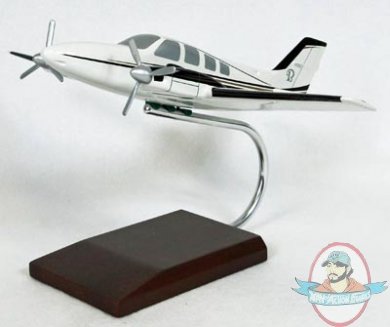
The Beechcraft Baron is a light, twin-engined piston aircraft originally developed by Beech Aircraft Corporation and currently manufactured by the Beechcraft Division of Raytheon Aircraft (now Hawker Beechcraft). The Baron is a variant of the Beechcraft Bonanza, and was introduced in 1961. Beech also offered a Twin Bonanza line, which featured some design commonality with the Bonanza but in all respects were entirely different airplanes and could not be considered to be true "twin bonanzas".
Scale: 1/40 scale model
Wing Span: 11.5
Length: 8.5
KBBG58T
|
"The Beechcraft Model 17 was the first aircraft produced by Beech Aircraft. A biplane with an atypical backward stagger (the upper wing inversely staggered behind the lower), it was a gamble for the company. Produced during the Great Depression, the expensive aircraft was designed as a high speed, comfortable business plane. The aircraft is more popularly known as the Staggerwing and first flew on November 4, 1932. During its time, it was considered to be the premier executive aircraft, setting the standard for private passenger airplanes for many years to come. The Staggerwing's unusual wing configuration and unique shape resulted in a design that maximized the pilot's visibility while minimizing the aircraft's tendency to stall. Its retractable conventional landing gear, which was uncommon at that time, coupled with streamlining, light weight and radial engines helped it perform significantly better than other biplane designs. The luxurious cabin could hold up to five passengers. Sales started slowly at first, and the Staggerwing's high price tag warded off any potential buyers. Only 18 aircraft were sold during the first year of production. However, the handbuilt Staggerwing gradually captured a substantial share of the passenger aircraft market. By the start of World War II, more than 424 planes had been sold. The Staggerwing's speed made it a favorite of air racers during the 1930s. An early version of the Model 17 won the 1933 Texaco Trophy Race. In 1935, Captain H. L. Farquhar, a British diplomat, successfully flew around the world in a Model B17R. Aviator Jackie Cochran set a women's speed record of 203.9 mph and an altitude record of 30,000 feet while flying a Staggerwing. The aircraft also performed well in the Bendix race between 1936 and 1938. As World War II approached, a number of Staggerwings saw service in various countries. The Second Spanish Republic used the aircraft as bombers during the Spanish Civil War. China used it as ambulance planes in the fight against Imperial Japan. On October 2, 1941, Beech delivered a special camouflaged plane to Prince Bernhard of Lippe-Biesterfeld who used it for refugee work while he was in exile in London. "
Scale: 1/32 scale model
Wing Span: 13
Length: 10
KBC17T
|
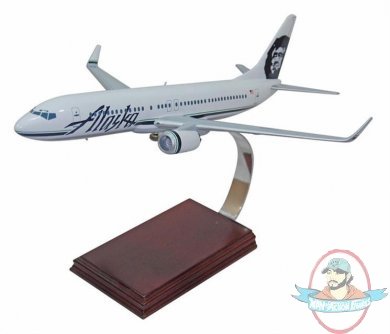
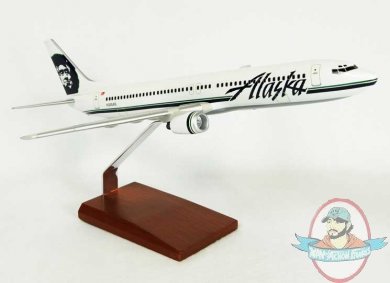
"Boeing's next generation 737-800 is one of the largest members of the strong selling 737 family. The Boeing 737-800 together with the 737-900, introduced new fuselage lengths, extending 737 single class seating range out of 189. The 737-800 was known as the 737-400X until its launch on September 5, 1994. The 737-800 since its launch, experienced strong sales and in early 2002, it was the highest selling Next Generation model. The 737-800's maiden flight was on July 31, 1997 and the first delivery was in April 1998. The 737-800 operating performance includes a typical cruising speed Mach 0.785, 3,585 km standard range with 162 passengers. It has a flight crew capacity of two. There are about 1,028 737-800 ordered, including 8 BBJ-2s and with 664 delivered by October 2002. On June 15, 2005, Alaska ordered 35 Boeing 737-800 aircraft worth $2.3 billion plus options for 15 additional aircraft and purchase rights for another 50, making it one of the largest orders for the 73-800. The Alaska Airlines all-Boeing fleet consists some of the 737-400 variants, 737-700, 737-900 and the 737-800 as of December 2007. The airline ultimately plans to replace all MD-80 aircraft with the Boeing 737-800 by the end of 2008. "
Scale: 1/100 scale model
Wing Span: 13.75
Length: 15.25
KB7378ATR
|
"The Boeing 737 is a popular short-to-medium range commercial passenger jet aircraft. It has been continuously manufactured by Boeing Commercial Airplanes since 1967. More commonly known to the Boeing engineers as ""FLUF"", being an acronym for ""Fat Little Ugly Fella"", although the industry affectionately called it the ""Baby Boeing"". The 737-800, together with the 737-900 are among the largest members of the strong selling 737 family. The 737-800 was launched on September 5, 1994. The 737-800 has a flight crew of two. The 737-800 has a typical two class seating for 162 with 12 first class passengers at four abreast. It incorporates two CFM56-7B27s on high gross weight versions. By October 2002, there were 1,028 737-800s ordered with deliveries of 664."
Scale: 1/100 scale model
Wing Span: 13.75
Length: 15.25
KB7378CATR
Pre-Order! Available: July
|
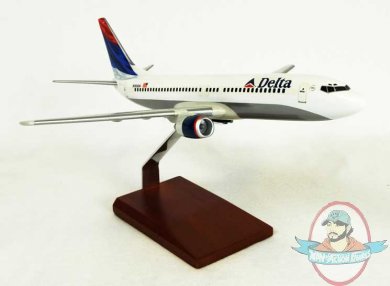
"The Boeing 737 is a short to medium range, single aisle, narrow body jet airliner. With over 7,000 ordered and over 5,000 delivered, it is the most ordered and produced commercial passenger jet of all time. Born out of Boeing's need to introduce a competitor in the short-range, small capacity jetliner market, it has been continuously manufactured since 1967. It is now so widely used that at any given time, there are over 1,250 airborne worldwide. On average, a 737 takes off or lands every five seconds somewhere around the world. Boeing was far behind its competitors when the 737 was launched, as rival aircraft were already into flight certification. To speed up the development time, Boeing reused 60 percent of the structure and systems of the existing 707, most notably the fuselage cross section. The 737-800 was a stretched version of the 737-700. It filled the gap left by Boeing's discontinuation of the McDonnell Douglas MD-80 and MD-90 after the two company's merger. Major United States airline Delta Air Lines has an all-Boeing fleet. It was one of the last major airlines to operate the original Boeing 737-200 models until the last aircraft retired in 2006. Its many Boeing 727s were completely replaced with Boeing 737-800s in 2003. Delta's Boeing 737-800 airplanes have an empty area in the rear cabin where seats are normally located. Not placing seats in this area results in a reduction of capacity to 150 seats, reducing the number of Federal Aviation Administration mandated flight attendants to three, as one flight attendant is required for every fifty passenger seats. This seat reduction was done after 9/11 to reduce costs, however, Delta has backtracked on this decision, and will increase the capacity of the 737-800 fleet to 160 passengers by using slimline seats. "
Scale: 1/100 scale model
Wing Span: 13.75
Length: 15.25
KB7378DTR
|
"The 737-800 entered service with its launch customer Hapag-Lloyd in 1998. The 737-800 became the basis for the Boeing Business Jet 2. 737-800 received its certification from the FAA on March 13, 1998 and from JAA on April 22, 1998. 737-800 was first delivered on April 22, 1998. 737-800 users and operators include American Airlines, Delta Airlines, Ryan Air, Qantas, Virgin Blue, Air Europa, Hainan Airlines, Shandong Airlines, Alaskan Airlines, Air China and Air Berlin. The 737-800 has a seating capacity of 162 in a two-class configuration. It incorporates a CFMI CFM56-7 engine. The 737-800 has has a typical cruising speed of 0.785 Mach and a maximum range of 3,060 nautical miles. "
Scale: 1/100 scale model
Wing Span: 13.75
Length: 15.25
KB737AATR
|
"The Boeing Business Jet - or BBJ - is a long range capacity corporate jet development of the 737-700 and -800. Boeing Business Jets is a joint venture formed by Boeing and General Electric in July 1996 to develop and market a corporate version of the popular 737 airliners, initially focusing on the 737-700. The first BBJ rolled out from Boeing's Renton plant on August 11 1998 and had its maiden flight on the 4th of September the same year. On October 30 the US FAA awarded certification to the developed 737-700 airframe on which the BBJ is based. The first completed BBJ was delivered on September 4 1999. On December 7, 1986, the first 737-700 rolled out and was granted certification in November 1997. It entered service with the Southwest Airlines the following month. The 737-700 has a flightcrew of two and has a seating capacity of 126 in two classes or 149 in a single class. It incorporates two CFM56-7B20 engines. By October 2002, there were 883 737-700 ordered and deliveries of 465."
Scale: 1/100 scale model
Wing Span: 14
Length: 13.25
KB737BBJTR
|
A short to medium range airliner. The 737-700 rolled out on December 7 1996. The Boeing 737 is a popular short-to-medium range commercial passenger jet aircraft. It has been continuously manufactured by Boeing Commercial Airplanes since 1967.
Scale: 1/100 scale model
Wing Span: 13.5
Length: 13.5
KB737CATR
|
"The 737-700 rolled out on December 7 1996, was granted certification in November 1997 and entered service (with Southwest) the following month. The Boeing 737 is a popular short-to-medium range commercial passenger jet aircraft. It has been continuously manufactured by Boeing Commercial Airplanes since 1967. "
Scale: 1/100 scale model
Wing Span: 13.5
Length: 13.5
KB737SWTR
|
"The 747 family is one of the most popular family of aircraft and was the first wide-body commercial airliner produced. The 747-200 variantincorporates more powerful engines, higher takeoff weights (MTOW) and range than the 747-100. There were several 747-200 versions produced. Introduced in 1971, and further improved over successive years, the 747-200 has higher thrust and weight-lifting capability than the 747-100, allowing it to fly further. A sub-variant is unofficially called the 747-200M and is a ""combi"" aircraft that can carry both at the same time. Like the 100, many 200s have been given a new lease on life as freight aircraft. There's a total of 393 747-200 versions built, when production ended in 1991. Currently, there are still many 747-200s still in operation, although most large carriers have retired the 747-200s from their fleets and were sold to smaller operators. Following the September 11th attacks, large carriers have speeded up fleet retirement and some 747-200s were either scrapped or turned into freighters. "
|
"The Boeing 747-400 is the latest, longest ranging, most advanced and best-selling model of the 747 family. It is the second largest commercial airliner after the Airbus A380. It was announced by Boeing Commercial Airplanes in October 1985, rolled out in January 1988 and first flew on April 29, 1988. Production of the 747-400 passenger version officially ended on March 15, 2007. The last to order the -400 was China Airlines in November 2002, with the last passenger 747-400 constructed in 2005 and delivered in April of that year. It was the 1358th aircraft produced. The 747-400 is set to be replaced by the Boeing 747-8 in 2009. United Airlines (UA) is one of the only two US airlines that still operate the 416-passenger 747-400. On December 9, 2004, UA made history when Flight 869, a 747-400, landed at Ho Chi Minh City, Vietnam. The scheduled flight from San Francisco via Hong Kong was the first by a US airline since the end of the Vietnam War, when Pan Am halted service shortly before the fall of Saigon. United offers in-flight entertainment on all its mainline aircraft. UnitedFirst Suite is offered on the 747-400, which features a 78-inch pitch flat-bed seat that reclines to 180 degrees. On board, passengers can enjoy pre-takeoff beverages, a five course meal, and a personal entertainment unit featuring nine channels of video as well as an additional fourteen feature film titles. Passengers also have access to personal phones and laptop power ports, as well as comfortable pillows and duvets. UnitedEconomy International is also available on the 747-400. Seats range from 17 to 18 inches wide, and have 31 inches of pitch. The in-flight entertainment system features nine channels of entertainment, along with audio channels. Shortly after takeoff, passengers are served a beverage with cocktail snacks. The main meal consists of a salad, an appetizer, a choice of hot entrées and dessert. On longer flights, United also offers a light pre-arrival meal. "
Scale: 1/200 scale model
Wing Span: 12
Length: 14
KB7474UATP
|
"The 747-400 is an improved model with increased range. It has wing-tip extensions of 6 ft (1.8 m), winglets of 6 ft (1.8 m), which improve the 747-400's fuel efficiency by 4% compared to previous 747 versions. It has a new glass cockpit designed for a flight crew of two instead of three. The use of electronics reduced the number of dials, gauges and knobs from 971 to 365. It has tail fuel tanks, revised engines and a new interior. The longer range was used by some airlines to bypass traditional fuel stops, such as Anchorage. The -400 was offered in passenger (400), freighter (400F), combi (400C), domestic (400D), extended range passenger (400ER) and extended range freighter (400ERF) versions. The freighter version does not have an extended upper deck. The 747-400D was built for short range operations and does not include winglets, but these can be retrofitted. The passenger version first entered service in February 1989 with Northwest Airlines on the Minneapolis to Phoenix route. The combi version entered service in September 1989 with KLM. The freighter version entered service in November 1993 with Cargolux. The 747-400ERF entered service in October 2002 and the 747-400ER entered service the following month with Qantas, the only airline ever to order the passenger version. Some of the last built Boeing 747-400s were delivered with Dreamliner livery along with the modern interior from the Boeing 777. The last passenger version of the 747-400 was delivered in April 2005. Boeing announced in March 2007 that it had no plans to produce further passenger versions of the -400. However, orders for 36 -400F and -400ERF freighters were already in place at the time of the announcement. As of October 2008, a total of 685 of the 747-400 series aircraft had been delivered. At various times, the largest 747-400 operator has been Singapore Airlines, Japan Airlines, and British Airways. "
Scale: 1/100 scale model
Wing Span: 24
Length: 28
KB747NWTR
|
"The Boeing 747-400 is the most recent version of the Boeing 747 in service and is the best-selling and the most advanced model of the 747 family. In October 1985, Boeing Commercial Airplanes announced the delivery of 747-400. 747-400's maiden flight was on April 29, 1988 and received cerification on January 10, 1989 with PW4000 engines, May 18, 1989 with CF6-80C2s and June 8, 1989 with RB211-524Gs. On January 26, 1989, the first 747-400 was delivered to Northwest Airlines and entered service on February 9, 1989. In October 2002, the extended range fighter of the 747-400 entered service and the next month, the extended range passenger version entered service with Qantas. The 747-400 has 6 feet wing tip extensions and 6 feet winglets and a glass cockpit. The 747-400 has an improved tail fuel tanks, revised engines, an all-new interior, revised fuselage/wing fairings and newer in-flight entertainment. On March 15, 2007, production of the 747-400 passenger version officially ended. The last four 747-400s on order were cancelled by the Philippine Airlines. In November 2002, China Airlines ordered and was the last one to order 747-400. "
Scale: 1/100 scale model
Wing Span: 24
Length: 28
KB747UATR
|
"The Boeing 757-200 is a member of the popular 757/767 family of medium-sized airplanes. The 757-200 is a twin-engine short-to-medium-range jetliner incorporating advanced technology for exceptional fuel efficiency, low noise levels, increased passenger comfort and top operating performance. The 757 offers great versatility by reducing airport congestion. In January 13, 1982, the first 757-200 rolled out of the Boeing Renton, Washington plant. Its maiden flight was on February 19, 1982. The 757-200 underwent 1,380 hours of flight testing over a ten month period for certification by the U.S. Federal Aviation Administration. The 757-200 was delivered on December 22, 1982 to launch customer Eastern Airlines. The aircraft was placed into service on January 1, 1983. On January 14, 1983, the 757-200 was certified to fly in the United Kingdom by the British Civil Aviation Authority. The 757-200 version forms the majority of 757s sold. Boeing positioned the plane above the 737 and as an eventual replacement for the 727. This variant can carry up to a 228 passengers in a single class; however, it can carry a maximum of 234 passengers with a seat pitch of 29"". The 757-200 and twin-aisle 767 were developed concurrently, both having the same technological advancements in propulsion, aerodynamics, avionics and materials. That's why many airline operators operate both 757 and 767 airplanes. The 757-200's high-bypass-ratio engines combined with the wing design making it the quietest, most fuel-efficient jetliners in the world. The 757-200 is available in two different door configurations. The 757-200's interior became standard on all narrowbody Boeing aircraft. The 757's wing is less swept and is thicker through the center than earlier aircraft, permitting a longer span. The 757-200 flight deck pioneered the use of digital electronics and advanced displays offering increased reliability and advanced features compared to older electro-mechanical instruments. "
Scale: 1/100 scale model
Wing Span: 15
Length: 19
KB757AWTR
|
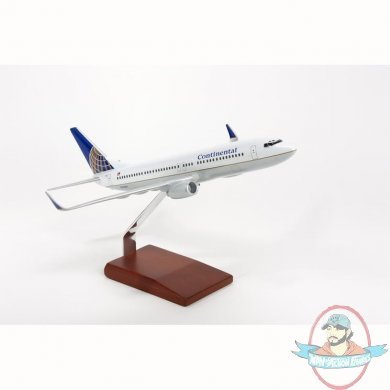
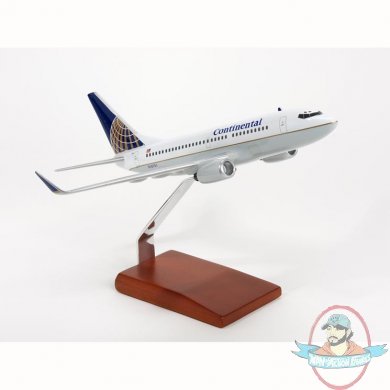
"Continental Airline is the fourth-largest airline in the United States based in Houston, Texas. Continental Airline is considered the eighth-largest in the world by revenue passenger miles. The 757 is the only type of aircraft which is being operated by all six U.S. ""legacy"" airlines and it includes the Continental Airlines. The B757 is an American twin-engine short to medium range commercial passenger aircraft manufactured by Boeing Commercial Airplanes. The 757 was the first Boeing airliner launched with engines produced outside the U.S., with early customers selecting the Rolls-Royce RB211. More than 1,030 of the 757s are still in service. The B757-200 variant of the B757, first flew on February 19 1982, can carry 228 passengers in a single class. The -200 version, a member of the popular 757/767 family of medium-sized airplanes, is a twin-engine short-to-medium-range jetliner incorporating advanced technology for exceptional fuel efficiency, low noise levels, increased passenger comfort and top operating performance. The 757-200 is the definitive version and forms the majority of the 757. The 757-200 version is shorter and has a longer operating range than the 757-300. The -200 was available in two different door configurations. One version used three standard doors per side with an additional, smaller door aft of the wing on each side for emergency evacuations. All eight door locations are equipped with inflatable evacuation slides. The alternate version is equipped with three standard doors per side (two towards the front and one at the aft of the cabin) with two ""plug-type"" overwing exits per side replacing the smaller door aft of the wing. Presidential challenger John Kerry used a chartered 757-200, nicknamed ""Freedom Bird"" during the 2004 U.S. presidential campaign. The -200 model has also been manufactured in freighter (757-200F) and passenger-freight combi (757-200M) versions. In the late 1990's, some of the airliners 757-200s were converted to freighters. "
Scale: 1/100 scale model
Wing Span: 15
Length: 19
KB757CATR
|
The Boeing 727 was, for a very long time, the most popular jet-liner in the world. The 727 first took to the skies during the 1960s, much earlier than its bigger and more famous sister the Boeing 747. Through its exceptional fuel efficiency it can fly both long- and short-range routes. Range with max payload 3965km (2140nm), The 727-200 remains popular with passengers and pilots but it does not meet Stage 3 noise requirements.
Scale: 1/100 scale model
Wing Span: 12.75
Length: 18
KB727NTR
|
"The Boeing 727 is a mid-size, narrow-body, three-engine, T-tailed commercial jet airliner. The 727's fuselage has an outer diameter of 148 inches (3.8 m). This allows six-abreast seating (three per side) and a single central access walkway when coach-class (18 inch width) seats are installed. The first Boeing 727 flew in 1963 and for over a decade it was the most produced commercial jet airliner in the world. A total of 1,831 727s were delivered. The 727's sales record for the most jet airliners ever sold was broken in the early 1990s by its younger stablemate, the Boeing 737. In August 2008, there were a total of 81 Boeing 727-100 aircraft and 419 727-200 aircraft in airline service. "
Scale: 1/100 scale model
Wing Span: 12.75
Length: 18
KB727PATR
|
"The Boeing 727 is a mid-size, narrow-body, three-engine, T-tailed commercial jet airliner. The 727's fuselage has an outer diameter of 148 inches (3.8 m).[1] This allows six-abreast seating (three per side) and a single central access walkway when coach-class (18 inch width) seats are installed. The first Boeing 727 flew in 1963 and for over a decade it was the most produced commercial jet airliner in the world. A total of 1,831 727s were delivered. The 727's sales record for the most jet airliners ever sold was broken in the early 1990s by its younger stablemate, the Boeing 737. In August 2008, there were a total of 81 Boeing 727-100 aircraft and 419 727-200 aircraft in airline service"
Scale: 1/100 scale model
Wing Span: 12.75
Length: 18
KB727TWAT
|
"B737-900 Boeing's Next Generation 737-800 and 737-900 are the largest members of the strong selling 737 family. Alaska Airlines launched the B737-900 in 1997 and accepted delivery in 2000. Because the -900 retains the same exit configuration of the -800, seating capacity is limited to 177 seats in two classes, or 189 in a single-class layout. The 737-900 also retains the MTOW and fuel capacity of the -800, trading range for payload. The B737-900 is the newest addition and the largest variant of the Boeing 737 line and was introduced to meet the range and passenger capacity of the discontinued 757-200 and to directly compete with the Airbus A321. An additional pair of exit doors and a flat rear pressure bulkhead increase seating capacity to 180 passengers in a 2-class configuration or 215 passengers in a single-class layout. Additional fuel capacity and standard winglets improve range to that of other 737NG variants. The first B737-900 was rolled out of the Renton, Washington factory on August 8, 2006 for its launch customer, Lion Air. Then on April 27, 2007, Boeing delivered the first B737-900 to Lion Air. The B737-900 airplane features a special dual paint scheme that combines the Lion Air lion on the vertical stabilizer and the Boeing livery colors on the fuselage. Lion Air has ordered 100 737-900ERs to be delivered by 2013. "
Scale: 1/100 scale model
Wing Span: 13.75
Length: 16.75
KB7371ATR
|
"The Boeing 727 is a mid-size, narrow-body, three-engine commercial jet airliner. It first flew in 1963 and for over a decade, Boeing 727 was considered the most produced commercial jet airliner in the world. 1,831 Boeing 727s were delivered. The Boeing 727's sales record for the most jets bought in history was broken in the early 1990s by the Boeing 737. In August 2006, a total of 127 Boeing 727-100 aircraft and 493 Boeing 727-200 aircraft were in airline service. The Boeing 727-200 is a stretched version of the 727-100. The -200 is 20 feet longer (153 feet, 2 inches) than the -100 (133 feet, 2 inches). A ten foot ""plug"" was added in front of the wings and another ten foot ""plug"" was added behind them. The wing span and height remain the same on both the -100 and -200 (108 feet and 34 feet, respectively). The gross weight was increased from 169,000 to 209,500 pounds. The dorsal intake of the number 2 engine was also redesigned to be round in shape, as opposed to oval as it was on the 100 series. At the turn of the 21st century, the 727 was still in service with a few airline fleets. However, because in the meantime the U.S. FAA and the ICAO had changed their requirements for overwater operations, most major airlines had already begun to switch to twinjets, aircraft with only two engines, which are more fuel-efficient and quieter than the notoriously loud three-engined 727. Also, the 727 was one of the last airliners in service to have a three-person flight crew, including a flight engineer, a crewmember whose job is performed by computerized systems on newer planes. The Boeing 727 proved very successful with airlines worldwide partly because of its capability to use smaller runways while still flying medium range routes. Thus, Boeing 727 effectively allowed airlines to attract passengers from cities with large populations but smaller airports to worldwide tourist destinations."
Scale: 1/100 scale model
Wing Span: 12.75
Length: 18
KB727AATR
|
"The Boeing 727 was, for a very long time, the most popular jet-liner in the world. The 727 first took to the skies during the 1960s, much earlier than its bigger and more famous sister the Boeing 747. Through its exceptional fuel efficiency it can fly both long- and short-range routes. The 727-200 is a stretched version of the 727-100. 727-200's maiden flight was on July 27, 1967 and was granted certification in November that year. The 727-200 entered service with the Northeast Airlines, (an airline that was later acquired by Delta) the following month. The 727-200 boosted in sales but it has quite a poor range, so Boeing developed the increased range Advanced 727-200. The 727-200 remains popular with passengers and pilots"
Scale: 1/100 scale model
Wing Span: 12.75
Length: 18
KB727CATR
|
"The Ford Tri-motor was a rugged, dependable transport airplane, which won a permanent place in aviation history. It underwent several design changes. They were flown by more than one hundred airlines in the United States and all over the world. First flew on June 11, 1926. The two main production versions of the Ford Trimotor the 4-AT and the 5-AT was introduced in 1928. The 5-AT-C, which is essentially in original condition, was built in 1929. The Ford Trimotor was dubbed as the Tin Goose and it also appeared in a variety of official and unofficial modifications. It was operated with wheel, float or ski landing gear and had served with all branches of the US military. The Ford 5-AT-C was still operating in the Scenic Airlines of Las Vegas in the 1990s."
Scale: 1/48 scale model
Wing Span: 18
Length: 18
KAT5CAAT
|
"The ATR-42 is a twin-turboprop airliner manufactured by ATR. The ATR42's maiden flight was on August 16, 1984 and it received certification following in September 1985. As of January 2007, there are 390 ATR 42s delivered worldwide, following another 11 aircraft order. There are three major variants of the ATR-42 and an STC exists to convert all ATR 42 variants to all-cargo transport aircraft. Major operators of the ATR-42 are FedEx, UPS and DHL. The ATR-42 ""Surveyor"" is a maritime patrol version of the -500 and VIP transport and in-flight inspection versions of the -500 also exist. The ATR-42 has a seating capacity of 44-50 passengers. It has a cruising speed speed of 556 km/h and a range of 2,965 km. t incorporates Pratt & Whitney Canada PW127E. The rear door is used to avoid possible injuries from the blades of the spinning propellers and the vast majority of commercial aircraft are boarded from the front. The ATR-42 also doesn't have Auxiliary Power Unit (APU), but it has a propeller brake, allowing the turbine to run and provide air power to the aircraft without the propeller spinning. Thus it eliminates the need for added weight and expense of an APU. the engines are periodically switched during maintenance to ensure equal wear. "
Scale: 1/48 scale model
Wing Span: 20
Length: 19
KATR42AET
|
"The revolutionary Boeing 247, developed in 1933, was an all-metal, twin engine airplane and the first modern passenger airliner. It had a gyro panel for instrument flying, an autopilot, pneumatically operated de-icing equipment, a variable-pitch propeller and retractable landing gear. It also featured thick upholstered chairs, an insulated cabin, a lavatory and individual overhead lighting. The phenomenon of the Model 247 caught the attention of America's young airline companies. When its commitment to United prevented Boeing from filling orders fast enough, Transcontinental and Western Air (TWA) turned to Douglas. Douglas offered to build something similar to the Boeing 247, only faster and larger. TWA quickly accepted the proposal. The Douglas DC-1 which was eventually refined as the legendary DC-3, immediately attracted new customers. Thus, making the 247 obsolete less than a year after its first flight. Seventy-five 247s were built. Boeing Air Transport flew 60 247s. United Aircraft Corporation flew 10 and the rest went to Deutsche Lufthansa and a private owner in China. The Boeing 247s remained in airline service until World War II, when several were converted into C-73 transports and trainers. Some were still flying along with the Douglas DC-2 that supplanted it, the Model 247 ushered in the age of speed, reliability, safety and comfort in air travel."
Scale: 1/48 scale model
Wing Span: 18.5
Length: 12.63
KB247UATE
|
"The Boeing 314 ""Clipper"" is a long-range flying boat produced between 1938 and 1941 by the Boeing Airline Company. It is one of the largest aircraft at that time using the massive wing of earlier XB-15 bomber prototype. The Boeing 314 uses a series of heavy ribs and spars, creating a strong fuselage and cantilevered wing. It incorporates sponsons into the hull structure. The Pan Am Clippers were built for luxury, a necessity given the long duration of transoceanic flights. Pan American World Airways signed a contract for six Boeing 314 on July 21, 1936. The first 314, the Honolulu Clipper, entered service in January 1939. Pacific Clipper was enroute to New Zealand during the outbreak of war in the Pacific. In June 24, 1939, the Yankee Clipper had flown across the Atlantic on a route from Southampton to New York with intermediate stops at Foynes, Ireland, Botwood, Newfoundland and Shediac, New Brunswick. The Boeing 314 Dixie Clipper is another aircraft operated by Pan Am. It started its transatlantic passenger service in 1939 and was later sold to World Airways. It was scrapped on 1950. "
Scale: 1/100 scale model
Wing Span: 18.5
Length: 12.5
KB314T
|
"The Boeing 367-80, or ""Dash 80"" as it was called within Boeing, was a concept jet transport built to demonstrate that high speed jet transport was no longer the sole preserve of military aircraft. Boeing 367-80 was considered to be the prototype for both the Boeing 707 airliner and the C-135 series aircraft (including the best known variant, the KC-135 air tanker used by the United States Air Force), the Boeing 367-80 was built in less than two years from project launch in 1952 to rollout on May 14, 1954 for a cost of US$16 million. This was at the time an enormous risk for the Boeing Company, since they had no committed customers for the project. By early 1952 the designs were complete, and on April 1952, the Boeing board approved the program to build the jet. Construction of the Boeing 367-80 took place at Boeing's Renton, Washington plant, but as a prototype there was no production line and most of the parts were custom built. The plane's interior was not fitted with an airline cabin; rather it consisted of a basic plywood lining that was used to house the test instrumentation required for the flight test program. In addition to the flight testing program, Boeing also used the Boeing 367-80 to provide demonstration flights to airline executives and other key industry figures."
Scale: 1/100 scale model
Wing Span: 15.5
Length: 15.38
KB367T
|