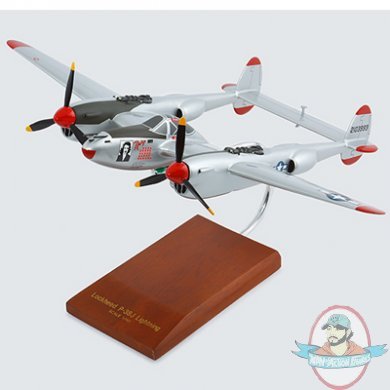
"The P-38J Pudgy aircraft was flown by Thomas McGuire and won 38 victories, second to the lightning called “Marge”. The aircraft was developed for the United States Army Air Corps to be one of the American fighter aircrafts during the Second World War. The P-38J Pudgy was designed by Clarence “Kelly” Johnson in response to the Army specification for an aircraft that can reach 20,000 feet in 6 minutes. The P38 had its unique twin booms with forward-mounted engines. It was the only American fighter with twin booms during World War II. It was most used for bombing and reconnaissance missions and in theaters of war such as the Pacific Theater and the China-Burma-India Operations. The P-38 is said to be one of the best American fighter planes of the Second World War. "
Scale: 1/32 scale model
Wing Span: 19.5
Length: 14.25
AP38PUTS
|
"The Curtiss P-40 Warhawk was an American single-engine, single-seat, low-wing, all-metal fighter and ground attack aircraft manufactured by Curtiss-Wright Corporation. In the 1930s and 1940s, the P-40 Warhawk fighter bomber was the last of the famous ""Hawk"" line, and it shared certain design elements with its predecessors, the Hawk and Sparrowhawk. Warhawk was the name the United States Army Air Corps adopted for all models, making it the official name in the United States for all P-40s. It was the third-most numerous US fighter of World War II. An early prototype version of the P-40 was the first American fighter capable of speeds greater than 300 mph. Design work on the aircraft began in 1937, but numerous experimental versions were tested and refined before the first production version of the P40, the Model 81, appeared in May 1940. By September of that year, over 200 had been delivered to the Army Air Corps. 185 more were delivered to the United Kingdom in the fall of 1940, where they were designated the Tomahawk Mk I. P-40s first saw wartime service with the British Commonwealth squadrons of the Desert Air Force in August 1941. The P-40E, also called the ""Kittyhawk"" and ""Tomahawk"" in England and Canada, was a modified version of the earlier P-40 Warhawk. The P-40E had six machine guns and 700 lbs. of external bombs. P-40E was an accurate scale rendition of an actual Flying Tiger aircraft used during World War II, but its realistic scale looks don't hinder its outstanding sport flight performance. In the Philippines, Lt. Boyd D. Wagner became the first American ace of World War II while flying a P-40E when he shot down six Japanese aircraft during mid-December 1941. Produced until 1944, P-40s were used by the Air Forces of 28 nations and gained reputation for its high durability and toughness. A total of 2,320 P-40E Warhawk were built. "
Scale: 1/32 scale model
Wing Span: 14.5
Length: 12.25
AP40T
|
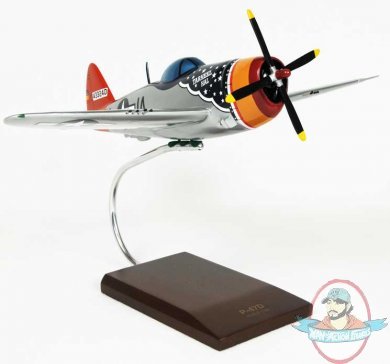
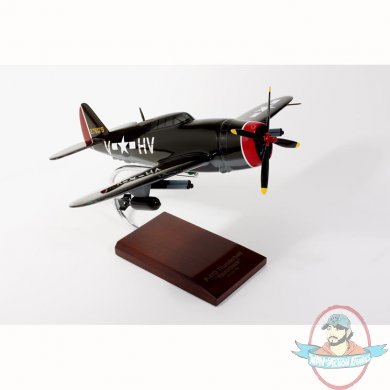
"The P-47 Thunderbolt is the largest single-engined fighter of the United States Army Air Force (USAAF) fighters of World War II and was manufactured by Republic Aviation. The P-47 Thunderbolt was the product of Russian immigrant Alexander de Seversky and Georgian immigrant Alexander Kartveli, who had left their homelands to escape the Bolsheviks. The P-47s maiden flight was on May 6, 1941 and was introduced in 1942. Initial deliveries of the P-47s to the USAAF were to the 56th Fighter Group on Long Island. In 1942, P-47s prepared for combat operations in England. The first P-47 combat mission started in March 10, 1943 and the mission failed due to radio malfucntions. The P-47 gradually became the best fighter-bomber which could carry 500 pound bombs, the triple-tube M-8 4.5 inch rocket launchers and eventually HVARS. P-47s were operated by several Allied air arms during World War II. There's a large number of surviving airframes exist in flying condition as well as in museum collections worldwide. A total of 15,686 P47s built. "
Scale: 1/32 scale model
Wing Span: 15.5
Length: 14
AP47T
|
"The P-47 Thunderbolt is the largest single-engined fighter of the United States Army Air Force (USAAF) fighters of World War II and was manufactured by Republic Aviation. The P-47 Thunderbolt was the product of Russian immigrant Alexander de Seversky and Georgian immigrant Alexander Kartveli, who had left their homelands to escape the Bolsheviks. The P-47s maiden flight was on May 6, 1941 and was introduced in 1942. Initial deliveries of the P-47s to the USAAF were to the 56th Fighter Group on Long Island. In 1942, P-47s prepared for combat operations in England. The first P-47 combat mission started in March 10, 1943 and the mission failed due to radio malfucntions. The P-47 gradually became the best fighter-bomber which could carry 500 pound bombs, the triple-tube M-8 4.5 inch rocket launchers and eventually HVARS. P-47s were operated by several Allied air arms during World War II. There's a large number of surviving airframes exist in flying condition as well as in museum collections worldwide. A total of 15,686 P47s built. "
Scale: 1/32 scale model
Wing Span: 13.63
Length: 15.5
AP47TE
|
"The P-51D Mustang Old Crow was an American fighter aircraft which was most widely produced by Mustang. The P-51D was equipped with a larger canopy and an aero products propeller to replace the Hamilton Standard propeller. The Old Crow arrived in Europe in mid 1944 and quickly became the primary USAAF fighter in the theater. In the same year, 1944, Captain Clarence Anderson returned to the 375th Fighter Group for a second combat tour. He was assigned a new P-51D Old Crow in the dark green mask. Captain Bud was on a mission when the first drop of snow in Germany fell. Thus he noted a mixed flight of dark green and silver aluminum Mustangs below him. After his mission, he told his ground crew that the one painted the dark green stood out against the snow background and silver ones appeared to the have the best camouflage. Because of that Bud suggested to paint the Old Crow silver color the next time it was down for heavy maintenance. The next morning, Captain Bud arrived at the station to find his P-51D Old Crow to use for his mission. To his surprise he found the Old Crow in a gleaming aluminum paint scheme ready for flight. Three members of his crew worked on it through the night scrapping, rubbing and remarking. They were all tired and their hands were raw due to the cold and solvents they used. The change made to P-51D Old Crow was dedicated to Bud Anderson and all 357th crew chief and ground support personnel who maintained the P-51 Mustang during World War II. "
Scale: 1/24 scale model
Wing Span: 18.25
Length: 16.2
AP51OCTS
|
This REAL.BIG. Fathead Wall Graphic is a high definition image made of tough high-grade vinyl that's tear and fade resistant, so you can be assured your eye catching Fathead will stay strong. And if the thought of taking down your Fathead makes you want to cry, don't worry, because it uses a low-tack adhesive that can be moved and reused without any damage to your wall. As if it couldn't get any better, your Fathead comes with free separate smaller images (made of the same stuff) to go with your awesome new wall graphic. You can stick ‘em near your REAL.BIG. or use ‘em to decorate another space.
Dimensions : 3'2" W x 7'6" H
|
This REAL.BIG. Fathead Wall Graphic is a high definition image made of tough high-grade vinyl that's tear and fade resistant, so you can be assured your eye catching Fathead will stay strong. And if the thought of taking down your Fathead makes you want to cry, don't worry, because it uses a low-tack adhesive that can be moved and reused without any damage to your wall. As if it couldn't get any better, your Fathead comes with free separate smaller images (made of the same stuff) to go with your awesome new wall graphic. You can stick ‘em near your REAL.BIG. or use ‘em to decorate another space.
Dimensions : 4'7" W x 2'1" H
|
This REAL.BIG. Fathead Wall Graphic is a high definition image made of tough high-grade vinyl that's tear and fade resistant, so you can be assured your eye catching Fathead will stay strong. And if the thought of taking down your Fathead makes you want to cry, don't worry, because it uses a low-tack adhesive that can be moved and reused without any damage to your wall. As if it couldn't get any better, your Fathead comes with free separate smaller images (made of the same stuff) to go with your awesome new wall graphic. You can stick ‘em near your REAL.BIG. or use ‘em to decorate another space.
Dimensions : 3'5" W x 4'2" H
|
The North American P-51 Mustang was a fighter-bomber aircraft that served during World War II and the Korean War. This long-range fighter was first flown by the Royal Air Force, but also served the Tuskegee Airmen in the Second World War. Among the different aircrafts flown by the Tuskegee (also known as the Red Tail Squadron), the Mustang was the one to which the airmen owe their popularity from. Introduced in 1942, the Mustang aircraft retired from military service sometime in 1984.
This handcrafted model is painstakingly built from Philippine mahogany by our skilled craftsmen with a wealth of detail and makes a great gift for any veteran, aviation enthusiast or history buff.
Scale: 1/52
Length: 7.5"
Wingspan 8.5"
PP11SS011
|
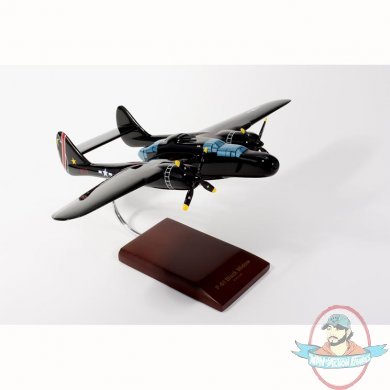
"The P-61 Black Widow is a night fighter aircraft manufactured by Northrop. It was used by the United States Army Air Forces in World war II. The P-61 was also used in European missions and was successful against a variety of targets such as fighter planes, bombers, V-1 buzz bombs and ground targets. In mid 1944, the 418th and 412st NFS adopted the Black Widow and in the CBI, the 426th and 427th NFS transitioned to the P-61 later that year. The P-61 Black Widow is a very versatile fighter and is fairly effective against enemies. The P-61 was said to be the first American and only Allied purpose built aircraft to serve as a radar equipped fighter. It features three pilot, gunner and radar operator. Armament include four 20 mm Hispano M2 forward firing cannons and four Browning M2.50 cal machine fire control computer. "
AP61T
|
"During World War II, the United States Navy (USN) acquired unmodified B-24 Liberator aircraft, used under the name PB4Y-1 Liberator, due to the need for longer ranges and increased use of land-based types, particularly for Arctic and other northern wintertime operations. While the type has performed very well for the USN as a maritime patrol plane, it was originally designed for the US Army Air Corps. In 1943, a decision was made to “navalize†the aircraft as a dedicated long-range patrol bomber. Three B-24s were taken off the assembly line and were reconfigured with longer fuselages, increased defensive armament, modified engine cowlings and a distinctive, single vertical tail. The resulting aircraft was the dedicated, long-range patrol bomber PB4Y-2 Privateer, designed to operate for long times over water in an anti-shipping or anti-submarine role. The Navy took 739 planes, though few reached front line service by Victory Over Japan Day. The PB4Y-2 was delivered to Navy squadrons beginning in May 1944 and taken into Pacific theater combat operations in January 1945, gradually replacing the Liberator. While serving in the Korean War, the Privateer earned the nickname “Lamp Lighter†for its role of dropping parachute flares in “Firefly†missions. Recipe for a Privateer: Take one B-24, replace the twin tails with a high single fin, extend the fuselage 7 ft, and add a crew of 11. Spice it with Martin dorsal turrets, Erco nose turrets and waist blisters."
Scale: 1/66 scale model
Wing Span: 20
Length: 13.6
APB4Y
|
"In 1930s, The Martin PBM-3 Mariner was designed as a Patrol Bomber Flying Boat for the US Navy. Originally, this flying boat was known as the Martin 162. The first prototype - the quarter-scale 162A - flew in 1937. The full-scale prototype - the XPBM-1 - first flew in February 1939. There were 1,285 built. The type entering service was in September 1940. The PBM-3 Mariner is a huge flying boat with a very graceful, bird-like silhouette. It is designed for very long range operations. The craft is equipped to remain away from its base for protracted periods while fulfilling its duties as a patrol bomber, convoy escort or fleet operations scout. It's capability to fly very long range mission is underscored by it having a galley and sleeping accommodations. The Mariner was built to replace the older Consolidated PBY series, but so many patrol planes were needed, that it ended up as an addition and not a replacement. Over 1,000 Mariners were built during the war. They proved so useful and reliable that many remained in service for decades. The PBM-3 was similar to the PBM-1 in most respects, differing mainly in fit of uprated P&W R-2600-12 engines with 1,270 kW (1,700 HP) each; larger and fixed wing floats; and revised engine nacelles that featured much bigger bombbays. Only 32 PBM-3s as such were built and never saw formal service in their original configuration. 31 of them were converted to a transport configuration, the ""PBM-3R"", and 18 new-build PBM-3Rs were constructed as well. These machines had armor and armament removed, with the turrets faired over; a reinforced floor, cargo doors, and a hoist; and removeable seating for 20 passengers, though it was nothing unusual for them to carry 33 or more. "
Scale: 1/72 scale model
Wing Span: 20
Length: 13.25
APBMT
|
"The PBY-5 Catalina is one of the variants of PBY Catalina, an American and Canadian built flying boat in 1930s and 1940s. PBY is the abbreviation of Patrol Bomber Consolidated. The PBY-5 could be equipped with depth charges, bombs, torpedoes and .50 caliber machine guns. The PBY Catalina is one of the most use aircraft in World War II since it can play multiple roles. This aircraft was released in July 1943 with higher power engines discontinued use of propeller spinner and standardized waist gun blisters. The PBY-5 Catalina was one of the most successful patrol flying boats of the US Navy. On December 20, 1939, The US Navy ordered 200 PBY-5 Catalinas. The PBY-5 could fly at a maximum speed of about 282 kph at an altitude of about 2,128 m or 7000 feet. It has a service ceiling of about 4469 m or 14700 feet and the pilot could fly at a distance of about 4097 km without refueling. As the demand for Catalina aircraft increases, the Consolidated contracted various companies to build license versions of the PBY-5. Some of these companies were the Naval Aircraft Factory, Boeing Aircraft of Canada, Canadian Vickers Factory, Canadian Vickers Ltd and the OA-10A. The PBY-5 and all other earlier versions of PBY Catalina were true flying boats which mean that it cannot land on any medium except water. The very main feature that makes the PBY-5 Catalina sleeker than many flying boats is the way the wingtip floats retract to fair into the wing while in cruising flight. "
Scale: 1/72 scale model
Wing Span: 16.75
Length: 10.75
APBYBT
|
The N2S is a biplane used to train carrier pilots at the start of World War II and was nicknamed "Yellow Peril" since it has a brightly colored paint job intended to alert everyone around that a novice pilot was flying it and because the plane itself has poorly designed gear which gave it a tendency to "ground loop." After world War II, the remaining stock of N2S's were transferred to the Naval Academy, remaining in service until 1960.
Scale: 1/24 scale model
Wing Span: 17.63
Length: 12.25
APT17NT
|
"In 1935, Lloyd Stearman developed the N2S Stearman and produced several models until February 4, 1941. The N2S Stearman or Yellow Peril was a unique, all metal frame construction aircraft. The front of the Yellow Peril to the firewall in the front cockpit and the vertical stabilizer were metal covered and the rest of the aircraft was fabric covered. The N2S Stearman depicted a revised tail shape and with the exception of first thirty produced. The Yellow Peril served as a primary trainer during World War II. Four of the N2S Stearman was assigned to the coast guard during the war. The name Yellow Peril originated from the fact that all naval trainers painted the N2S Stearman orange-yellow since 1917 as well as from its use in Naval Aviation Reserve bases where the cadets received their first training. There were several versions of N2S Stearman which were also delivered to England, China, Peru and Venezuela. The NS2 Yellow Peril was easy to fly and very user friendly to new pilots. The Yellow Peril had a reputation for being a rugged airplane and a good teacher. The airplane was consistently known as the Stearman by many, PT by the army, N2S by the Navy and Kaydet by the Canadian forces. Whatever name it may have, the N2S Yellow Peril was still one of the planes that made mark in history. "
Scale: 1/22 scale model
Wing Span: 17.5
Length: 13.5
APT17NTS
|
"The Lockheed Ventura is a bomber and patrol aircraft during World War II, developed from the Lockheed Lodestar transport. PV-1 is the version of Ventura built for the U.S. Navy and early production of the aircraft still carried a bombardier's station behind the nose radome, having four side windows and a flat bomb-aiming panel underneath the nose. Late production of PV-1s dispensed with this bomber position and replaced it with a pack with three 0.50 inch machine guns underneath the nose. It could also carry eight 5 in (127 mm) HVAR rockets on launchers underneath the wings. In December 1942, PV-1 was delivered and entered service in February 1943. The first squadron was the VP-135 which was deployed in the Aleutian Islands in April 1943. They were operated by three other squadrons in this theater. PV-1s would often lead B-24 bomber formations, since the aircraft comes equipped with radar. PV-1s were deployed to the Solomon Islands as night fighters in late 1943. After World War II, PV-1s became obsolete and the aircraft were sent to Naval Air Station Clinton to be demilitarized and reduced to scrap. "
Scale: 1/48 scale model
Wing Span: 16.5
Length: 12.75
APV1TE
|
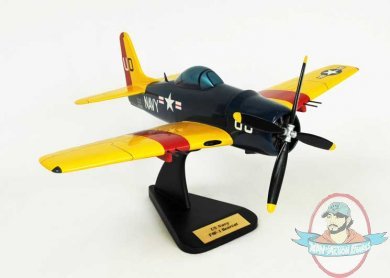
"The F8F-1 Bearcat was the last piston-engine carrier-based fighter plane built by Grumman. Production of the F8F-1 began six months after the first flight of its prototype. Affectionately called “Bear”, it was intended to be an interceptor aircraft. The plane's design was influenced by an evaluation of a captured German Focke-Wulf Fw 190 fighter in England. It carries the Pratt & Whitney R-2800 Double Wasp, which was the most powerful and reliable radial engine of its time. By building the smallest and lightest airframe possible, Grumman was able to produce a fast and highly maneuverable plane. The Bearcat was 20% lighter and had a rate of climb that was 30% higher than its predecessor, the Hellcat. Pilots often called it “hot rod” for its fantastic acceleration and climbing ability. It was the first Navy fighter to have an all-bubble canopy, offering the pilot a 360-degree visibility. The first production aircraft was delivered in February 1945 and the first squadron was operational by May, but before the Bearcat could see combat the Second World War had already ended. Postwar, the Bearcat became a major part of the United States Navy, equipping 24 fighter squadrons. It is often mentioned as one of the best handling piston-engine fighters ever built, even outperforming many early jets. It is also capable of aerobatic performances and was flown by the Navy's Blue Angels in 1946. The French and Thai air forces have also operated the Bearcat. Under the French, it served as a fighter-bomber in the First Indochina War during the early 1950s. "
Scale: 1/24 scale model
Wing Span: 17.5
Length: 13.5
AF8TE
|
"After Vladimir Petlyakov had been arrested and imprisoned in 1937 for allegedly deliberately delaying design work on the Tupolev ANT-42 bomber, the Pe-2 was designed in a Sharashka. In the Sharashka, Petlyakov was put in charge of a team to develop a high-altitude fighter escort for the ANT-42 under the designation VI-100. In December 22, 1939, the first of two prototypes flew and was a very sophisticated aircraft for its time, featuring a pressurized cabin, all-metal construction, superchargers and many electrically-actuated systems. The prototypes proved so pleasing that production was ordered almost immediately. It is said that Petlyakov and his team could see the VI-100 prototype from their prison as it was put through its paces for the crowds watching the annual May Day parade in 1940. After the Soviet Air Force had a chance to regroup after the German onslaught during the Winter, the aircraft did not really show its true potential until the end of the year. The Pe-2 quickly proved itself to be a highly capable aircraft, capable of eluding the Luftwaffe's interceptors and allowing their crews to develop great accuracy with their bombing. Throughout 1942 the design was steadily refined and improved, in direct consultation with pilots who were actually flying them in combat. The product of this evolutionary development was the Pe-2FT variant, where FT stands for Frontovoe Trebovanie(Frontline Request). "
Scale: 1/32 scale model
Wing Span: 15.75
Length: 21
AFRPE2TE
|
"The Grumman HU-16 Albatross is a large twin-radial engine amphibious flying boat. Originally designated SA-16, it was renamed HU-16 in 1962. The Albatross was designed to be able to land at sea in open ocean situations in order to effect the rescue of downed pilots. Its deep-V cross-section and substantial length helped make it possible for it to land in wavy conditions. Since it weighs over 12,500 pounds, pilots must have a type rating in order to act as pilot or co-pilot on board the Albatross. There is a yearly Albatross fly-in at Boulder City, Nevada, where Albatross pilots can renew their type ratings. "
Wing Span: 16.13
Length: 10.13
AHU16T
|
"The Grumman J2F Duck was an American single-engine amphibious biplane. The G-15 was an improved version of the earlier JF Duck, differing by having a longer float.[1] It was ordered by the United States Navy as the J2F Duck. The J2F-1 Duck first flew on 2 April 1936 powered by a 750hp (559kW) Wright R-1820 Cyclone, and was delivered to the US Navy on the same day. The J2F-2 had a Wright Cyclone engine but boosted to 790hp (589kW). Twenty J2F-3 variants were built in 1939 for use as executive transports for the Navy with plush interiors. Pressure of work following the United States entry into the war in 1941 production of the J2F Duck was transferred to the Columbia Aircraft Corporation of New York. They produced 330 aircraft for the Navy and US Coast Guard. A surplus Navy Duck was converted for use by the United States Air Force in the Air/Sea Rescue role as the OA-12 in 1942. The J2F was an equal-span single-bay biplane with a large monocoque central float which also housed the retractable main landing gear. It had strut-mounted stabiliser floats beneath each lower wing. A crew of two or three were carried in tandem cockpits, forward for the pilot and rear for an observer with room for a radio operator if required. It had a cabin in the fuselage for two passengers or a stretcher. The Duck's main pontoon was blended into the fuselage, making it almost a flying boat despite its similarity to a conventional landplane which has been float-equipped. This configuration was shared with the earlier Loening OL, Grumman having acquired the rights to Loening's hull, float and undercarriage designs.[2] Like the F4F Wildcat, its narrow-tracked landing gear was hand-cranked. "
Wing Span: 14.63
Length: 12.88
AJ2TE
|
"The JN-4 ""Jenny"" is a biplane trainer aircraft built and manufactured by Curtiss Aeroplane Company and was designed by Glen Curtiss. North America's most famous World War I aircraft is the Curtiss JN-4 since it was used to train beginner pilots. The JN-4's Canadian version was the JN-4 Can, also known as ""Canuck"". It was built with a control stick instead of the Deperdussin control wheel used in the regular JN-4 model, and has a more rounded rudder outline than the American version. The US version was called ""Jenny"" and has a twin seat dual control. The tractor prop and maneuverability of the Jenny made it ideal for initial pilot training. Most JN-4s built were unarmed, though some had machine guns and bomb racks for advanced training. After World War I, hundred JN-4s were sold in the civilian market, including the ones sold to Charles Lindbergh as his first aircraft. The Low speed of the JN-4 made it ideal for stunt flying and aerobatic displays. In the 1930s, some JN-4s were still operational. The primary users of the JN-4 were the United States Army Air Service and the Royal Flying Corps. "
Wing Span: 16.63
Length: 10.75
AJN4T
|
"The OS2U Kingfisher, manufactured by Vought, was the U.S. Navy's first catapult-launched monoplane observation floatplane. The OS2U first flew on March 1, 1938. The OS2U was a compact mid-wing monoplane, with a big central float and small stabilizing floats. Performance was modest, because of its light engine. The OS2U could also operate on fixed, wheeled, taildragger landing gear. The OS2U came in both float and land-based configurations, and served as observer aircraft, anti-submarine aircraft, and rescue aircraft. The Kingfisher's most important role during the war was as rescuer of downed aviators, and was second only to the PBY Catalina in this job. On November 11, 1942, a Kingfisher known as ""The Bug"", which had survived the attack on Pearl Harbor - rescued Captain Eddie Rickenbacker and the crew of the B-17 he was with after they crashed in the Pacific and survived 28 days in life rafts. After rescuing pilot CAPT. W.T. Cherry and four others on November 11, ""the Bug"" found Rickenbacker's raft the next day. Unable to fly all three survivors back at one go, LT. William F. Eadie, the pilot, taxied the airplane 40 miles through the open sea with Rickenbacker and one crewman lashed to the wings, while the most seriously-ill survivor was stuffed in the rear seat on the lap of ARM1 L.H. Boutte, the crewman. ""The Bug"" survived this mission and continued to fly throughout the war. "
Scale: 1/24 scale model
Wing Span: 18
Length: 15.25
AOS2UTE
|
"The North American Rockwell OV-10 Bronco was a special aircraft for counter insurgency (COIN) combat, developed in response to a specification approved by the United States Navy, Air Force and Army that was issued at the end of 1963. It is a fixed-wing, turboprop-driven light attack and observation aircraft with mission capabilities that resemble that of a fast, long-range and ultra-heavy attack helicopter. It can carry three tons of external munitions and loiter for more than three hours. The OV-10 is praised for its versatility, redundancy, high visibility cockpit, rear cargo compartment and ease of maintenance. Primarily a light attack and forward air controller aircraft, it has also performed armed reconnaissance, gunfire spotting and low-level aerial photography among many other roles. The specification in 1963 was based on a need for a new type of “jungle fighting” versatile light attack and observation aircraft. Some requirements of the aircraft were tandem seating, twin engines, basic aerobatic ability, and a capability of carrying at least 1,100 kg of cargo, various armament and external weapons. Eleven proposals were submitted from different companies, and in August 1964, the North American Rockwell design was selected. Seven prototypes were produced, and on July 16, 1965, the first OV-10 took wing. The Bronco was developed with much fanfare as a counter insurgency warplane. The OV-10 is a light and nimble aircraft that can fly close support. FAC and light attack missions were also common duties for the Bronco. "
Scale: 1/28 scale model
Wing Span: 17.25
Length: 17.75
AOV10
|
"The Lockheed P2V Neptune was a naval patrol bomber and anti-submarine warfare aircraft for the United States Navy (USN) between 1947 and 1978. It replaced the PV-1 Ventura and the PV-2 Harpoon and was successful in export, seeing service with several armed forces around the world. Development of the Neptune began early in World War II, but was considered a low priority compared to other aircraft in development at that time. It was not until 1944 that the program went into full swing. The first aircraft flew in 1945. Production began in 1946, and the P2V was accepted into service in 1947. A major factor in the design of the aircraft was ease of manufacture and maintenance, and this can be said to have played an important role in the P2V's long career and worldwide success. It was one of the first aircraft to be fitted in operational service with both piston and jet engines. The P2V-5, which first flew on December 29, 1950, was the most produced variant of the Neptune. The P2V-5 replaced the nose cone with a turret. It was mounted with an APS-20 radar and had enlarged wing tip fuel tanks. The aircraft was capable of carrying an 8,000 lb load of mines, torpedoes, bombs or depth charges and rockets. In addition to the US Navy, the P2V-5 served the military needs of Argentina, Australia, Brazil, Great Britain, The Netherlands and Portugal. During the Vietnam War, the Neptune was used by the USN as a gunship and patrol airplane. Under the Argentine Navy, the aircraft was used extensively during the 1978 Beagle Conflict, a border dispute between Argentina and Chile over the possession of the Picton, Lennox and Nueva islands and sea located south of Tierra del Fuego. During the Falklands War in 1982, the last two Neptunes in service played a key role of reconnaissance and aiding Dassault-Breguet Super Étendard aircraft, particularly on May 4 against HMS Sheffield. The lack of spare parts, caused by the US having enacted an arms embargo in 1977 due to the Dirty War, led to the Neptune's retirement before the end of the conflict."
Scale: 1/72 scale model
Wing Span: 17.38
Length: 16
AP02V5T
|
"The Lockheed P-2 Neptune is a naval patrol bomber and submarine warfare aircraft. The first P-2 Neptune flew in 1945 and production began in 1946. In 1947, it was accepted into service. P-2 Neptune was one one of the first aircraft which was accepted into service in 1947. Its early developments began in World War II. The Neptune was used by the US Navy during the Vietnam War and was also utilized by the US Army's 1st Radio Research Company (Aviation) located at Cam Ranh Bay. In 1982, during the Falklands War, the last two airframes in service, the P-111 and 2-P-112, had played a key role of reconnaissance and aiding Dassault Super Etenards, particularly on the May 4 attack against HMS Sheffield. P-2/P2Vs are currently employed in aerial firefighting roles by operators such as Aero Union and Neptune Aviation Services. The Neptune was succesful in export, being in service with several armed forces. The last Neptune variant produced by Lockheed was the P2V-7 (P-2H). Its upgrades include upgraded powerplant, jet pods standard,improved wingtip tanks, APS-20 search radar, early fitted with nose and tail turrets, but replaced with observation nose and MAD tail, dorsal turret also fitted early and replaced with observation bubble with 311 built."
Scale: 1/72 scale model
Wing Span: 17.38
Length: 16
AP02V7T
|
"The Lockheed P-3 Orion is a four-engine turboprop anti-submarine and maritime surveillance aircraft. In February 1959, the United States Navy (USN) awarded Lockheed a contract to develop a replacement for the aging P2V Neptune. The P-3 Orion, initially designated P3V, was based on Lockheed's successful L-188 Electra airliner and had its maiden flight on November 1959. It is primarily operated by the USN, the Japan Maritime Self-Defense Force, the Royal Australian Air Force and the Republic of Korea Navy. Despite its high performance, the P-3 has not been adapted into gunship, ground attack or aerial refueling tanker roles. Since its production in July 1962, it has had three major models: the P-3A, the P-3B and the P-3C. Paint schemes have changed from overall postwar blue, to white and gray in the 1960s and low-vis gray in the 1980s. The last P-3 Orion aircraft rolled off the production line at the Lockheed plant in April 1990. The P-3 Orion has been serving as the Navy's frontline, land-based maritime patrol aircraft since the 1960s. It still remains the USN's sole land-based anti-submarine warfare aircraft. Its long range and long loiter time have proved to be invaluable during Operation Iraqi Freedom as it was capable of viewing the battlespace while instantaneously providing that information to ground troops, especially the US Marines. "
Scale: 1/85 scale model
Wing Span: 14
Length: 16.25
AP03LVTR
|
"Starting in 1925 with the P-1, Curtiss built a long series of fighters carrying the name “Hawk”. Of the eight different P-6 models produced, the P-6E remains the best known. Originally designated the Y1P-22, it was later redesignated the P-6E because of the similarity to the other P-6 series airplanes. The P-6E was never used in combat, but it is perhaps the best-known of all the “between wars” Army pursuit aircraft. Despite its excellent performance, only 46 P-6E's were ordered because of the shortage of funds for the Air Corps during the austere days of the depression. The P-6Es served between 1932 and 1937 with the 1st Pursuit Group (17th and 94th PS) at Selfridge, and with the 8th Pursuit Group (33rd PS) at Langley Field, Virginia. Numerous accidents claimed at least 27 of the 46 aircraft delivered. As the P-6Es became obsolete, instead of receiving depot overhauls, they were allowed to wear out in service and were scrapped or sold. At least one survived into 1942 in United States Army Air Forces service. "
Scale: 1/20 scale model
Wing Span: 17.5
Length: 12.5
AP06
|
"The P-12 or F4B is a fighter aircraft manufactured by Boeing Aircraft Company. It was operated by the United States Army Air Corps and the Untied States Navy. P-12s were flown by the 17th Pursuit Group and the 20th Pursuit Group. There were older P-12s used by groups overseas such as the 4th Composite Group in the Philippines, the 16th Pursuit Group and the 18th Pursuit Group in Hawaii. In 1934-35, P-12 remained in service with first-line pursuit groups until it was replaced by the Boeing P-26. P-12 survivors were relegated to training duties until 1941, when most were grounded and assigned to mechanics' schools. The primary users and operators of the P-12 are the United States Air Force, United States Navy, Philippine Army Air Corps and the Royal Thai Air Force. Other operators of the P-12s are the Chinese Nationalist Air Force and the Philippine Army Air Force. There's a total of 366 P-12s built. "
Scale: 1/20 scale model
Wing Span: 12.25
Length: 18.13
AP12TE
|
"The American Boeing P-26 (Peashooter) was the first all-metal production fighter aircraft and the first pursuit monoplane used by the United States Army Air Corps. The diminutive Peashooter, as it became affectionately known by service pilots, was faster than previous American Combat aircraft, however it was also an anachronism. The Peashooter's wings were braced with wire, rather than with the rigid struts used on other airplanes, so the airplane was lighter and had less drag. Its initial high landing speeds were reduced by the addition of wing flaps in the production models. The P-26 flew 27 mph faster and outclimbed biplane fighters, that's why the Army ordered 136 production-model Peashooters. The first Boeing P-26 major combat mission was the Chinese Model 281, in what was the world's first air-interception and destruction of raiding monoplane aircraft. The P-26 remained in active service for many years. In November 1940, a full year after the start of World War II, the U.S. Army's entire fighter strength in the Philippines consisted of only 28 P-26's. Most of P-26 were destroyed in the first Japanese attacks, but two of them, flown by Philippine pilots, became the first American fighters to shoot down Japanese airplanes. Two original P-26s are known to exist. One is in the collection of the National Air and Space Museum, while the other has been owned for many years by the Planes of Fame Museum located in Chino, California. "
Scale: 1/24 scale model
Wing Span: 14
Length: 12
AP26T
|
"The Lockheed P-38 Lightning was an American fighter aircraft used by the US Air Force during the World War II. Developed to a United States Army Air Corps requirement, the P-38 had distinctive twin booms and a single, central nacelle containing the pilot and armament. The aircraft was used in a number of different roles, including dive bombing, level bombing, ground strafing, photo reconnaissance missions, and extensively as a long-range escort fighter when equipped with droppable fuel tanks under its wings. Designed by Engineer Clarence “Kelly†Johnson, the P-38 Lightning flew for the first time on January 27 1939. The P-38J was the fastest variant of the entire Lightning series--420 mph at 26,500 feet. Maximum speed at 5000 feet was 369 mph, 390 mph at 15,000 feet. Range was 475 miles at 339 mph at 25,000 feet, 800 miles at 285 mph at 10,000 feet, and 1175 miles at 195 mph at 10,000 feet. Maximum range was 2260 miles at 186 mph at 10,000 feet with two 250 Imp gall drop tanks. An altitude of 5000 feet could be attained in 2 minutes, 15,000 feet in 5 minutes, 10,000 feet in 7 minutes. Service ceiling was 44,000 feet. Weights were 12,780 lbs empty, 17,500 lbs normal loaded, 21,600 lbs maximum. Wingspan was 52 feet 0 inches, length was 37 feet 10 inches, and height was 9 feet 10 inches. Wing area was 327.5 square feet. Armament consisted of one 20-mm Hispano M2(C) cannon with 150 rounds plus four 0.50-inch Colt-Browning MG 53-2 machine guns with 500 rounds per gun. In addition two 500, 1000, or 1600-lb bombs or ten five-inch rockets could be carried on underwing racks. "
Scale: 1/40 scale model
Wing Span: 15.63
Length: 11.25
AP38BT
|
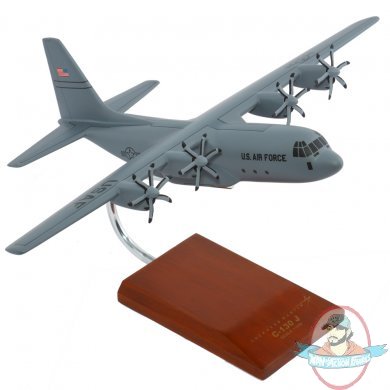
"The initial production of C-130 was the C-130A, having four Allison T-56-A-11 or -9 turboprops. A total of 219 C-130s were ordered and delivered by December 1956. The C-130J Hercules is the newest version of the Hercules. The aircraft features new Rolls-Royce Allison AE2100 turboprops with six-bladed composite scimitar propellers, digital avionics, reduced crew requirements, increased reliability and lower operating costs. The C-130J incorporates state-of-the-art technology to reduce manpower requirements, lower operating and support cost and life cycle cost savings compared to earlier C-130 models. The C-130 can accommodate 92 combat troops. It also flies at a higher cruise speed and lands in a shorter distance. The first delivery of the C-130J began in 1999. The USAF was the largest operator ordering the aircraft in increased numbers. The C-130J has several major improvements such as advanced two-pilot flight station, color multi-functional LCD and head-up displays, state-of-the-art technology reducing manpower requirements, low power color radar, digital moving map display, new turboprop engines with six-bladed, all composite propellers, digital auto pilot and improved fuel, environmental and ice protection systems. As of December 2006, a total procurement of C-130J reached 186 orders. There's another purchase of six C-130J aircraft upon request by the Indian Air Force. By mid 2007, the C-130J sales will be finalized. The C-130J will eventually replace the C-130Es and C-130Hs."
Wing Span: 16
Length: 12
AC130JT
|
"The Lockheed C-130 Hercules is a four-engine turboprop cargo aircraft and the main tactical airlifter for many military forces worldwide. Over 40 models and variants of the Hercules serve with more than 50 nations. The C-130J Super Hercules is the newest version of the Hercules and the only model still produced. Externally similar to the classic Hercules in general appearance, the J model is a very different aircraft. These differences include new Rolls-Royce Allison AE2100 turboprops with six-bladed composite scimitar propellers, digital avionics, reduced crew requirements, increased reliability and up to 27% lower operating costs. The C-30J is also available in a standard-length or stretched -30 variant. Lockheed received the launch order for the J from the RAF, who ordered 25 aircraft, with first deliveries beginning in 1999 as Hercules C. Mk 4 and Hercules C. Mk5 The largest operator for C-130J will be the USAF, who is ordering the aircraft in increasing numbers, although as of 2005 Congress announced C-130J acquisition would be dramatically cut. Current operators of the C-130J are United States Air Force, United States Marine Corps, U.S. Air National Guard, US Coast Guard, Royal Air Force, Royal Australian Air Force, Danish Air Force and the Italian Air Force. Total procurement of C-130J aircraft has reached 186 orders as of December 2006. The Hercules holds the record for the largest and heaviest aircraft to land on an aircraft carrier. The C-130J is a modification of the C-130H, undertaken by Lockheed Martin at company expense, with intended sales to the United States and various foreign markets. The C-130J modification includes a two-crew flight member station, upgraded Allison AE 2100D3 engines, enhanced performance and improved reliability and maintainability. The C-130 has been a part of some notable offensive operations including the Vietnam War, Indo-Pakistani War of 1965, Entebbe raid, Falklands War of 1982, Gulf War, Afghanistan invasion and Iraq invasion of 2003."
Wing Span: 16
Length: 13.75
AC130T
|
The C-130 Hercules is a four-engine turboprop military transport aircraft designed and built by Lockheed. The C-130 was originally designed as a troop, medical evacuation, and cargo transport aircraft. The versatile airframe has found uses in a variety of other roles, including as a gunship (AC-130), airborne assault, search and rescue, scientific research support, weather reconnaissance, aerial refueling, maritime patrol and aerial firefighting. It is now the main tactical airlifter for many military forces worldwide; over 40 models and variants of the Hercules serve with more than 60 nations.
This specific C-130 is the AC-130 Gunship variant.
This handcrafted model is painstakingly molded from pressure cast composite resin by our skilled craftsmen with a wealth of detail and makes a great gift for any veteran, aviation enthusiast or history buff.
Wing Span: 16
Length: 14
AC130TR
|
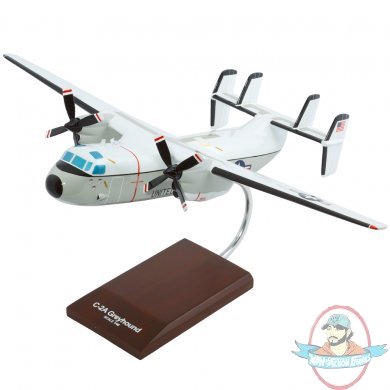
"The C-2 Greyhound was designed by the Navy to provide critical logistics support to aircraft carriers. The C-2 aircraft primary mission is Carrier Onboard Delivery or COD. The Greyhound replaced the piston-engined C-1 and was a derivative of the E-2 Hawkeye. The C-2 Greyhound shares wings and power plants with the E-2 Hawkeye but it has more widened fuselage with a rear loading ramp. The C-2 Greyhound has a vast range of communications and radio navigation equipment compatible for both military and civil airways on a worldwide basis. The communication equipments include HF, WHF and UHF. And for the radio navigation aids, it includes GPS, OMEGA, TACAN, dual VOR, UHF/DF, LF/ADF, weather radar, Doppler radar and two carrier approach systems. The C-2 Greyhound can deliver a payload of 10,000 lb. The cabin of C-2 can accommodate cargo, passengers or even both. The C-2 Greyhound is also equipped to accept litter patients in medical evacuation missions. The cage system of C-2 aircraft provides cargo restraint for loads during carrier launch or landing. The open ramp of C-2 Greyhound aircraft has the capability that allows airdrop of supplies and personnel from a carrier launched aircraft. The first two prototypes of C-2 Greyhound first flew in 1964. From the period of November 1985 to February 1987, the VR-24, operating with seven C-2 Greyhound depicted outstanding operational readiness while delivering two million pounds of cargo, two million pounds of mail and 14,000 passengers in support of the European and Mediterranean theaters. The C-2 Greyhound also provided support to the carrier battle groups during the operations of Desert Shield and Desert Storm. "
Scale: 1/48 scale model
Wing Span: 21
Length: 14.88
AC2AT
|
"The G-5/FF-1 Fifi is a naval fighter aircraft manufactured by Grumman and was designed by Leroy Grumman. The primary users and operators of the FF-1 are the United States NAvy, Spanish Republican Air Force and the Royal Canadian Air Force. In June 1933, FF-1s were delivered to Fighter Squadron VF-5B of the USS Lexington. In service, the FF-1 became known as Fifi. FF-1, together with the SF-1 were withdrawn from first-line US Navy squadrons by the end of 1936 and reallocated to reserve units. In the late 1940, most of the FF-1s are still in service. The FF-1 has a crew of 1. It has a maximum speed of 207 mph and a range of 685 mi. Armament includes 2 .30 M1919 Browning machine guns and a 100 lb bomb. It incorporates a Wright R-1820-78 Cyclone radial engine. There are 120 FF-1s built. "
Scale: 1/24 scale model
Wing Span: 17.75
Length: 12.25
ACFF1TE
|
"The F9 Sparrowhawk is a parasite fighter type designed to be deployed from a larger aircraft such as an airship or bomber and is ideal for service in the fighter complement of large rigid-framed airships for its small size. Its primary duty is reconnaissance. The F9 is carried by the US Navy airships USS Akron and USS Macon. The Akron was reported to have a complement of three F9s, while the Macon was found at its underwater resting place with four in its hangar. Currently, only one F9 Sparrowhawk still exists and it resides in the Smithsonian Institution's National Air and Space Museum. "
Wing Span: 15.25
Length: 21.13
ACSF9CTE
|
"The E-2 Hawkeye is an aircraft carrier-based tactical Airborne Early Warning (AEW) aircraft and is used for missions including surface surveillance coordination, strike and interceptor control, search and rescue guidance and communications relay. It was manufactured by Grumman Aerospace Corporation and Northrop Grumman. In 1964, after replacing the E-1, the Hawkeye has been the eyes of the fleet and has served the US Navy around the world. The E-2Cs has provided the command and control for successful operations during the Persian Gulf War. The original E-2C Hawkeye became operational in 1973 and has been through several upgrade programs since then. The E-2 aircraft served and have worked extremely effective with US law enforcement agencies in drug interdictions. During the late 1980s and the early 1990s, the E-2C Hawkeye has supported numerous naval engagements including the 1985 intercept of the aircraft containing the hijackers of the liner Achille Lauro. It has also participated in the strikes against Libya in 1986. The E-2C Hawkeye has a maximum speed of 374 mph and a range of 200 nauticla miles. It has a crew of five, including equipment operators. The primary users and operators of the E-2C Hawkeyes are the United States Navy, French Navy, Israeli Air Force and the Japan Air Self-Defense Force. "
Wing Span: 20
Length: 15
AE2CT
|
The Grumman E-2 Hawkeye is an American all-weather, aircraft carrier-based tactical Airborne Early Warning (AEW) aircraft. The twin turboprop aircraft was designed and developed in the 1950s by Grumman for the United States Navy as a replacement for the E-1 Tracer. The aircraft has been progressively updated with the latest variant, the E-2D, first flying in 2007.
Scale: 1/48 scale model
Wing Span: 20
Length: 15
AE2DT
Pre-Order! Available: October
|
"The EC-121 is an airborne early warning aircraft manufactured by Lockheed. The WV-2 is the main USN variant. From 1956 to 1954, WV-2s served in two barrier forces, each coast of the North American continent. Its aim was to extend early warning coverage against surprise attack of Soviet bomber and missile. On September 1965, Barrier Force operations were discontinued, however, Navy EC-121 operations continued until 1975 in four other squadrons. EC-121M was operated by VQ-1 and VQ-2 at NAS Atsugi, Japan and Naval Station Rota, Spain respectively. EC-121M, also known as Rivet Top, is a modified EC-121K and it carried the QRC-248 newly installed in the College Eye aircraft and has electronic interrogators capable of reading two additional Soviet transponders, the SRO-1 and SOD-57. EC-121M's electronics were custom-built. The most important upgrade was the installation of the highly secret Rivet Gym. The EC-121M Rivet Top prototype moved to Korat along with the College Eye Task Force in October 1967 and was scheduled to return to the United States in February 1968 but it remained at Korat until 1969. The primary users and operators of the EC-121 are the United States Air Force and the United States Navy. There's a total of 232 EC-121s built. "
Scale: 1/72 scale model
Wing Span: 19.25
Length: 20.25
AEC121MT
|
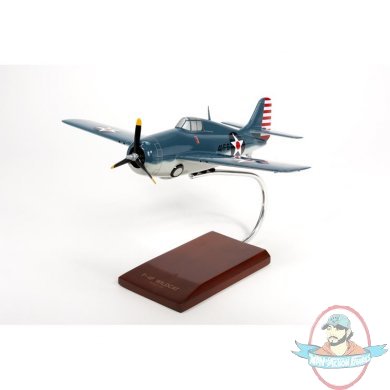
"The F4F-4 Wildcat entered the US Navy service in 1942. The carrier has six guns and folding wings that allow more people to get on board. Although it performed the most combat service during the early war days, F4F Wildcat was less popular with the American pilots because of the additional guns which caused the decrease of firing time as the same amount of ammunition was spread to it. The F4F-4 can accommodate only 1 crew. It has a length of 28 ft and 9 in or 8.8 m; wingspan of 38 ft or 11.6 m; height of 9 ft and 2.5 in or 2.8 m; and weight of 5,760 lb (when empty). F4F Wildcat has a maximum speed of 320mph and rate of climbing 1,950 ft/min. It also has six M2 Browning machine guns and two bombs. The F4F-4 broke the dominance of the Japanese Zero. Grumman became known as the Ironworks because of its strongly designed aircrafts that were tremendously damaged but were still able to fly home. "
Scale: 1/32 scale model
Wing Span: 10.75
Length: 14.25
AF4FT
|
"The F4U Corsair was a single-engine aircraft. It was conceived to be using the most powerful engine and the largest propeller a fighter aircraft ever had. The long propeller blades caused ground clearance problems, while the “W” shaped wings helped reduce the length required for the landing gear to provide good visibility on the sides. The F4U Corsair was called the “Ensign Eliminator”, a strong engine torque which didn’t make it an easy plane to land. The F4U Corsair aircraft went into production in 1942. There were different World War II aircraft variants and the F4U-1D Corsair was one of them. The F4U-1D was a fighter aircraft that served the US Navy during World War II and Korean War. It became the first United States single-engine production aircraft that was capable of reaching 400 mph. The F4U-1D was built in parallel with the F4U-1C, a variant that was in production in 1943 but entered the service in 1945. The F4U-1D Corsair was introduced in 1944. It was the Fighter-Bomber variant because compared to other variants it had a double payload of rockets which was exactly what the US Navy needed. It weighs 4100 kg/9040 lbs when empty and 6400 kg/14100 lbs when full; its engine is Pratt & Whitney R-2800 Double Wasp, 18 cylinders and power of 2200 hp; the aircraft’s armament is 6 x 12.7 mm (.50cal) machine guns in the wings; and max speed of 635 km/h and ceiling of 11280 m. "
Wing Span: 16.25
Length: 12.25
AF4U1NT
|
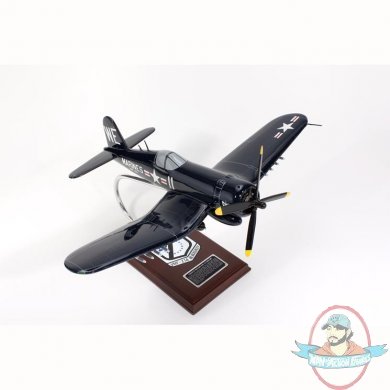
"The F4U Corsair has proven to the most capable capable carrier based fighter of World War II. In June 1942, the first production of the F4U-1s were delivered. The famous ""Black Sheep"" squadron of book and TV series fame immortalized the Corsair in the blue South Pacific skies. The F4U-4 was the definitive version of the F4U Corsair. It features a four-bladed Hamilton Standard Hydromatic propeller, a new cockpit layout, a clear view sliding hood, a two stage turbo-supercharged engine and under wing attachment points for 8-5 inch rockets or bombs. Most F4U-4s retained the standard armament of 6- .50 caliber wing mounted machine guns. The F4U-4 incorporates a Pratt & Whitney R-2000-18W. It has a maximum speed of 435 mph at 15,000 ft and a range of 1,005 miles at 214 mph at 15,000 ft. The Corsair was one of the great fighters of World War II and was proven much later in its service during the Korean War."
Wing Span: 19
Length: 15.25
AF4U4MTS
|
"The F4U Corsair was the result of a 1938 United States Navy (USN) requirement for a new carrier aircraft that could match the performance of the best land and carrier-based fighter planes. Designed by Rex Buren Beisel and manufactured by Chance Vought, it was made to carry the most powerful engine and largest diameter propeller ever built at that time. Although designed as a carrier fighter for the USN, concerns about its landing and visibility characteristics led it to be used initially by the United States Marine Corps (USMC), which operated on land-based runways. In March 1943, the Marines introduced the aircraft to its debut combat. Eventually it was put into service with the USN in January 1944, after the British proved that it was able to operate safely from carriers. The plane was not slow to prove its fighting ability and succeeded in gunning down 2,140 enemy aircraft while losing only 189 F4Us during World War II. Consequently, 24 Corsair pilots became air aces. The Corsair was given the nicknames “The Sweetheart of the Marianas” and “The Angel of Okinawa” by allied ground forces. The Japanese troops dubbed it “Whistling Death” because of the sound that it made during dive-bombing or strafing runs. The F4U-4 was the last variant to be produced during World War II, entering service just four months before the end of hostilities. With a rate-of-climb of nearly 4,000 feet per minute and a service ceiling of 41,500 feet, it was the Navy’s answer to the much improved Japanese fighters that were arriving in the Pacific. In addition to a new propeller, the F4U-4 had a completely redesigned cockpit, a new canopy for improved bubble effect, a new armor-plated bucket seat, and regrouped instruments. Improved fighter-bomber capabilities were made possible by putting rocket stations on the outer wing panels. The F4U-4 saw combat in Korea between 1950 and 1953. "
Wing Span: 16.25
Length: 12.25
AF4U4TE
|
"The Grumman F6F Hellcat was a fighter aircraft descended from the earlier F4F Wildcat, but was a completely new design sharing only a familial resemblance to the Wildcat. Some tagged it as ""Wildcat's big brother"". The name Hellcat was eventually retained in early 1943 for the sake of simplicity. The Hellcat proved to be the most successful aircraft in naval history, destroying 5,171 aircraft in service with the U.S. Navy and U.S. Marine Corps, plus 52 with the Royal Navy's Fleet Air Arm during World War II. The first production aircraft off the line, designated F6F3s, flew on October 3, 1942 with the type reaching operational readiness with VF-9 on USS Essex i February 1943. Two night fighter subvariants of the F6F-3 were also developed. The F6F-3E, converted from standard -3 frames, featured the AN/APS-4 radar in a fairing in the starboard wing. The later F6F-3N, first seen in July 1943, was fitted with the AN/APS-6 radar in a similar fairing. Hellcat night fighters had their first action in November 1943. The first real test of the F6F-3 against the Zero came a few months later in December when a groupof about a hundred Hellcats ripped into a like number of Japanese planes of which half were Zeros. In the ensuing battle, 28 of the Zeros were splashed for a total loss to the Hellcats of 3 planes. Many U.S. Navy pilots had good cause to refer to the Hellcat as the ""Aluminum Tank"". With its six.50 caliber Browning M2 machine guns, it could spit out a veritable hail of destruction which no Japanese adversary could hope to survive. After the war, Japanese pilots related their fear and dread each time they were engaged by the Hellcat. The Hellcat aircraft was rapidly phased out of front line service, retiring in 1954 as a night-fighter in composite squadrons. "
Wing Span: 12.25
Length: 16
AF6FT
|
"The date was September 1, 1943 when the Hellcat first saw action against the Japanese when fighters off the USS Independence (CVL-22) shot down a snooping seaplane. After which at 23rd of November, Hellcats engaged Japanese aircraft over Tarawa, shooting down a claimed 30 Mitsubishi Zeros for the loss of one F6F. On November 11, 1943, Hellcats were engaged in day-long fights with many Japanese aircraft including A6M Zeros, claiming more than 100 victories while losing few F6Fs over Rabaul, New Britain. The ""Thach Weave"" had developed into a formation tactic by that time. Each time an enemy fighter made a run at a section of US fighters, the pursued Hellcats would break towards the opposing formation that would cross over and force the Japanese to break off or expose themselves to the Hellcat's weapons. The ""wingman"" tactics started which are still used to this day, allowing less maneuverable US aircraft such as the Hellcat to deal with much more nimble Japanese opponents. Hellcats were involved in practically all engagements with Japanese air power from that point onward. Navy and Marine F6Fs flew 66,530 combat sorties (45% of all fighter sorties of the war, 62,386 sorties were flown from aircraft carriers) and destroyed 5,163 enemy aircraft (56% of all Naval/Marine air victories of the war) at a cost of 270 Hellcats (an overall kill-to-loss ratio of 19:1).The aircraft performed well against the best Japanese opponents with a 13:1 kill ratio against Mitsubishi A6M, 9.5:1 against Nakajima Ki-84, 28:0 against Kawanishi N1K-J, and 3.7:1 against Mitsubishi J2M during the last year of the war. In the ground attack role, Hellcats dropped 6,503 tons of bombs. "
Scale: 1/48 scale model
Wing Span: 10.5
Length: 8.5
AF6FTR
|
"The F-82 Twin Mustang is a heavy fighter manufactured by North American Aviation and was based on the P-51 Mustang. The F-82 was originally designed as a long-range fighter in World War II though its role was changed to night-fighting. On June 11, 1948, United States Air Force eliminated the P designation for pursuit and replaced it with F which pertains to fighter. The night fighter versions which were designated the F-82F/G required numerous modifications such as the removal of the right side cockpit to be replaced with a radar operator's position lacking flight controls. The most significant modification was the addition of a long radar pod attached to the underside of the center wing. The first F-82G that became operational was in late 1948. In mid 1949, F-82 became widespread and some of the E/F/G models were used by the United States Air Force. F-82Gs were also deployed to the 347th Fighter Group in Japan. The F-82G, though it missed its opportunity to fight in World War II, it distinguished itself during the Korean War. The F-82G has a crew of two. It has a maximum speed of 400 knots and a range of 1,950 nm. It incorporates 2 Allison V-1710-143/145 liquid-cooled V12 engines. The primary user and operator of the F-82 Mustang is the United States Air Force. There's a total of 270 F-82s built. Currently, there are three F-82s known to have existed. "
Scale: 1/32 scale model
Wing Span: 16.25
Length: 20.5
AF82TE
|
"The C-130 Hercules is a four-engine turboprop cargo aircraft and the main tactical airlifter for many military forces worldwide. Over 40 models and variants of the Hercules serve with more than 50 nations. In December 2006 the C-130 became the fourth aircraft (after the English Electric Canberra in May 2001, B-52 Stratofortress in January 2005 and the Tupolev Tu-95 in January 2006) to mark 50 years of continuous use with its original primary customer, the United States Air Force (USAF). The C-130 is capable of short takeoffs and landings from unprepared runways. The C-130 was originally designed as a troop, medical evacuation and cargo transport aircraft. The versatile airframe has found uses in a variety of other roles, including as a gunship, and for airborne assault, search and rescue, scientific research support, weather reconnaissance, aerial refuelling and aerial firefighting. The C-130H model has updated Allison T56-A-15 turboprops, a redesigned outer wing, updated avionics and other minor improvements. Later H models had a new, fatigue-life-improved, center wing that was retro-fitted to many earlier H-models. The H model remains in widespread use with the US Air Force (USAF) and many foreign air forces. Initial deliveries began in 1964 (to the RNZAF), remaining in production until 1996. An improved C-130H was introduced in 1974."
Wing Span: 16
Length: 12
AC1302T
|
"The Blue Angels, a U.S. Navy Flight Demonstration Squadron was formed to enhance the Navy and Marine Corps. It started in 1946 and is known as the first officially sanctioned military aerial demonstration team in the world. The Blue Angels fly three aircrafts in formation first and then four and now six per show. With the aerobatic stunts they perform, the group became known worldwide. The team was first led by Lt. Cdr. Voris. The team also operates a Marine Corps C-139T Hercules known as “Fat Albert”. It was designed to transport 25,000lbs of equipment and 45 personnel from one air show to another. As soon as Fat Albert arrives in the site, it is prepared for its dynamic demonstration. The widely known demonstration of Fat Albert is the JATO or Jet Assisted Take-Off. Whenever the aircraft sets off for a highspeed flat pass the words “United States Marine Corps” embossed across the Fat Albert’s skin is seen from below. The Fat Albert has the privilege to open each Blue Angel performance with its great demonstration flight. It is said to be operated by the US Marine Corps and its crew only consisted of USMC personnel."
Scale: 1/84 scale model
Wing Span: 19
Length: 14
AC130BA
|
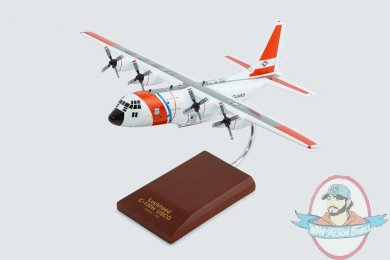
"The HC-130 Hercules is a long-range surveillance and transport, fixed-wing aircraft that is used to perform search and rescue operations, marine environmental protection, military readiness, enforcement of laws and treaties including illegal drug interdiction, and International Ice Patrol missions, as well as cargo and personnel transportation. The aircraft took its first flight on August 23, 1954. The HC-130 is an extended-range, combat rescue version of the C-130 transport aircraft. Its main mission is to provide air refueling for rescue helicopters. The aircraft can surpass 2,600 miles in low-altitude flying with mission strength of up to 14 hours. The aircraft is equipped with a ten tube flare launching system and scanner windows. Guidance aids such as GPS, Inertial Navigation System, and radar improves the HC-130s performance during long range maritime patrols. "
Wing Span: 16
Length: 14
AC130CGT
|
"The C-130 Hercules Gunship has the record for being the heaviest and biggest aircraft to land on an aircraft carrier. When the Korean War started in June 1950 it illustrated that the performance of some transport aircrafts like the C-119 Flying Boxcars and C-46 Commandos were insufficient. In February 2 1951, the United States Air Force released a General Operating Requirement for a new transport aircraft. It was issued to aircraft companies like Boeing, Fairchild, North American, Northrop, Lockheed, Martin Company and Airlifts Incorporated. The transport aircraft would be capable of accommodating 92 passengers or 64 paratroopers, can fly with one engine stopped, and can reach a range of 1100 nautical miles. The Martin Company, Fairchild, Northrop and North American refused to join. The companies, who agreed, proposed nine designs. The Lockheed submitted two designs, Boeing submitted one, Douglas submitted three and the Airlifts Incorporated submitted one. The design proposals were a tight fight between the Lockheed Company and the Douglas. A 130 page proposal for Lockheed L-206 was submitted by the Lockheed team that was led by Willis Hawkins. The president and chief engineer of Lockheed, Hall Hibbard, noticed the proposal and gave it to Kelly Johnson. Hall Hibbard and Kelly Johnson signed the proposal and got the contract designated Model 82 in July 2 1951. In August 23, 1954, the YC-130 prototype made its first flight from the Lockheed plant in California. Its serial number was 53-3397 and it was the second prototype but the first to fly. Stanley Beltz and Roy Wimmer were the pilots of the prototype and Jack Real and Dick Stanton were the flight engineers. "
Wing Span: 19
Length: 14
AC130GS
|
"C-123 is a military transport aircraft manufactured and built by Chase aircraft and Fairchild Aircraft. The C-123 was famous for its service with various armed forces in Southeast Asia. The United States Air Force was the first recipient of the C-123 aircraft and was followed by the United States Coast Guard. USAF Demonstration team, Thunderbirds also used the C-123 for a time. They used the C-123 for search and rescue missions and C-123 was widely exportedin the USA under various aid programmes direct military stocks of the USAF. The C-123 was also known for his participation in Operation Ranch Hand defoliation operations in Vietnam. In the Vietnam War, some C-123s have been modified for roles. C-123s were also used in movies where scenes call for big planes, like Air America. A C-123 became the principal place of action films such as Con Air and Operation Dumbo Drop. The C-123 also has a small scene in Tomorrow Never Dies. In 2007, a C-123 was presented in a television advertising for Ford."
Wing Span: 18.5
Length: 12.75
AC123T
|
"The Douglas C-124 Globemaster II, also known as ""Old Shakey"", was a heavy-lift cargo military aircraft manufactured by the Douglas Aircraft Company in Long Beach, California. C-124s provided heavy airlift during the Korean War, Southeast Asia War and other important airlifts such as re-supply missions to Antarctica, refugee evacuation in the Congo and mercy flights to Morocco, Chile and elsewhere throughout the world following floods and other natural disasters. It could lift 33.560 kilograms (74,000 pounds) of cargo. Its double-decked cabin could also be fitted with 200 seats for troops, or with 123 litters for casualty evacuation. Flight crew was six. The C-124 first flew on November 27, 1949. This C-124C variant of Globemaster was manufactured by Douglas Aircraft Corporation at Long Beach, California, and delivered to the U.S. Air Force on May 4, 1955. The aircraft was assigned to the 15th Air Transport Squadron (Heavy) of the Military Air Transport Service (MATS) operating out of Dover AFB, Delaware. The C-124C featured uprated engines, an APS-42 weather radar with a distinctive nose ""thimble"" radome, and wingtip-mounted combustion heaters to provide cabin heating and wing de-icing. The radar and combustion heaters were retrofitted to most C-124As. At the type's peak in 1963, there were 377 C-124s in service with 20 transport squadrons. A total of 243 C-124C were built. "
Wing Span: 21
Length: 15.5
AC124T
|
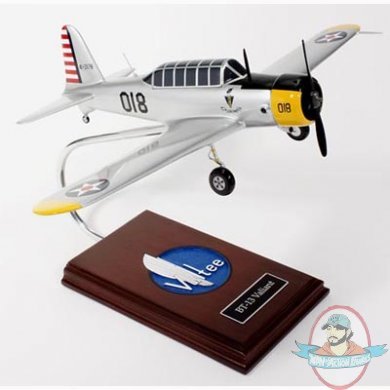
"The BT-13 Valiant is a basic trainer aircraft of World War II manufactured by Vultee Aircraft and was designed by Richard Palmer. The BT-13 Valiant was flown by most American pilots during World War II. The BT-13 incorporates a more powerful engine and was faster and heavier than the primary trainer. The BT-13's maiden flight was on March 1939. The BT-13 had served its purpose well and it made a good aircraft to help transition many hundreds of pilots toward their advance trainers and fighters yet to be mastered. The BT-13 has a crew of two, for a student and instructor. It has a maximum speed of 180 mph and a range of 725 miles. It incorporates a Pratt & Whitney R-985-AN-1. The primary users and oerators of the BT-13 are the USAAF and the US Navy. Curently, some BTs including the BT-13s are still flying, though there were only limited numbers. Postwar, virtually all were sold as surplus for a a few hundred dollars each. The BT-13 production run outnumbered all other Basic Trainer types produced. "
ABT13
|
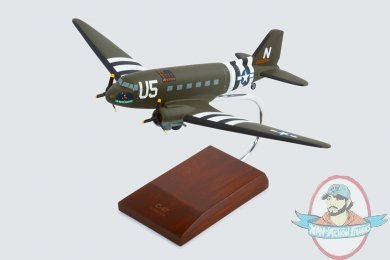
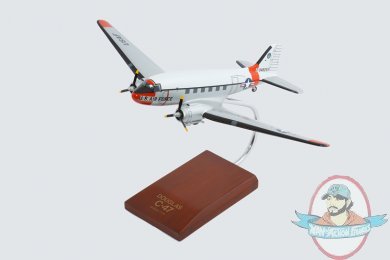
The Douglas C-47 Skytrain is a military transport aircraft that was developed from the Douglas DC-3 airliner. It was used extensively by the Allies during World War II and remained in front line operations through the 1950s with a few remaining in operation to this day.
This model is personally signed by William “Wild Bill” Guarnere from the Band of Brothers. He earned the nickname "Wild Bill" and lived up to it; he was terror on the battlefield and had a reckless attitude towards the Germans. Guarnere received the Silver Star for combat during D-Day, and was later decorated with two Bronze Stars and two Purple Hearts. Certificate of Authenticity included.
This handcrafted model is painstakingly built from Philippine mahogany by our skilled craftsmen with a wealth of detail and makes a great gift for any veteran, aviation enthusiast or history buff.
Scale: 1/62 scale
Wing Span: 18
Length: 13
AC047BBSS
|
"The C-47 Skytrain is a military transport based and developed from the DC-3 and was used extensively in world War II. It was manufactured by Douglas Aircraft Company. The C-47 has proven itself for the success of many Allied campaigns, including Guadalcanal, New Guinea and Burma with its ability to counter the mobility of the light-traveling Japanese army. The C-47s were also used to airlift supplies to the embattled American forces during the Battle of Bastogne. The C-47 became notable for flying The Hump from India into China. From 1946 to 1947, the C-47s saw service with the USAF Strategic Air Command. The C-47 was also used by the Americans during the initial stages of the Berlin Airlift and subsequently, it was replaced by the C-54. The C-47 also played various roles including the AC-47 gunships and the EC-47 for counterintelligence during the Vietnam War. The C-47 was also acquired by the Royal Canadian Air Force for search and rescue operations in 1940-1950. The C-47A is a variant of the C-47 with a 24-volt electrical system and there were 5,254 C-47As built. The primary users of the C-47 are the U.S. Army Air Force, U.S. Air Force and Royal Air Force."
Scale: 1/72 scale model
Wing Span: 16
Length: 11
|
"The Douglas C-47 Skytrain is a military transport derived from the DC-3 airliner. Considered the greatest airplane of its time, the DC-3 did not go unnoticed by one of Douglas's oldest customers, the United States Army. In 1940, a large order was placed for the military DC-3, which was designated C-47. By 1941, the US Army Air Force had selected the C-47 as its standard transport aircraft. A reinforced fuselage floor and the addition of a large cargo door were the only major modifications. For both airline and military use, the aircraft proved to be tough, flexible, and easy to operate and maintain. As a supply plane, the C-47 can carry up to 6,000 pounds of cargo. It can also hold a fully assembled jeep or a 37 mm cannon. As a troop transport, it can carry 28 soldiers in full combat gear. As a medical airlift plane, it can accommodate 14 stretcher patients and three nurses. The ubiquity of the Skytrain and its ability to operate from very rough forward airstrips made it familiar to Allied forces stationed around the world. It not only pioneered in-theater wartime routes but also served as a VIP transport, general personnel transport, troop carrier, cargo transport, paratroop assault transport, glider tug, airborne ambulance, air-sea rescue craft, and special operations aircraft. "
Scale: 1/72 scale model
Wing Span: 16
Length: 11
AC047ST
|
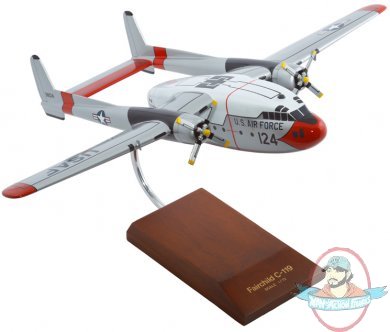
The Fairchild AC-119G Shadow was a twin-engine piston-powered gunship developed by the United States during the Vietnam War. By late 1967, the idea of the fixed-wing gunship had been proven so successful that the United States Air Force was having a difficult time keeping up with demand. These aircraft were primarily intended to replace the AC-47 in the close air support role. and were placed in the 71st Special Operations Squadron (SOW). They were used by the SOW from 1969–1971.
This handcrafted model is painstakingly built from Philippine mahogany by our skilled craftsmen with a wealth of detail and makes a great gift for any veteran, aviation enthusiast or history buff.
Wing Span: 18.75
Length: 14.75
AC119T
|
"The B-26 Marauder is an American Second World War twin engine medium bomber made by the Glenn L. Martin Company. In 1942, it was the first bomber in the Pacific Theater and Aleutian Islands. In 1946, it was the main offensive weapon of the Western Front by the Army Air Force. The B-26B sustained the lowest record of any fighter aircraft during the war. Its loss earned its unofficial nickname “The Widowmaker.” There were 5,288 aircrafts produced between the years 1941 to 1945. The Royal Air Force and the South African Air Force used 522 of them. The B-26B Marauder first came out in May 1942. It was the Marauder model that was built in large numbers. The difference between the B-26B from the earlier versions of the Marauder aircrafts is the two .50 inch machine guns with 1500 rpg placed in a stepped down tail position. It replaced the B26 and B-26A single hand-held guns. The guns are used manually by bead sight and ring. The gunner kneels down to find his targets and shoots his armaments. The ammos are on the cartridge belts standing on a pair of roller tracks. Each of the guns has 800 rounds. The overall length was increased to 58 feet and 3 inches because of its new tail position. The B-26C was similar to the B-26B. But all B-26C aircrafts were made with a larger wing. In fact, it was the first Marauder version to show with a larger wing. The wing was showed on the Omaha line before it showed on the Baltimore line. Its wing span turned to 712 feet and the area of the wing increased to 713 sq. ft. The modifications made, such as the additional weapons and armor and its enlarged wing and tail assembly, increased the weight by 1500 lbs. The top speed at 15,000 feet decreased to 282 miles per hour and cruising speed decreased to 214 miles per hour."
|
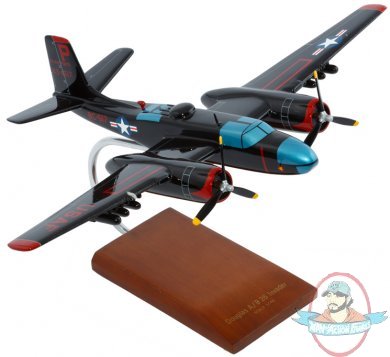
The A-26 Invader (designated B-26 between 1948–1965) was a United States twin-engined light attack bomber built by the Douglas Aircraft Co. during WWII. The B-26 was an unusual design for an attack bomber of the early 1940s period, as it was designed as a single-pilot aircraft. It was found to be a fast aircraft which was capable of carrying twice its specified bomb load.
This handcrafted model is painstakingly built from Philippine mahogany by our skilled craftsmen with a wealth of detail and makes a great gift for any veteran, aviation enthusiast or history buff.
Scale: 1/48 scale model
Wing Span: 16.5
Length: 13.5
AB26T
|
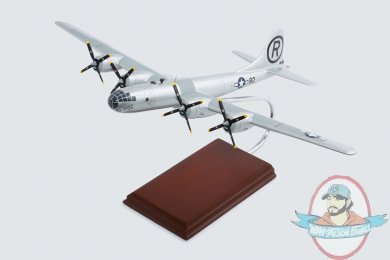
"The B-29 Enola Gay is the most complicated and propeller-driven bomber aircraft in the Second World War. The crew quarters are in the b29's pressurized compartments and the aircraft has highly developed armaments and avionics systems. It brought the first nuclear weapons used in the Pacific Theater war. Colonel Paul W. Tibbets Jr. dropped the first atomic bomb “Little Boy” in Hiroshima, Japan. The strategies for the first atomic bombing were set in August 1945. There were seven Superfortress aircrafts, three of which were to scout in front. One of them is to measure the blast of the bomb, and one photo plane is assigned to be the standby plane and the primary plane. The aircraft’s bombing is visual not radar. They used it to target the cities of Hiroshima, Kokura, Niigata and Nagasaki. Paul Tibbet’s own aircraft decided to name it “Enola Gay” after his loving mother. This gave him inspiration while he was building it. The Enola Gay allows 12 crewmen. In the afternoon of August 5, the Americans placed the bomb into the Enola Gay plane. The “Little Boy” atomic bomb is 12 feet long and 28 inches in diameter. Its power matches up 20,000 tons of TNT or approximately as much as two thousand Superfortress aircrafts could take. They started their engines in August 6, 1945 at 2:30 AM. Three hours after, they flew over Iwo Jima at dawn, where 5,500 Americans and 25,000 Japanese had died, so that the USAAF could use Iwo as an emergency landing field. They altered course and went northwest. They climbed to 30,700 feet for their bombing altitude. And at 8:30 they got a coded message saying Hiroshima was covered with clouds. At 9:15AM they dropped the ""Little Boy"" and made a 155 degree diving turn to the right. "
AB29ET
|