"The ATR-42 is a twin-turboprop airliner manufactured by ATR. The ATR42's maiden flight was on August 16, 1984 and it received certification following in September 1985. As of January 2007, there are 390 ATR 42s delivered worldwide, following another 11 aircraft order. There are three major variants of the ATR-42 and an STC exists to convert all ATR 42 variants to all-cargo transport aircraft. Major operators of the ATR-42 are FedEx, UPS and DHL. The ATR-42 ""Surveyor"" is a maritime patrol version of the -500 and VIP transport and in-flight inspection versions of the -500 also exist. The ATR-42 has a seating capacity of 44-50 passengers. It has a cruising speed speed of 556 km/h and a range of 2,965 km. t incorporates Pratt & Whitney Canada PW127E. The rear door is used to avoid possible injuries from the blades of the spinning propellers and the vast majority of commercial aircraft are boarded from the front. The ATR-42 also doesn't have Auxiliary Power Unit (APU), but it has a propeller brake, allowing the turbine to run and provide air power to the aircraft without the propeller spinning. Thus it eliminates the need for added weight and expense of an APU. the engines are periodically switched during maintenance to ensure equal wear. "
Scale: 1/48 scale model
Wing Span: 20
Length: 19
KATR42AET
|
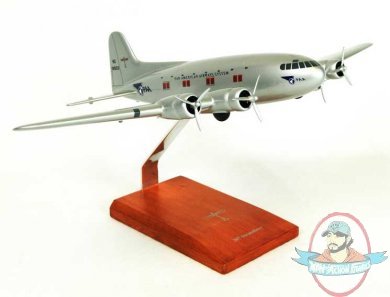
"The revolutionary Boeing 247, developed in 1933, was an all-metal, twin engine airplane and the first modern passenger airliner. It had a gyro panel for instrument flying, an autopilot, pneumatically operated de-icing equipment, a variable-pitch propeller and retractable landing gear. It also featured thick upholstered chairs, an insulated cabin, a lavatory and individual overhead lighting. The phenomenon of the Model 247 caught the attention of America's young airline companies. When its commitment to United prevented Boeing from filling orders fast enough, Transcontinental and Western Air (TWA) turned to Douglas. Douglas offered to build something similar to the Boeing 247, only faster and larger. TWA quickly accepted the proposal. The Douglas DC-1 which was eventually refined as the legendary DC-3, immediately attracted new customers. Thus, making the 247 obsolete less than a year after its first flight. Seventy-five 247s were built. Boeing Air Transport flew 60 247s. United Aircraft Corporation flew 10 and the rest went to Deutsche Lufthansa and a private owner in China. The Boeing 247s remained in airline service until World War II, when several were converted into C-73 transports and trainers. Some were still flying along with the Douglas DC-2 that supplanted it, the Model 247 ushered in the age of speed, reliability, safety and comfort in air travel."
Scale: 1/48 scale model
Wing Span: 18.5
Length: 12.63
KB247UATE
|
"The Boeing 314 ""Clipper"" is a long-range flying boat produced between 1938 and 1941 by the Boeing Airline Company. It is one of the largest aircraft at that time using the massive wing of earlier XB-15 bomber prototype. The Boeing 314 uses a series of heavy ribs and spars, creating a strong fuselage and cantilevered wing. It incorporates sponsons into the hull structure. The Pan Am Clippers were built for luxury, a necessity given the long duration of transoceanic flights. Pan American World Airways signed a contract for six Boeing 314 on July 21, 1936. The first 314, the Honolulu Clipper, entered service in January 1939. Pacific Clipper was enroute to New Zealand during the outbreak of war in the Pacific. In June 24, 1939, the Yankee Clipper had flown across the Atlantic on a route from Southampton to New York with intermediate stops at Foynes, Ireland, Botwood, Newfoundland and Shediac, New Brunswick. The Boeing 314 Dixie Clipper is another aircraft operated by Pan Am. It started its transatlantic passenger service in 1939 and was later sold to World Airways. It was scrapped on 1950. "
Scale: 1/100 scale model
Wing Span: 18.5
Length: 12.5
KB314T
|
"The Boeing 367-80, or ""Dash 80"" as it was called within Boeing, was a concept jet transport built to demonstrate that high speed jet transport was no longer the sole preserve of military aircraft. Boeing 367-80 was considered to be the prototype for both the Boeing 707 airliner and the C-135 series aircraft (including the best known variant, the KC-135 air tanker used by the United States Air Force), the Boeing 367-80 was built in less than two years from project launch in 1952 to rollout on May 14, 1954 for a cost of US$16 million. This was at the time an enormous risk for the Boeing Company, since they had no committed customers for the project. By early 1952 the designs were complete, and on April 1952, the Boeing board approved the program to build the jet. Construction of the Boeing 367-80 took place at Boeing's Renton, Washington plant, but as a prototype there was no production line and most of the parts were custom built. The plane's interior was not fitted with an airline cabin; rather it consisted of a basic plywood lining that was used to house the test instrumentation required for the flight test program. In addition to the flight testing program, Boeing also used the Boeing 367-80 to provide demonstration flights to airline executives and other key industry figures."
Scale: 1/100 scale model
Wing Span: 15.5
Length: 15.38
KB367T
|
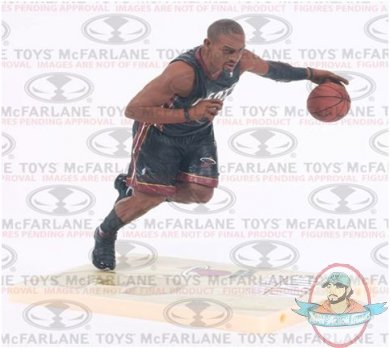
McFarlane SportsPicks is no stranger to recreating some of the NBA’s greatest players as highly detailed action figures and their 20th lineup is no exception.
This Set of NBA Series 20 seven 6-inch tall pieces contains the following players
-1x Carmello Anthony (New York Knickks)
-1x John Wall (Washington Wizards)
-1x Dwyane Wade (Miami Heat)
-1x Kevin Durant (Oklahoma City Thunder)
-1x Kobe Bryant (Los Angeles Lakers)
-1x Derrick Rose (Chicago Bulls)
-1x Blake Griffin (Los Angeles Clippers)
|
"The Boeing 377 Stratocruiser was the civilian version of the C-97 Stratofreighter, which in turn was derived from the B-50 Superfortress. It first flew on July 8, 1947. Despite serious design flaws and a marginal service record, the Stratocruiser was considered one of the greatest post-war propeller airliners. In the 1960s, several Stratocruisers were modified by Aero Spacelines to make oversized transports and were dubbed as ""Guppys"". The Boeing 377 has a seating capacity of up to 100 passengers on main deck and an additional 14 in lower deck lounge. The typical seating for 63 or 84 passengers. It incorporates 4 Pratt & Whitney R-4360-B6 Wasp Major 28-cylinder radial engines four-bladed propellers. It has a maximum speed of 375 mph and a range of 3,650 nm. The primary users and operators of the Boeing 377 are the Pan Am and the BOAC. Extremely complex and expensive, only 56 were built. It continued in mainline service until 1960, when it had been made obsolete by the coming of the 707 and other first generation jetliners. "
Scale: 1/100 scale model
Wing Span: 16.5
Length: 13
KB377NWT
|
"The Boeing 377 Stratocruiser was airliner version of the 367 Boeing Stratofreighter, which in turn was the transport version of B-29 Superfortress. It first flew on July 8, 1947. It was generally considered the greatest airliner in the air before the coming of the 707 and was the flagship of the Pan Am fleet. The Boeing 377 Stratocruiser has a variety of interior configurations which could accommodate 55 to 112 passengers or if equipped as a sleeper, with 28 upper and lower berth units plus five seats. The Boeing 377 Stratocruiser has a maximum speed of 375 mph and a range of 4,200 miles. There's a total 55 Boeing 377 Stratocruisers built. In 1963, B-377s disappeared from service."
Scale: 1/100 scale model
Wing Span: 16.5
Length: 13
KB377T
|
"The Boeing 707 transport marks the real beginning of the revolutionary jet age in transportation. There were over 900 Boeing 707 commercial transports built. By 1980, the 707 was no longer in production as a commercial transport. Today, many people still consider the terms 707 and jet transport to be synonymous. Boeing developed the 707-320 Intercontinental series which is a stretched version of the original 707 model with increased range, making it a true intercontinental jet. Boeing 707-320 was a later version of the Boeing 707 series, which had larger wings, and more fuel capacity to operate as a true, transoceanic aircraft. It also had a large cargo door, making it a dual-purpose transport aircraft. Although the Boeing 707 was not the first commercial jetliner in service, yet it was the first to be commercially successful."
Scale: 1/100 scale model
Wing Span: 17.5
Length: 18.5
KB707AAT
|
The Boeing 707-320 civilian variant of the 707 is a stretched version of the turbojet-powered original model. The 707-320's maiden flight was on January 11, 1958. It incorporates JT4A-3 turbojets which produce 15,800 lbst each. The interior of the 707-320 allows seating for up to 189 passengers. The longer wing could carry more fuel, increasing range by 1,600 miles and allows the it to operate as a transoceanic aircraft. There were 60 turbojet -320s produced.
Wing Span: 17.5
Length: 18.5
KB707PAT
|
The new version of the 707 was the 707-320, featuring an added larger wings and more fuel capacity to allow for transcontinental flights, making it a true intercontinental jet. It incorporates JT4A engines. The improvements of the 707-320 allows increased fuel capacity from 15,000 gallons to more than 23,000 gallons.
Scale: 1/100 scale model
Wing Span: 17.5
Length: 18.5
KB707TWAT
|
"The Airbus A320 is a short-to-medium range commercial passenger airliner manufactured by Airbus SAS. The Airbus Family members include the A318, A319, A320, and A321, as well as the ACJ business jet. Airbus A-320 flew for the first time in February 22, 1987 and first delivered in 1988. The A320 pioneered the use of digital fly-by-wire flight control systems in a commercial aircraft. With more than 3,000 aircraft of the A320 family built, it is the second best selling jet airliner family of all time, after the family's primary competition, the Boeing 737. The A320 Airbus features a computerized on-board maintenance system. The avionics systems are designed for easy upgrade without major rework. With the exception of the very earliest A320's, most can be upgraded to the latest avionics standards, keeping the aircraft advanced even after almost 2 decades in service. Also integral to the A320 is the advanced electronic flight deck; with six fully integrated EFIS colour displays and innovative side stick controllers rather than conventional control columns. The A320 also employs a relatively high percentage of composite materials compared to earlier designs. Two engines are offered, the CFM56 and IAE V2500. The A-320 has seating for 150 to 179 passengers, these accommodated in a wider cabin than most single-aisle aircraft, allowing for far greater comfort and the ability to take standard baggage containers. Typical cruising speed of the Airbus A-320 is Mach 0.8 with a range of 3,270 miles with 150 passengers and luggage. "
Scale: 1/100 scale model
Wing Span: 13.5
Length: 14.75
KA320UATR
|
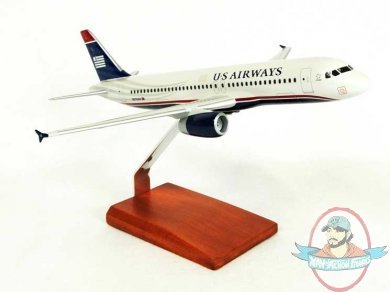
"The US Airways is an American low-cost airline headquartered in Tempe, Arizona, owned by US Airways Group, Inc. In 1996, the airline ordered up to 400 new Airbus A319, A320 and A321 narrow-body twin jets for delivery starting in 1998 and continuing through 2009; then within days announced its new identity as US Airways. The A320, a short to medium range airliner, is perhaps best known as the first airliner to introduce a fly-by-wire flight control system. The most important contributor to Airbus Industry's success as an airliner manufacturer, the four member A320 family is significant sales success and a technological trailblazer. As of early 2003, firm orders for the A320 stood at 1397 with 1131 delivered. The A320-200 is one of the member of A320's it has a maximum cruising speed of 903km/h at 28,000ft, economical cruising speed of 840km/h at 37,000ft. The A320 Airbus features a computerized on-board maintenance system. The avionics systems are designed for easy upgrade without major rework. With the exception of the very earliest A320's, most can be upgraded to the latest avionics standards, keeping the aircraft advanced even after almost 2 decades in service. The A-320 has seating for 150 to 179 passengers, these accommodated in a wider cabin than most single-aisle aircraft, allowing for far greater comfort and the ability to take standard baggage containers. Typical cruising speed of the Airbus A-320 is Mach 0.8 with a range of 3,270 miles with 150 passengers and luggage."
Scale: 1/100 scale model
Wing Span: 13.5
Length: 14.75
KA320USATR
|
"The A330-300 is the biggest member of Airbus' twinjet family and is closely related to the four engined long range A340 with which it shares near identical systems, airframe, flightdeck and wings, the only major difference being the twin (versus four) engine configuration. The A340 and A330 were launched simultaneously in June 1987. Although developed in parallel the A330-300 made its first flight after the A340, on November 2 1992. It was the first aircraft to achieve simultaneous European Joint Airworthiness Authorities (JAA) and US FAA certification, on October 21 1993. Entry into service took place by the end of that year. Differences from the A340 aside from the number of engines are slight changes to the wing and internal systems, including fuel tankage. The A330 (like the A340) takes advantage of a number of technologies first pioneered on the A320, including the common advanced EFIS flightdeck with side stick controllers and flybywire computerised flight control system. While the standard A330-300 shares the same fuselage length as the A340-300, Airbus has studied various stretched (A330-400) and shortened (A330-100 and 200) versions. The shortened A330-200 was formally launched in 1996 as a long range 767-300ER competitor, and is described separately. One stretched, high capacity concept studied for a time featured lower deck seating in place of the forward freight hold. "
Scale: 1/100 scale model
Wing Span: 23
Length: 24.75
KA330NWTR
|
"The A330-300 is the largest member of the twin-engine A330 series. The Airbus A330-300 was developed as a replacement for the A300. It entered service in 1993. The A330-300 has a seating capacity of 295 passengers in a three class cabin. It is incorporates two Pratt & Whitney PW4000 or Rolls-Royce Trent 700 engines. It has a maximum cruise speed of Mach 0.86 and a range of 5,669 NM. The A330-300 offers the best balance for range and cost. It's highly efficient and optimized for medium-to-extended-range market."
Scale: 1/100 scale model
Wing Span: 23
Length: 24.75
KA330USATR
|
"The A340-500 is the world's longest-range commercial airliner. A340-500's maiden flight was on February 11, 2002 and it received certification on December 3, 2002 and was delivered to Emirates Airline. The A340-500 has a seating capacity of 313 passengers in a three class cabin. The A340-500 features a 4.3 m stretched fuselage, an enlarged wing area, massive increase in fuel capacity, slightly higher cruising speed, larger horizontal stabilizer and smaller vertical tailplane. It also has taxi cameras to help pilots during ground maneuvers. The A340-500 is powered by four 53,000 lb thrust Rolls-Royce Trent 553 turbofans. The A340-500 is capable of traveling non-stop from London to Perth, Australia, though a return flight requires a fuel stop due to headwinds. Thai Airways International also had flown the A340-500 non-stop from Bangkok to Los Angeles and Bangkok to New York. The most recent customer of the A340-400 is the Etihad Airways. Emirates Airline is the largest operator of the A340-400, with 10 aircraft in service. In February 2006, the 777-200LR entered service, replacing the A340-500 as the world's longest-range commercial airliner."
Scale: 1/100 scale model
Wing Span: 23.75
Length: 24.75
KA340ACTR
|
"The Javelin is a small high-speed personal jet being developed by the Aviation Technology Group (ATG). Planned for FAA certification under 14 CFR part 23, the Javelin has a design resembling a fighter aircraft, an unusual concept for civilian jets. The Javelin MK-20 derivative, being developed in cooperation between ATG and Israel Aerospace Industries, is expected to fill the jet trainer role for various air forces. The Javelin is designed to look and perform like a fighter jet. Pre-orders are being sold for approximately US$ 2.995 million in the civil market. ATG is presently headquartered at Centennial Airport (KAPA) in Centennial, Colorado, with manufacturing facilities at Front Range Airport (KFTG) in neighboring Aurora."
Scale: 1/32 scale model
Wing Span: 9.5
Length: 14
KAJT
|
"The Airbus A320 is a short to medium range commercial passenger airliner manufactured by Airbus. The A320 was first delivered in 1988 and it uses digital fly-by-wire flight control systems. At that time, the American West Airlines was experiencing financial troubles due to the rapid growth of the airlines which resulted in large operating losses. During 1986, the company was in the verge of bankruptcy. In 1990, the American West Airlines moved into the new terminal 4 and also took the delivery of several Airbus A320 aircraft that were destined for the now defunct Braniff Airways. The A320s were sold to America West at a steep discount. The America West Airlines continued to lose money and operated in bankruptcy from 1991 to 1994. The company resorted to organizational restructuring and the bankruptcy also forced a number of changes on the management aspect. The American West continued ordering Airbus A320 and gradually started retiring its older Boeing 737-200 aircraft. The most notable contribution of the A320 airliner is that it was the best selling member among the family. The A320 features a computerised on-board maintenance system. It also features a wider single-aisle cabin and larger overhead bins. The A320 airliners and other variants (A318, A319, and A321) incorporate LCD (liquid crystal display) units in the flight deck instead of the original CRT (cathode ray tube) displays. There are over 3,000 A320 airliners built, making it the second best selling jet airliner family of all time. "
Scale: 1/100 scale model
Wing Span: 13.5
Length: 14.75
KA320AWTR
|
"The VH-3D Sea King is a twin-engined, all-weather helicopter in support for the transportation operations of the United States President. It was flown by the Marine Helicopter Squadron One. It was developed from the series of Sikorsky S-61 and it was already in the air more than 40 years. It was built as an anti-submarine sensor carrier for the United States Navy. It is the replacement for the SH-60F Sea Hawk for the role of an antisubmarine warfare helicopter. In December 1974, the helicopter was delivered to HMX-1 to replace the VH-3A. It entered the service in 1963. The VH-3A helicopter was entirely replaced by the VH-3D in 1976. The United States Army Executive Flight Detachment was activated in January 1 1958. Together with the Marine Helicopter Squadron One they were given a task to evacuate the President, his family and other government officials. The VH-34D was the primary executive transport helicopter but it was replaced by the VH-3D Sea King in 1961. It was built for the United States Navy as a carrier based anti-submarine helicopter with modified interiors. It was the preferred VIP and executive transport. John F. Kennedy requested the executive aircraft to bear unique markings. He wanted the choppers to have a white and green paint design on both sides of the fuselage, a flag of the United States on the engine cowling, and the Presidential seal on the nose of the helicopter. The helicopter is still in use. It can be seen on televisions whenever it is being used to transport President George W. Bush. "
Scale: 1/48 scale model
Wing Span: 15.5
Length: 13
HVH3DT
|
"The Presidential Helicopter Replacement (VH-71) was a dual-piloted, multi-engine vertical take-off and landing aircraft that would bring the latest vertical lift and command and control communication technology to the primary helicopter platform employed by HMX-1. The VH-71 would be capable of operating day or night, in adverse weather worldwide, in climates including arctic, desert, mountainous, littoral, and tropical. Marine Helicopter Squadron One (HMX-1) is required to provide safe and timely transportation for the President and Vice President of the United States, heads of state and others as directed by the White House Military Office (WHMO). Currently two Type, Model, Series (TMS) aircraft are used by HMX-1 for the Presidential support mission, the VH-3D and the VH-60N. The VH-71 program provides the replacement helicopter for the VH-3D and VH-60N. The future ""Marine One"" would be one of the world's most technologically advanced helicopters, designed to safely and reliably transport the president, vice president, heads of state and other official parties both at home and abroad with mobile ""oval office in the sky"" capabilities."
Scale: 1/65 scale model
Wing Span: 11.25
Length: 13.75
HVH71T
|
"The Boeing Model 307 Stratoliner was the first fully pressurized airliner to enter service anywhere in the world. Capable of flying 20,000 feet higher than the 5,000 to 10,000-foot altitude unpressurized airplanes at that time, it was said that it could “fly above the weather�. The Model 307 had a capacity for five crew members and 33 passengers, and had a nearly 12-foot wide cabin for overnight berths. It was the first plane to include a flight engineer as a crew member. Only ten Stratoliners were produced. Three were built for Pan Am, five served with TWA, and a ninth was supplied to multi-millionaire Howard Hughes. The prototype crashed during a test flight. By 1940, the Model 307 was flying routes between Los Angeles and New York, as well as to locations in Latin America. Howard Hughes purchased a model for his personal use, and had it transformed into a luxurious “flying penthouse�. This same plane was later sold to oil tycoon Glenn McCarthy in 1949. The only surviving Stratoliner, operated by Pan Am, is preserved in flying condition at the Smithsonian Museum's Steven F. Udvar-Hazy Center. On March 29, 2002, this particular aircraft was subject to a dramatic crash in which it ditched into Elliott Bay in Seattle, Washington, on what was to be its last flight before heading to the Smithsonian. Despite the incident, it has again been restored and is now on display. "
Scale: 1/72 scale model
Wing Span: 18.5
Length: 12.63
K307PAT
|
"The A320 Airbus family is a short to medium range commercial passenger airliner manufactured by Airbus. The A320 series has two variants, the A320-100 and A320-200. The A320-200 is the definitive version and was delivered together with the A320-100 to Air Inter, an airliner acquired by Air France, Air France and British Airways. The A320-200 features wingtip fences and has an increased fuel capacity compared to the A320-100 for an increased range. The A320-200 has 2,900 nautical miles typical range with 150 passengers. It incorporates two CFMI CFM56-5 or IAE V2500 with thrust ratings between 25,500 to 27,000 pounds force. The A320-200 direct Boeing competitor is the 737-800. There are more than 3,000 A320s built and is the second best-selling jet airliner family of all time "
Scale: 1/100 scale model
Wing Span: 13.5
Length: 14.75
KA320ACTR
|
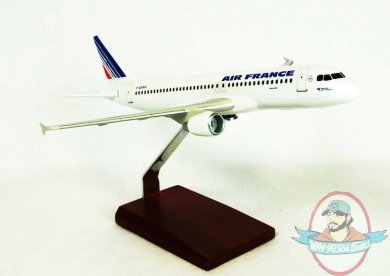
Air France is a Paris-based airline that operates worldwide scheduled passenger and cargo services to 185 destinations in 83 countries. In 1988, it became a launch customer for the A-320 narrowbody twin. The A320 is a short-to-medium range commercial passenger aircraft manufactured by Airbus.
Scale: 1/100 scale model
Wing Span: 13.5
Length: 14.75
KA320AFTR
|
"The UH-1 Huey Iroquois is a multipurpose utility helicopter. It was manufactured by Bell Helicopter Textron. Its maiden flight was on the 22nd of October 1956 but it was introduced commercially in 1959. Its primary users are the United States Army, Japan Ground Self-Defense Force, Royal Australian Air Force, and Philippine Armed Forces. The Huey, as it is commonly known, became famous for its use in the Vietnam War. The “U” stands for Utility as compared to Attack and the Cargo helicopters. In 1959, the Huey was first used by the military and in 1962 it went into triservice production and became the UH-1. The UH-1 has a lot of variants. The United States Military variants are the XH-40 which is the initial Bell 204 prototype; the YH-40 which the sixth pre-production aircraft; the HU-1A which is known initially as the Bell 204 production model but redesignated in 1962 as the UH-1A; the HU-1B which is an upgraded HU-1A having various external and rotor improvements and in 1962 it was redesignated as the UH-1B; the UH-1C which is similar to the UH-1B; the YUH-1d which is a pre-production prototype of the UH-1D; the UH-1D which is initially the Bell 205 production model and the long fuselage version of the Bell 204. "
Scale: 1/32 scale model
Wing Span: 18
Length: 15.75
HUH1DT
|
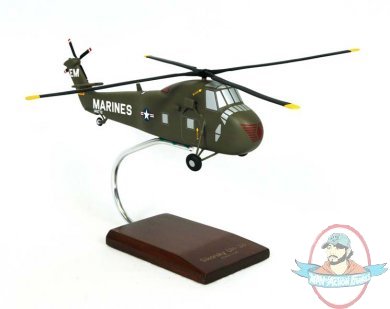
"Sikorsky, the manufacturer of UH-34, originally developed Seahorse for the Navy but the Army would become a primary user as well using the name “Choctaw”. The U. S. Army employed the UH-34 principally for general utility purposes, as well as VIP transport flights, and SAR missions. The UH-34 played a major role for the Navy in anti-submarine warfare along with search and rescue duties. In the Vietnam War, the Marine Corps depended on Seahorse reliability and modified the UH-34 into one of the first gunship helicopters of the war. The Army's Choctaw helicopter successfully carried out numerous missions in Vietnam ranging from combat assault to medical evacuation and general cargo transportation. The UH-34 was also the final evolution of large piston-engine helicopters before the rise of turbine powered designs. Ultimately the UH-34 was flown by all branches of the U. S. military and also by the armed forces of Argentina, Belgium, Brazil, Cambodia, Canada, Chile, Costa Rica, France, Germany, Haiti, Indonesia, Israel, Italy, Japan, Katanga, Laos, Netherlands, Nicaragua, Philippines, Soviet Union, Thailand, United Kingdom, Uruguay, and Vietnam. The Sikorsky UH-34D variant of the Seahorse, used for assault missions, was a 12-seater military helicopter mainly used by the U.S Navy. The US Marine Corps ordered the HUS-1 Seahorse (UH-34D) version on October 15, 1954. This helicopter entered Marine service on March 31, 1961, and served in units at New River, North Carolina; Jacksonville; Santa Ana and El Toro, California; and New Orleans. On November 25, 1970, it was retired and placed in storage at Davis-Monthan Air Force Base, Arizona, having accumulated 3,416 flying hours. "
Scale: 1/48 scale model
Wing Span: 12.5
Length: 14.25
HUH34DT
|
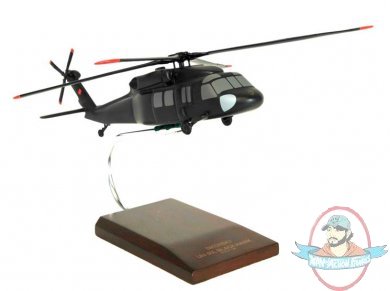
The UH-60 Black Hawk is the Armys front-line utility helicopter used for air assault, air cavalry, and aeromedical evacuation units. It is designed to carry 11 combat-loaded, air assault troops.
Scale: 1/48 scale model
Wing Span: 13.5
Length: 12
HUH60TR
|
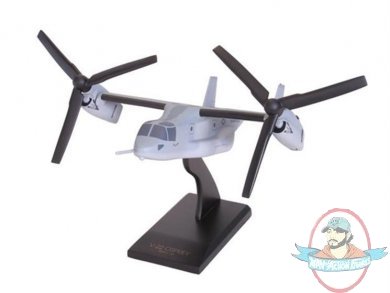
"Developed and built jointly by Bell Helicopter Textron and Boeing Helicopters, the V-22 Osprey is a joint service, multi-mission, military tilt rotor aircraft with both a vertical takeoff and landing (VTOL) and short takeoff and landing capability (STOL). It is designed to perform missions like a conventional helicopter with the long-range, high-speed cruise performance of a turboprop aircraft. The initial operators are the U.S. Marine Corps and United States Air Force. The Federal Aviation Administration (FAA) classifies the Osprey as a model of powered lift aircraft. The V-22 first flew on March 18, 1989. The V-22 Osprey is twice as fast as a helicopter and has much longer range resulting in greater mission versatility than a helicopter. The V-22 Osprey’s multi-mission capability provides: amphibious assault, combat support, long-range special ops infiltration and exfiltration, transport, search and rescue, medevac, and, in the future, tanker capability. The V-22 Osprey aircraft can transport 24 combat troops or up to 20,000 pounds of internal or external cargo using its medium lift and vertical takeoff and landing capabilities. Boeing V-22 meets U.S. Navy requirements for combat search and rescue, fleet logistics support, and special warfare support and matches the U.S. Special Operations Command's requirement for a high-speed, long-range, vertical lift aircraft. It can be stored aboard an aircraft carrier because the rotors can fold and the wing rotate. The Osprey has air-to-air refueling capability, the cornerstone of the ability to self-deploy. "
Scale: 1/48 scale model
Wing Span: 13
Length: 14.5
HV222TR
|
"The V-22 Osprey is a tilt rotor helicopter that was manufactured by Bell Helicopter and Boeing Company. It is an aircraft that takes off just like an ordinary helicopter but flies like a plane. It is an aircraft with great range, speed, and flexibility as it is twice the speed, five times the range, and twice as high as the older aircraft that it replaced. The V-22’s maiden flight was on the 19th of March 1989 and it was introduced commercially on the 8th of December 2005. Its primary users are the US Marine Corps and the US Air Force. The US Marines are the first to make use of the V-22 aircraft. It is said that it can efficiently save lives because it flies higher and faster than any other helicopter during its time. It is said to be the first aircraft designed to meet the needs of all four United States armed services. The United States Marine Corps took the V-22 Osprey to replace the CH-46E and CH-53D assault helicopters. The MV-22 is a medium lift assault aircraft. It can self-deploy and can sustain land operations. It can provide combat assault transport hence it was designated as the baseline variant for the Marines."
Scale: 1/96 scale model
Wing Span: 6.5
Length: 7.25
HV22TR
|
"The Sikorsky SH-60/MH-60 Seahawk (or Sea Hawk) is a twin turbo shaft engine, multi-mission United States Navy helicopter based on the airframe of the United States Army/Air Force UH-60 Black Hawk. The SH-60 Seahawk is still being operated by the U.S. Navy. The SH-60B variant of the Seahawk, a twin-engine helicopter, was the primary anti-submarine platform used by the U.S. Navy. SH-60B was also used for search and rescue, drug interdiction, anti-ship warfare, cargo lift, and special operations. The –B version of the Seahawk first flew on February 11, 1983. The SH-60B, also a Light Airborne Multi-Purpose System (LAMPS Mk III), has a 20deg tractor-type canted tail rotor, a controllable stabilator, conventional fixed landing gear, emergency flotation, an external cargo hook, a rescue hoist, and bomb racks for carrying and launching external stores. In addition, it is equipped with a flight-rated auxiliary power unit, a sonobuoy-launch system, an anti-ice system, a fire-extinguishing system, an environmental control system, an automatic flight control system (AFCS), a single-point pressure refueling system, a helicopter in-flight refueling (HIFR) system, and the necessary avionics and instrumentation for instrument flight and mission accomplishment. The helicopter design is compatible with ships equipped with a recovery, assist, securing and traversing (RAST) system, and the main rotor blades and tail pylon can be folded for storage. In addition, the helicopter can operate on non-RAST equipped combatants and a variety of other naval ships. A total of 260 –B version were built. "
Scale: 1/48 scale model
Wing Span: 13.5
Length: 12
HV60BTR
|
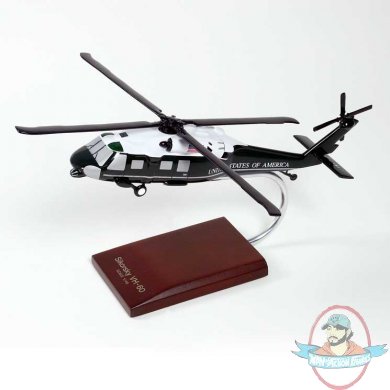
"VH-60 Seahawk Sikorsky is a twin engine multimission maritime helicopter based and developed on the USAF's UH-60 Black Hawk. The VH-60's maiden flight was on 1974 and was introduced in 1979. The VH-60 is able to deploy aboard any air-capable frigate, destroyer, cruiser, fast combat support ship, amphibious assault ship or aircraft carrier, the Seahawk can handle antisubmarine warfare, undersea warfare, naval special warfare insertion, combat search and rescue, vertical replenishment and medical evacuation. Each VH-60 unit costs up to US$36 million. The primary users and operators of VH-60 are the United States Navy, United States Coast Guard and Japan Maritime Self-Defense Force. Currently, VH-60 is still in production and still in active"
Scale: 1/48 scale model
Wing Span: 13.5
Length: 12
HV60TR
|
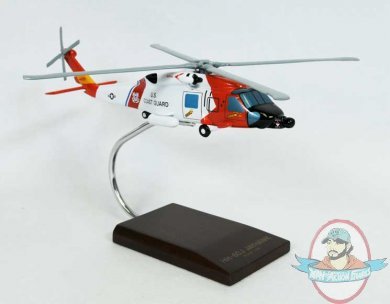
"HH-60 Jayhawk is a search and rescue (SAR) helicopter based on the airframe of the SH-60 Seahawk manufactured by Sikorsky Aircraft Corporation. The HH-60J Jayhawk is a variant of the HH-60, with a crew of four including a pilot, co-pilot and two flight crew. It has a maximum speed of 180 knots and a range of 700 nautical miles. The HH-60 incorporates two General Electric T700-GE-401C rates at 1980 HpThe HH-60, besides its SAR function, is also used for drug interdiction, cargo lift and special operations. The primary user of the HH-60 Jayhawk is the United States Coast Guard and was developed to replace the aging Sikorsky Pelican in 1986."
Scale: 1/48 scale model
Wing Span: 13.5
Length: 12.5
HH60JTR
|