"In 1980, the United States Coast Guard chose the SA 366 G1 Dauphin to be its short range recovery air rescue helicopter and it was given the title HH-65A Dolphin. A total of 99 Dolphin helicopters were improved for its function as a rescuer for the United States Coast Guard. The aircraft was the replacement of the Sikorsky HH-52A Sea Guard. In 2002, a total of 94 Dolphin units were used by the United States Coast Guard. Some of its functions were for security patrols, pollution control, enforcement of laws and treaties and missions like search and rescue. It is famous for its autopilot abilities that allow the crew to take on other duties. To meet the United States rules in local content engineering, modifications were made to the helicopter. Its engine was changed to Allied Signal LTS-101-750B-2 power plants. In 2004, the engine problems still continued and they decided to replace it with Arriel 2C2 units. It became a more competent and secured aircraft. The improved HH-65A Dolphins were chosen as HH-65C Dolphins. The HH-65A cannot execute water landings. It typically takes a crew of four. The HH-65 Dolphin was produced by the Aerospatiale Helicopter Corporation in Texas. The LTS-101 750B-2 turbo shaft engines were built by the Textron Lycoming in Pennsylvania and the electronic systems was built by the Rockwell International in Iowa. "
Scale: 1/32 scale model
Wing Span: 15.75
Length: 15
HH65ADT
|
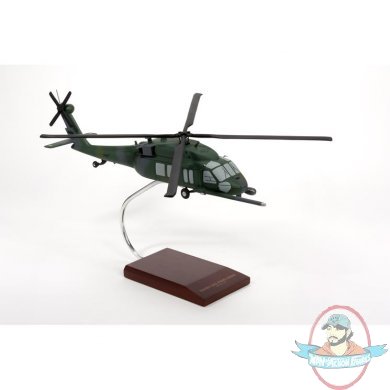
"The HH-60 Pave Hawk is a highly-modified edition of the Sikorsky UH-60 Black Hawk chopper. The aircraft was first developed by the United Technologies and Sikorsky Aircraft Corporation. The Pave Hawk is a twin-engine medium-lift helicopter operated by Air Combat Command, Pacific Air Forces, Air Education and Training Command, Air National Guard and Air Force Reserve Command. The HH-60 was first seen in action in 1982. The HH-60 features an upgraded communications and navigation suite that includes an integrated inertial navigation, global positioning, Doppler navigation systems, satellite communications, secure voice, and quick communications system. The HH-60 Pave Hawks costs an estimated amount of $15.8 million. All HH-60s have an automated flying control system, night vision goggles lighting and forward looking infrared system that improves night low-level operations. In addition, some Pave Hawks have color weather radar and rotor blade anti-ice system that gives the HH-60 an all-weather capability. The main role of the Sikorsky HH-60 Pave Hawk chopper is to perform day or night combat search and rescue (CSAR) operations into irreconcilable territories to recuperate downed aircrew and other isolated air force personnel’s during war. The HH-60 may also perform peace-time operations because of its versatility. "
Scale: 1/40 scale model
Wing Span: 16.25
Length: 18.38
HHMH60T
|
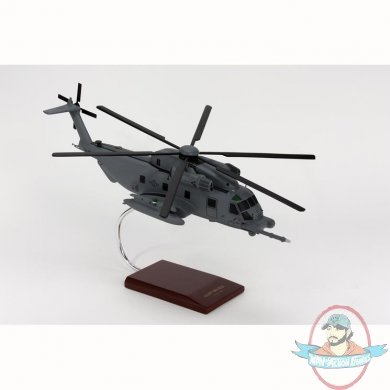
"The MH-53J Pave Low III heavy-lift helicopter is the largest, most powerful and technologically advanced transport helicopter in the US Air Force inventory. Under the Pave Low III program, the Air Force modified nine MH-53Hs and 32 HH-53s for night and adverse weather operations. Modifications included forward-looking infrared, inertial navigation system, global positioning system, Doppler naigations systems, APQ-158 terrain-following and terrain-avoidance radar, an onboard-mission computer, enhanced navigation system and integrated avionics to enable precise navigation to and from target areas. The Air Force designated these modified versions as MH-53Js. The MH-53J Pave Lows main mission is to drop off, supply and pick up special forces who are behind enemy lines. It also can engage in combat search and rescue missions. Low-level penetration is made possible by state-of-the-art terrain following radar, as well as infrared sensors that allow the helicopter to operate in bad weather. The MH-53Js were used in variety of missions during Desert Storm. Pave Lows were also used extensively during Operation Just Cause in Panama. The MH-53M Pave Low IV is a MH-53J model that has been modified with the Interactive Defensive Avionics System/Multi-Mission Advanced Tactical terminal or IDAS/MATT. "
Scale: 1/48 scale model
Wing Span: 19.2
Length: 21
HMH53JT
|
"The RAH-66 Comanche is an advanced U.S. Army military helicopter for reconnaissance, incorporating stealth techniques. The US Army planned to purchase almost 1,300 Commanches for scout and light attack roles and in May 1995, the first of the prototypes rolled out of the Sikorsky Aircraft Corporation's helicopter production facility. The prototypes maiden flight was on January 4, 1996. The RAH-66's very sophisticated design and navigation systems, allowing it to operate at night and in bad weather. Its airframe was designed to fit more easily than the Apache into transport aircraft or into transport ships, enabling it to be deployed to hot spots quickly. The RAH-66A has a crew of 2. It has a maximum speed of 175 knots and a range of 262 nmi. The primary user of the RAH-66 Comanche was the United States Army. On February 23, 2004, the US Army cancelled the Comanche helicopter program to provide funds to renvation with existing helicopter fleet of aging attack, utility and reconnaissance aircraft. Other factor was the growing popularity of Unmanned Aerial Vehicles for reconnaissance purposes and UAVs had proven their worth in Afghanistan and Iraq. Technology incorporated to the Comanche will be integrated into the Apache and other US military helicopter developments and some its roles will be taken over by the Bell ARH-70. "
Scale: 1/48 scale model
Wing Span: 11.5
Length: 9.75
HR66TR
|
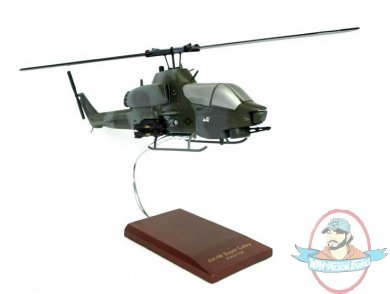
"The AH-1 SuperCobra is a twin-engine attack helicopter based on AH-1 Cobra. The AH-1 Cobra was developed in the mid-1960s as an interim gunship for the U.S. Army. The Cobras and Sea Cobras were deployed in the Gulf War for a support role. The AH-1W Super Cobras destroyed 97 tanks, 104 armored personal carriers and vehiclesand two anti-aircraft artillery sites during the 100-hour ground campaign. The AH-1 was also used by the Pakistan Army as its primary gunship helicopter during the mid- 1970s tribal uprising in Pakistan's Baluchistan province. The AH-1s continued to operate with the U.S. Marine Corps. The AH-1W utilizes a more diverse array of ordnance compared to the Apache. The AH-1W has a crew of 2, one pilot and a co-pilot/gunner (CPG). It has a maximum speed of 190 knots and a range of 317 nm. The primary users of the AH-1 are the U.S. Marine Corps, Islamic Republic of Iran Army, Republic of China Army and the Turkish Army. The AH-1W Super Cobra was considered the backbone of the United States Marine Corp's attack fleet, but it will be replaced by the AH-1Z Viper upgrade in the next decade. "
Scale: 1/32 scale model
Wing Span: 18
Length: 17
HSCT
|
The UH-1C represents the third generation of Bell's iroquois series. Of all Bell's UH-1C machines, this was the most heavily armed. It carried an M-5 40mm grenade launcher on its nose and the M3 Rocket System. Each of the two M3 rocket pods carried twenty-four 2.75 inch rockets and the M-5 grenade launcher held over 300 antipersonnel grenades. Used extensively as escort for unarmed transport helicopters, the Heavy Hog was able to provide especially effective cover and offensive firepower during unloading and recovery operations. The UH-1C saw its combat tour through to the close of the vietnam Conflict, deadly to the enemy and essential to U.S. forces in its capacity as a most formidable gunship.
Scale: 1/48 scale model
Wing Span: 36
Length: 15.5
HUH1C
|
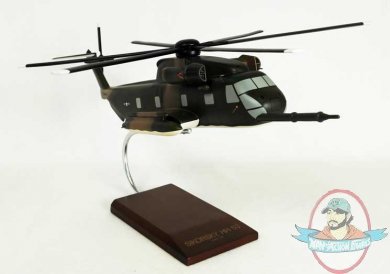
"The Sikorsky HH-53 or the Super Jolly Green Giant was ordered by the USAF for Search and Rescue operations. The Sikorsky HH-53 is the USAF version of the CH-53 Sea Stallion helicopter. The main reason for the development of Sikorsky HH-53 is to replace the HH-3 which is also called the Jolly Green Giant. Later on, the Sikorsky HH-53 was upgraded to MH-53. A lot of Sikorsky HH-53 variants were produced, such as the HH-53B which has a retractable in-flight refueling probe on the right side of the nose, the HH-53C which was an interim type that dispenses with the fuel tank bracing struts, the MH-53H which retained the in-flight refueling probe, external fuel tanks, rescue hoist and three gun armament, the MH-53J which is the largest and most powerful Sikorsky HH-53 variant produced by the US Air Force and the MH-53M has been modified with the Interactive Defensive Avionics System. On March 15, 1967, the Sikorsky HH-53 Super Jolly Green Giant made its first flight at Wright Patterson Air Force Base, Ohio. The Sikorsky HH-53 was faster and had tripled the take off of the HH-3. Other than that, the Sikorsky HH-53 was larger, more heavily armed and with almost double the shaft horsepower. Thus, the Sikorsky HH-53 had better overall performance and hover capability. "
Scale: 1/48 scale model
Wing Span: 18.25
Length: 19.5
HH53DT
|
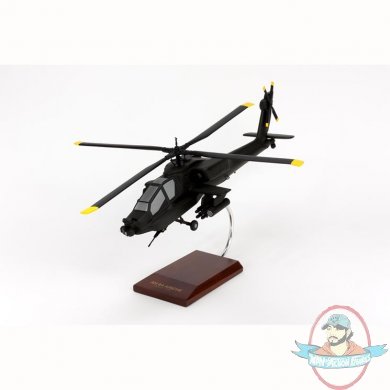
"The AH-64 Apache is the United States Army's main attack helicopter. It conducts rear, close and shaping missions, as well as distributed operations and precision strikes against relocatable targets. It provides armed reconnaissance when required in day, night, obscured battlefield and adverse weather conditions. It was designed by Hughes Helicopters, which in 1984 was purchased by McDonnell Douglas. In August 1997, McDonnell Douglas merged with Boeing. The AH-64D variant is now being produced by Boeing Integrated Defense Systems. After the cancellation of the AH-56 Cheyenne, the US Army sought an aircraft to fill the anti-armor attack role. It was to be better than the AH-1 Cobra in firepower, performance and range, and have the maneuverability to fly nap-of-the-earth missions. Hence, the Army issued a request for proposals for an advanced attack helicopter in 1972. Five manufacturers submitted proposals, and in 1973 the US Department of Defense selected Bell and Hughes as finalists. Each company built prototypes which underwent a flight test program. After evaluating test results, the Army awarded the contract to Hughes. In late 1981, the AH-64 was given the name “Apache” in keeping with the Army's tradition of using Native American tribal names for its helicopters. In 1983, the first production helicopter was rolled out. The AH-64 entered service in 1984 and was first used in combat during the 1989 US invasion of Panama. The AH-64D Apache Longbow, a more advanced model, began service in 1998. Both the AH-64A Apache and the AH-64D Apache Longbow have played important roles in several Middle Eastern wars, including the Gulf War, Operation Enduring Freedom in Afghanistan, and Operation Iraqi Freedom in Iraq. The Apaches proved to be excellent tank hunters and have destroyed hundreds of armored vehicles, mainly of the Iraqi army. The AH-64D has also been deployed in Afghanistan as part of Operation Anaconda, and from June 2003, in South Korea. Both the AH-64A and AH-64D are still in active service in the US Army. "
Scale: 1/32 scale model
Wing Span: 18.25
Length: 18.25
HA64DLT
|
"The AH-64 is an attack helicopter of the United States Army and the AH-1 Cobra successor. It was manufactured by the Hughes, McDonnell Douglas, and Boeing IDS. Its maiden flight was on the 30th of September 1975 and it is still active in service. Its primary users are the United States Army, Israel Air Force, Japan Ground Self-Defense Force, and Royal Netherlands Air Force. This helicopter was produced in 1984 up to the present time. The Apache is a two-seat principal attack helicopter with two General Electric T700 turboshaft engines. It carries a mixture of AGM-114 Hellfire and Hydra 70 rockets mounted on its stub wing pylons. It is also armed of 30 mm M230 chain gun. It is built to operate day or night and even in bad weather with the use of avionics and electronics like Target Acquisition and Designation System to endure the front line environment. In 1989, the Apache was used the first time in combat through the invasion of Panama, known as the Operation Just Cause. Two of its variants, the AH-64A and the AH-64D, have the most important role in some of the wars in the Middle East such as the Gulf War, the Operation Enduring Freedom in Afghanistan, and the Operational Iraqi Freedom in Iraq. These two variants are serving the United States Army. They are the major models of the AH-64. "
Scale: 1/32 scale model
Wing Span: 18.25
Length: 18.25
HA64LT
|
"During 1960, the United States Marine Corps (USMC) developed a need for a medium-lift tandem rotor assault helicopter that would replace the aging piston engine types being used at that time. Boeing Vertol won the design competition and in 1961 the USMC picked up the CH-46 Sea Knight. Since its introduction, the helicopter has served with both the USMC and United States Navy (USN) faithfully. It has been used in all Marine combat and peacetime environments. Sometimes known as the “Phrog”, the Sea Knight is a descendant of Boeing's first turbine-powered helicopter, the Boeing 107. It is used by the USMC to provide all-weather, day-or-night, night vision goggle assault transport of combat troops, supplies and equipment into or within a battle area. Other tasks include combat support, search and rescue, support for forward refueling and rearming points, casualty evacuation and tactical recovery of aircraft and personnel. The unique tandem rotor design of the CH-46 helicopter allows for increased agility and superior handling qualities in strong relative winds from all directions. Because of this feature, tons of cargo and thousands of passengers have safely been transferred over the years. The Sea Knight can stay airborne for 2-3 hours. It has the ability to land and taxi in the water when needed, and stay afloat for up to two hours in light seas. While other helicopters are extremely limited in various flight maneuvers, the Sea Knight can fly rearward or sidewards. "
Scale: 1/32 scale model
Wing Span: 19
Length: 17
HC46
|
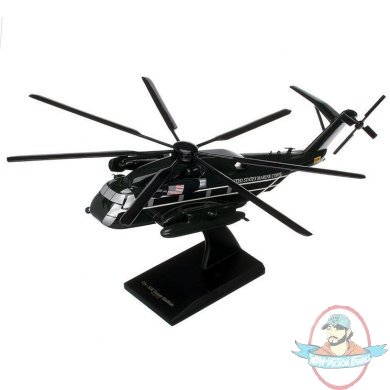
"The CH-53E Super Stallion is the biggest helicopter in the military of the United States. It was built by Sikorsky Aircraft and it is intended for shipping of equipments, goods and personnel in some operations. It is capable in all kinds of weather conditions both day and night. The sailors usually called the CH-53E the “Hurricane Maker” because of the downward force that the helicopter produces. The helicopter can take 37 passengers in its normal design and when it is installed with a centerline seats it can take 55 passengers. The CH-53E is a twin-engined helicopter and can lift 14.5 metric tons of weight. Modifications were made in the helicopter like its defensive electronic countermeasures and its extended fuel tanks. The Navy and Marines was served by the Super Stallion in the role of heavy lift transportation function. A total of 100 CH-53E Super Stallion helicopters are in with the Marines for service. For the US Navy, there are 15 MH-53E helicopters. Some MH-53E helicopters were exported to Japan to be part of the Japan Marines. The usual crew of the Super Stallion is 5. It accommodates two pilots, one right gunner, one left gunner and one tail gunner. Its weight when empty is 33,226 pounds and its maximum weight is 73,500 pounds. It can reach a maximum speed of 196 miles per hour. It is equipped with XM-218 machine guns and GAU-21 with M3M mounted machine gun. Other equipments are chaff and flare dispensers. "
Scale: 1/48 scale model
Wing Span: 19.5
Length: 18.25
HCH53T
|
This handcrafted Tornado 1/48 scale model is painstakingly built by our skilled craftsmen with a wealth of detail. The Panavia Tornado is a family of twin-engine, variable-sweep wing combat aircraft. There are three primary variants of the Tornado; the Tornado IDS (interdictor/strike) fighter-bomber, the suppression of enemy air defenses Tornado ECR (electronic combat/reconnaissance) and the Tornado ADV (air defence variant) interceptor. The Tornados of various operators were used in conflicts in the former Yugoslavia during the Bosnian War and Kosovo War, Iraq during the Gulf War and the Iraq War, Libya during the Libyan civil war, as well as smaller roles in Afghanistan and Yemen. Including all variants, a total of 992 aircraft were built.
This specific Tornado is painted in the German Luftwaffe paint scheme. Deliveries of production Luftwaffe Tornados began in July 1979, and overall they have received a total of 247 Tornados, including 35 ECR variants.
This handcrafted model is painstakingly built from Philippine mahogany by our skilled craftsmen with a wealth of detail and makes a great gift for any veteran, aviation enthusiast or history buff.
Scale: 1/48 scale model
Wing Span: 12.13
Length: 15
FGLTTE
|
This handcrafted Messerschmitt Me-109E 1/24 scale model is painstakingly built by our skilled craftsmen with a wealth of detail. The Messerschmitt Me-109, was a German World War II fighter aircraft. It was one of the first truly modern fighters of the era. The Me-109 first saw operational service during the Spanish Civil War and was still in service at the end of World War II, during which time it was the backbone of the Luftwaffe's fighter force.
This specific Me-109 is the E, which was the first major redesign of the series. The Me-109E, or "Emil", introduced a number of structural changes in order to accommodate the heavier, but significantly more powerful engine, heavier armament and increased fuel capacity. The 109E first saw service with the "Condor Legion" during the last phase of the Spanish Civil War and was the main variant from the beginning of World War II until mid-1941 when the 109F replaced it in the pure fighter role.
This handcrafted model is painstakingly built from Philippine mahogany by our skilled craftsmen with a wealth of detail and makes a great gift for any veteran, aviation enthusiast or history buff.
Scale: 1/24 scale model
Wing Span: 16.25
Length: 14.38
FGM109TE
|
This handcrafted Messerschmitt Bf-110 1/32 scale model is painstakingly built by our skilled craftsmen with a wealth of detail. The Messerschmitt Bf-110, or Me-110, was a twin-engine heavy fighter in the service of the Luftwaffe during World War II. The Bf 110 served with success in the early campaigns, the Polish, Norwegian and Battle of France. However, it's primary weakness was its lack of agility; this flaw was exposed during the Battle of Britain. They were then redeployed as night fighters, a role to which the aircraft was well suited. Later in the war, it was developed into a formidable night fighter, becoming the major night-fighting aircraft of the Luftwaffe. Most of the German night fighter aces flew the Bf 110 at some point during their combat careers, and the top night fighter ace of all time, Major Heinz-Wolfgang Schnaufer, flew it exclusively and claimed 121 victories in 164 combat missions.
This handcrafted model is painstakingly built from Philippine mahogany by our skilled craftsmen with a wealth of detail and makes a great gift for any veteran, aviation enthusiast or history buff.
Scale: 1/32 scale model
Wing Span: 16.25
Length: 14.25
FGM110TE
|
This handcrafted V-2 rocket 1/32 scale model is painstakingly built by our skilled craftsmen with a wealth of detail. The V-2 rocket was a ballistic missile that was developed at the beginning of World War II in Germany. Beginning in September 1944, over 3000 V-2s were launched as military rockets by the German Wehrmacht against Allied targets during the war, mostly London and later Antwerp. The liquid-propellant rocket was the world's first long-range combat-ballistic missile and first known human artifact to enter outer space. It was the progenitor of all modern rockets, including those used by the United States and Soviet Union's space programs. During the aftermath of World War II the American, Soviet and British governments all gained access to the V-2's technical designs and the actual German scientists responsible for creating the rockets.
This handcrafted model is painstakingly built from Philippine mahogany by our skilled craftsmen with a wealth of detail and makes a great gift for any veteran, aviation enthusiast or history buff.
Scale: 1/32 scale model
Wing Span: 17.25
Length: 4
FGV2TE
|
This handcrafted V-1 Flying Bomb 1/20 scale model is painstakingly built by our skilled craftsmen with a wealth of detail. The V-1 Flying Bomb, also known as the Buzz Bomb or Doodlebug, was an early pulse-jet-powered predecessor of the cruise missile. The V-1 was developed by the German Luftwaffe during World War II. At its peak, more than 100 V-1s were fired daily at southeast England, numbers decreased as sites were overrun until October 1944, when the last V-1 site in range of Britain was overrun by Allied forces.
This handcrafted model is painstakingly built from Philippine mahogany by our skilled craftsmen with a wealth of detail and makes a great gift for any veteran, aviation enthusiast or history buff.
Scale: 1/20 scale model
Wing Span: 15.63
Length: 12.38
FGVITE
|
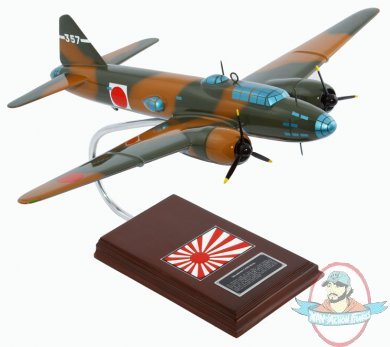
This handcrafted Mitsubishi G4M3 1/48 scale model is painstakingly built by our skilled craftsmen with a wealth of detail. The Mitsubishi G4M was the main twin-engine, land-based bomber used by the Imperial Japanese Navy Air Service in World War II. The Allies gave the G4M the reporting name Betty. The Allies usually gave Japanese fighters and floatplanes male names, while giving female names to bombers and reconnaissance aircraft. The G4M was designed for a long range and high speed at the time of its introduction. Several weight-saving measures were incorporated into the design, such as dispensing with self-sealing fuel tanks, which started nicknames such as "the one-shot lighter", "the flying Zippo" and "the flying cigar" because of their tendency to explode or catch on fire from any slight damage to the fuel tank wings after being hit by aerial machine gun fire or ground antiaircraft fire. The G4M was used for low-altitude torpedo attacks on shipping in which their performance advantages were negated, and the G4M was frequently shot down by antiaircraft artillery fire, and even by small arms. The G4M's relatively large size made it an easy gunnery target, and the predictable approach path required for a torpedo run made for a generally easy interception by Allied fighter aircraft. Towards the end of World War II, the "Betty" bomber was commonly used for carrying and launching kamikaze aircraft, and was the usual aircraft for carrying the Ohka kamikaze manned rocket-powered bombs.
This specific G4M is a G4M3, which is a redesigned G4M2 with added self-sealing fuel tanks, improved armor protection, redesigned wings and an entirely new tail gunner's compartment. The G4M3 entered production in October 1944.
This handcrafted model is painstakingly built from Philippine mahogany by our skilled craftsmen with a wealth of detail and makes a great gift for any veteran, aviation enthusiast or history buff.
Scale: 1/48 scale model
Wing Span: 20.5
Length: 16.5
FJBTE
|
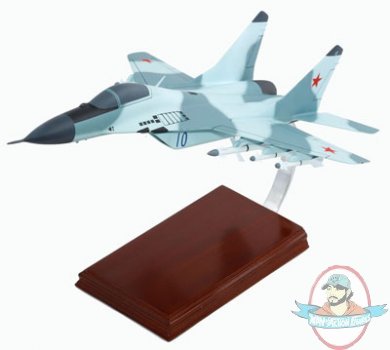
This handcrafted MiG-29 1/48 scale model is painstakingly built by our skilled craftsmen with a wealth of detail. The MiG-29, NATO name "Fulcrum", is a fourth-generation jet fighter aircraft designed in the Soviet Union for an air superiority role. It was developed at the height of the Cold War to counter new American fighters such as the McDonnell Douglas F-15 Eagle, and the General Dynamics F-16 Fighting Falcon. A Soviet response was necessary to avoid the possibility of a new American fighter gaining a serious technological advantage over existing Soviet fighters. The Soviet Union exported MiG-29s to several countries. Because 4th-generation fighter jets require the pilots to have extensive training, air-defense infrastructure, and constant maintenance and upgrades, MiG-29s have had mixed operational history with different air forces. The MiG-29 still remains in use today by the Russian Air Force and many other nations.
This handcrafted model is painstakingly built from Philippine mahogany by our skilled craftsmen with a wealth of detail and makes a great gift for any veteran, aviation enthusiast or history buff.
Scale: 1/48 scale model
Wing Span: 14.75
Length: 10.13
FRM29T
|
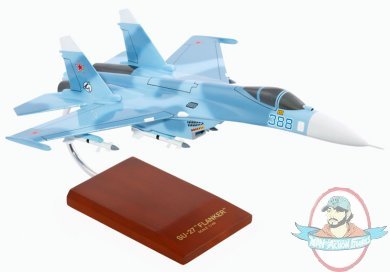
This handcrafted Su-27 "Flanker" 1/48 scale model is painstakingly built by our skilled craftsmen with a wealth of detail. The Su-27, NATO reporting name: Flanker, is a twin-engine supermanoeuverable fighter aircraft designed by Sukhoi. The Su-27 most often flies air superiority missions, but is able to perform almost all combat operations. The Su-27's basic design is aerodynamically similar to the MiG-29, but it is substantially larger. It is a very large aircraft, and to minimize its weight its structure has a high percentage of titanium (about 30%, more than any of its contemporaries). The Su-27 began to enter operational service around 1984, although manufacturing difficulties kept it from appearing in strength until 1986.
This handcrafted model is painstakingly built from Philippine mahogany by our skilled craftsmen with a wealth of detail and makes a great gift for any veteran, aviation enthusiast or history buff.
Scale: 1/48 scale model
Wing Span: 11.75
Length: 12
FRSU27T
|
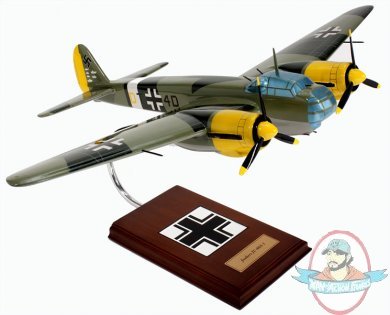
This handcrafted Junkers Ju-88 1/36 scale model is painstakingly built by our skilled craftsmen with a wealth of detail. The Junkers Ju-88 was a World War II German Luftwaffe twin-engine, multi-role aircraft. Affectionately known as "The Maid of all Work" (a feminine version of "jack of all trades"), the Ju-88 proved to be suited to almost any role. Like a number of other Luftwaffe bombers, it was used successfully as a bomber, dive bomber, night fighter, torpedo bomber, reconnaissance aircraft, heavy fighter, and even as a flying bomb during the closing stages of conflict. The assembly line ran constantly from 1936 to 1945, and more than 16,000 Ju-88s were built in dozens of variants, more than any other twin-engine German aircraft of the period. Throughout the production, the basic structure of the aircraft remained unchanged, proof of the outstanding quality of the original design.
This handcrafted model is painstakingly built from Philippine mahogany by our skilled craftsmen with a wealth of detail and makes a great gift for any veteran, aviation enthusiast or history buff.
Scale: 1/36 scale model
Wing Span: 22
Length: 16
FGJ88TE
|
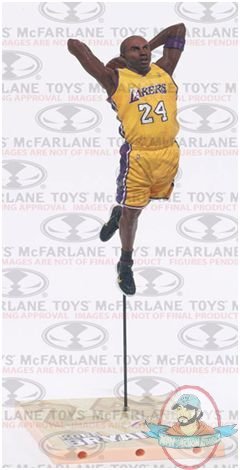
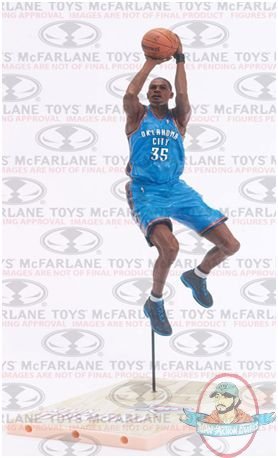
McFarlane SportsPicks is no stranger to recreating some of the NBA’s greatest players as highly detailed action figures and their 20th lineup is no exception.
WARNING: CHOKING HAZARD - Small parts & small ball. Not for children under 3 years.
|
The Saturn V was an American human-rated expendable rocket used by NASA's Apollo and Skylab programs from 1967 until 1973. NASA launched 13 Saturn Vs from the Kennedy Space Center, Florida with no loss of crew or payload. It remains the tallest, heaviest and most powerful rocket ever brought to operational status and still holds the record for the heaviest launch vehicle payload.
This handcrafted model is painstakingly built by our skilled craftsmen with a wealth of detail and makes a great gift for any space buff or history fan.
Scale: 1/200 scale model
Wing Span: 21.75
Length: 3.63
KYNS5T
|
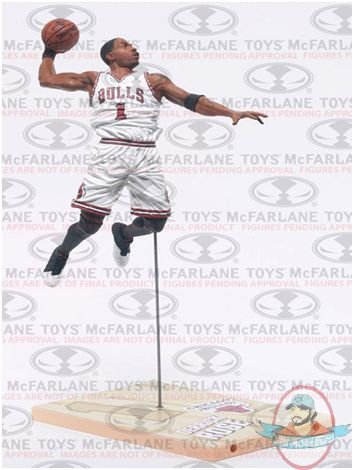
McFarlane SportsPicks is no stranger to recreating some of the NBA’s greatest players as highly detailed action figures and their 20th lineup is no exception.
WARNING: CHOKING HAZARD - Small parts & small ball. Not for children under 3 years.
|
"The Lunar Excursion Module (LEM), also known as the Apollo Lunar Module, is the portion of the Apollo spacecraft that lands on the moon and returns to lunar orbit. The 6.65 m³ module was designed to carry a crew of two. It is 6.4 m high and 4.3 m across, and rests on four legs. During the Cold War, the United States and the Soviet Union were in an astronautical engineering race. President Kennedy made space exploration and lunar landing a top national priority. The LEM came into being out of NASA's choice to reach the moon via a lunar orbit rendezvous (LOR) instead of a direct ascent or Earth orbit rendezvous (EOR). Both a direct ascent and an EOR would have required the entire Apollo spacecraft to land on the moon. Once the decision had been made to proceed using an LOR, it became necessary to produce a separate spacecraft capable of reaching the lunar surface. Out of the eleven firms invited, nine submitted proposals for the LEM. In September 1962, Grumman was awarded the contract. As the program continued, there were numerous redesigns to save weight, improve safety, and fix problems. The LEM is divided into two major parts, the Descent Module and the Ascent Module. The Descent Module contains the landing gear, landing radar antenna, descent rocket engine, and fuel to land on the moon. It also carries the water tank and the majority of the battery power and oxygen. The Ascent Module contains the crew cabin, radar and communications antennas, instrument panels, and guidance and navigation systems. The first LEM flight was on January 22, 1968 when the unmanned LM-1 was launched on a Saturn IB for testing of propulsion systems in orbit. On July 20, 1969, LM-5 Eagle, the LEM of the Apollo 11 mission, landed on the moon. "
Item Number: KYNLEMTP
Scale: 1/48 scale model
Wing Span: 5.75
Length: 5.5
Pre-Order! Available: September
Upc: KYNLEMTP
|
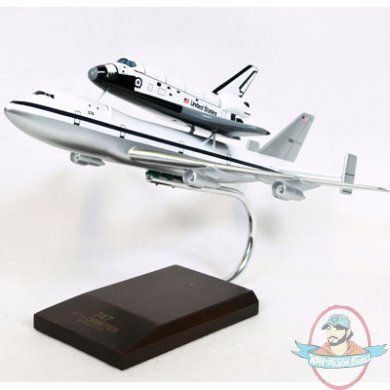
"The Boeing 747 is a long-haul, widebody commercial airliner. Sometimes called the “Jumbo Jet”, it is known for its impressive size and is one of the world's most recognizable aircraft. It has held the passenger capacity record for 37 years and was the first commercial wide-body aicraft. It uses a double decker configuration for part of its length, and the hump created by the upper deck has made the plane a highly recognizable icon of air travel. The 747 was expected to become obsolete after sales of 400 units, but it has outlived many of its critics' expectations. As of June 2007, 1,387 planes had been built, with 120 more on order. Throughout its history, the National Aeronautics and Space Administration or NASA has used several different types of aircraft on a permanent, semi-permanent, or short-term basis. The agency has three 747s: a 747-100, a 747-100SR, and a 747SP. The 747-100 and 747-100SR are currently used as Shuttle Carrier Aircraft (SCA) while the 747SP is in use as Stratospheric Observatory for Infrared Astronomy (SOFIA). The SCAs are used to ferry space shuttles from landing sites back to the launch complex at the NASA Shuttle Landing Facility at the Kennedy Space Center, and to and from other locations too distant for the orbiters to be delivered by ground transport. The 747-100 was was acquired from American Airlines in 1974 and was extensively modified in 1976. Its cabin was stripped, mounting struts were added, the fuselage was strengthened, and vertical stabilizers were added to the tail. The avionics and engines were also upgraded. In 1988, in the wake of the Challenger accident, NASA procured the 747-100SR from Japan Airlines on recommendation from the review board. It entered service with NASA in 1990 after similar modifications. It was the first used to ferry the new shuttle Endeavour in 1991. "
|
The Antonov AN-225 Mriya (Mriya meaning Dream), is a strategic airlift cargo aircraft designed by the Antonov Design Bureau in the 1980s. It was designed to airlift the Energia rocket's boosters and the Buran space shuttle for the Soviet space program. The first AN-225 was completed in 1988 and a second AN-225 has been partially completed. The completed AN-225 is in commercial operation with Antonov Airlines carrying oversized payloads. The An-225's original mission and objectives are almost identical to that of the United States' Shuttle Carrier Aircraft.
This handcrafted model is painstakingly built by our skilled craftsmen with a wealth of detail and makes a great gift for any space buff or history fan.
Scale: 1/200 scale model
Wing Span: 17.5
Length: 16.5
KYNRAN25
|
McFarlane SportsPicks is no stranger to recreating some of the NBA’s greatest players as highly detailed action figures and their 20th lineup is no exception.
WARNING: CHOKING HAZARD - Small parts & small ball. Not for children under 3 years.
|
"The T-33 Shooting Star is a jet trainer aircraft produced by Lockheed and piloted by Tony Levier. The T-33 was originally designated as the TF-80C and its maiden was on March 22, 1948. In the 1980s, the T-33 served as currency trainers, drone towing, combat and tactical simulation training, ""hack"" aircraft, electronic countermeasures and warfare training and test platforms. There was an attempt to modify and modernize the T-33 as the Boeing Skyfox, but the project was cancelled due to lack orders. The T-33A has a crew of two. It has a maximum speed of 600 mph and a range of 1,275 miles ferry. The T-33 has two 0.50 in Browning M3 machine guns with 350 rounds per gun and has up to 2,000 lb of ordnance on two underwing hardpoints. Weapons carried include bombs and rocket pods. The primary users of the T-33 are the United States Air Force, United States Navy and the Royal Thai Air Force. The T-33 saw service in over 30 nations and still operates as a trainer in smaller air forces. Other operators of the T-33 include Brazil, Turkey and Thailand, using the aircraft extensively. "
Scale: 1/48 scale model
Wing Span: 10.25
Length: 9.5
CT33AT
|
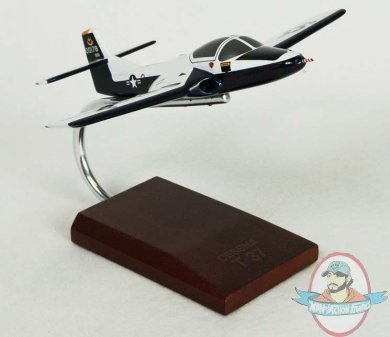
"The Cessna T-37 is a twin-engine trainer used for teaching the fundamentals of jet aircraft operation, and instrument, formation and night flying. Widely known as the Tweety Bird or Tweet, it has been a primary trainer for the United States Air Force (USAF) for decades, and serves in the air forces of several other nations as well. It is the first USAF jet designed originally as a jet trainer, rather than being modified from existing designs. The T-37's flying characteristics help students in transitioning to the faster T-38 Talon in the latter stage of flight training. Its side-by-side seating allows the instructor to observe and train the student pilot easily. In the spring of 1952, the USAF issued a request for proposals for a lightweight two-seat basic trainer for introducing Air Force cadets to jet aircraft. Cessna responded to the request with a twin-jet design that featured side-by-side seating. The USAF liked the design and awarded Cessna the contract in 1954. The XT-37 prototype first flew on October 12, 1954. The first production T-37A was delivered in 1956 and entered operational Air Force service in 1957. Instructors and students considered the T-37A an extremely pleasant aircraft to fly. It was agile, responsive and capable of all traditional aerobatic maneuvers. However, it was very noisy. The intake of air into its small turbojets emitted a high-pitched piercing shriek. The whistling sound quickly gave the T-37 the name “Tweety Bird” or “Tweet”. The USAF spent a lot of time and money sound-proofing buildings at bases where the aircraft was stationed, and ear protection was mandatory for ground crews and pilots when near it. The USAF liked the T-37A but felt that it was underpowered. In 1959, the T-37B joined the Air Force. It had more powerful engines, a redesigned instrument panel, improved avionics, more thrust and better reliability. A total of 552 newly-built T-37Bs were produced through 1973. Eventually all surviving T-37As were upgraded to T-37B standards as well. "
Scale: 1/48 scale model
Wing Span: 8.5
Length: 7.5
CT37BT
|
McFarlane SportsPicks is no stranger to recreating some of the NBA’s greatest players as highly detailed action figures and their 20th lineup is no exception.
WARNING: CHOKING HAZARD - Small parts & small ball. Not for children under 3 years.
Pre-Order, Sold Out Available: September
|